
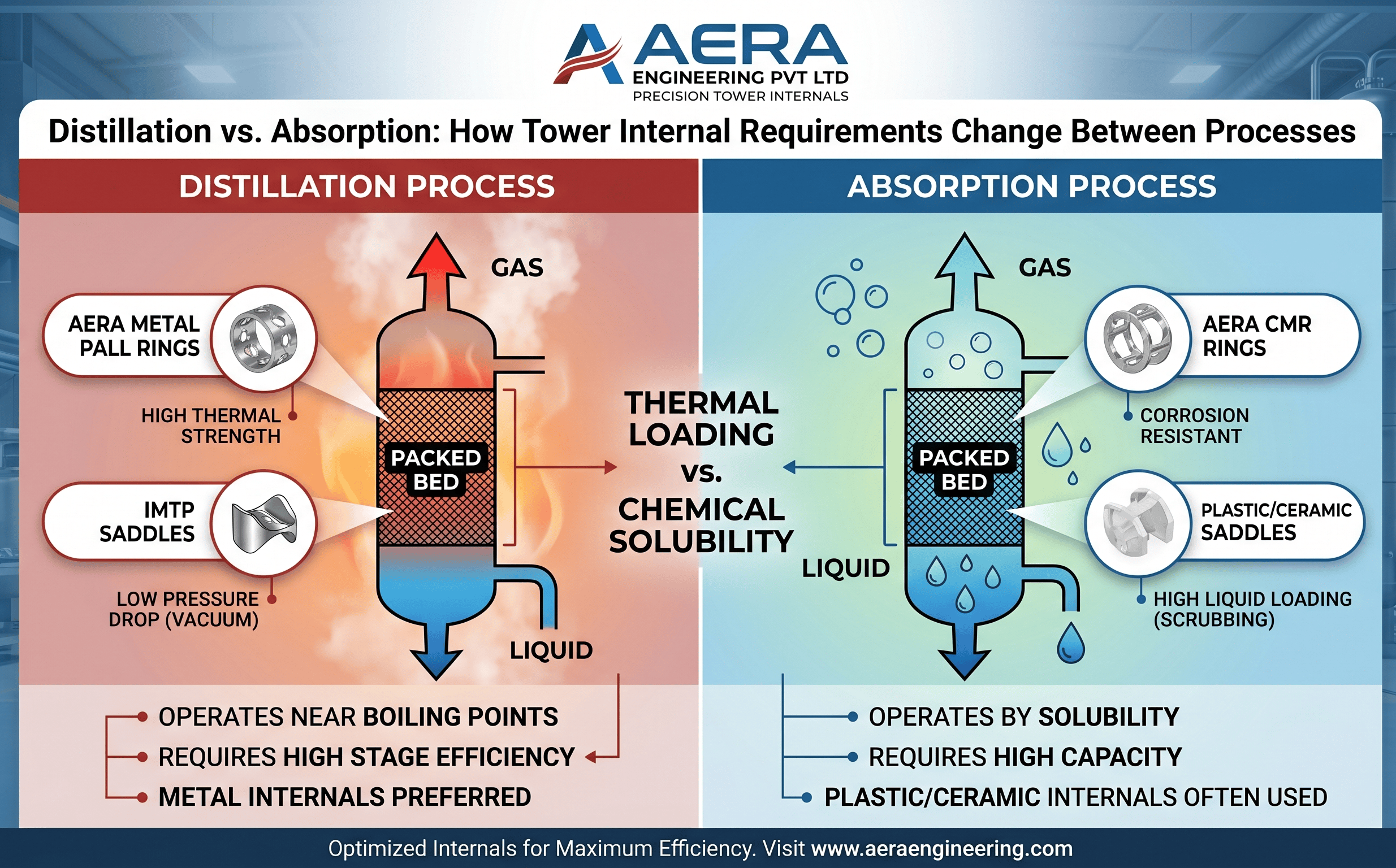
Understanding the nuance between Distillation and Absorption is critical for any process engineer. While both rely on gas-liquid contact, the mechanical demands on your tower internals—like Pall Rings, IMTP Saddles, and CMR Rings—change significantly based on the thermodynamics of the process. At Aera Engineering Pvt Ltd, we specialize in designing internals that thrive in these distinct environments. Here is how the requirements shift when moving from a distillation column to an absorption tower. 1. Thermal Loading vs. Chemical Solubility The fundamental driver of separation dictates the material and design of your packing. Distillation: This is a thermal separation. The tower operates at or near the boiling points of the components. Internals must withstand constant thermal cycling and high temperatures. Internal Requirement: High-strength Metal Pall Rings or Aera Saddles (in SS316L or Carbon Steel) are preferred to prevent deformation under heat. Absorption: This is a mass transfer based on solubility, often operating at lower temperatures but with potentially corrosive solvents (like amines or acids). Internal Requirement: Chemical resistance is king. Plastic Pall Rings or Ceramic Saddles are often utilized here to resist chemical attack while maintaining high surface area. 2. Pressure Drop and Vapor Velocity How the 'wind' blows through your tower changes the shape of the packing you need. In Distillation: Often performed under vacuum to protect heat-sensitive products. Every Pascal of pressure drop matters because it directly increases the boiling point at the bottom of the tower. The Aera Solution: IMTP (Intalox Metal Tower Packing) Saddles. Their aerodynamic shape offers a significantly lower pressure drop than traditional rings, allowing for high efficiency in vacuum distillation. In Absorption: Usually operates at atmospheric or high pressure (e.g., CO2 scrubbing). The gas volumes can be massive, requiring internals that won't 'flood' easily. The Aera Solution: CMR (Cascade Mini Rings). Their lower aspect ratio and 'flanged' edges provide superior capacity and resistance to fouling, which is common in dirty gas streams. 3. Liquid Distribution and 'Wetting' Efficiency is only as good as your liquid-to-gas contact area. Distillation: Requires High Stage Efficiency. Because the components have similar properties, you need a high 'NTSM' (Number of Theoretical Stages per Meter). Packing Choice: Small-to-medium Pall Rings are excellent here as they provide a balanced surface area and prevent liquid 'channeling.' Absorption: Requires High Liquid Loading. You are often drenching the gas with a large volume of solvent. Packing Choice: Saddles or Aera Mini Rings. These designs promote a 'random' tumble that constantly redistributes the liquid, ensuring that no gas 'escapes' without contacting the solvent. 4. Comparison Table: Internal Selection at a Glance Feature Distillation Requirements Absorption Requirements Primary Driver Relative Volatility (Heat) Solubility (Concentration) Best Packing Type Aera P-Rings or IMTP Saddles Aera CMR Rings or Saddles Material Focus Temperature & Mechanical Strength Chemical & Corrosion Resistance Critical Metric Low Pressure Drop (Vacuum) High Liquid Handling (Scrubbing) Common Materials SS304, SS316, Monel PP, PVC, PVDF, Ceramic Conclusion: Choosing for Aera-Grade Performance Selecting the right internal isn't just about picking a part number—it’s about matching the physics of your process to the geometry of the packing. Whether you are aiming for the high-purity output of a distillation column or the rigorous cleaning of an absorption scrubber, Aera Engineering Pvt Ltd provides the precision-engineered Pall Rings, Saddles, and Mini Rings to get the job done. Need a custom calculation for your tower? > We provide tailored mass transfer simulations to ensure your tower internals are optimized for your specific chemical process. Are you currently designing a new column? I can help you compare the pressure drop specs for SS316 Pall Rings versus IMTP Saddles for your specific flow rate.


This is your website preview.
Currently it only shows your basic business info. Start adding relevant business details such as description, images and products or services to gain your customers attention by using Boost 360 android app / iOS App / web portal.
Absorption: How Tower Internal Requirements Change Between Processes
2026-04-23T09:12:55
Understanding the nuance between Distillation and Absorption is critical for any process engineer. While both rely on gas-liquid contact, the mechanical demands on your tower internals—like Pall Rings, IMTP Saddles, and CMR Rings—change significantly based on the thermodynamics of the process. At Aera Engineering Pvt Ltd, we specialize in designing internals that thrive in these distinct environments. Here is how the requirements shift when moving from a distillation column to an absorption tower. 1. Thermal Loading vs. Chemical Solubility The fundamental driver of separation dictates the material and design of your packing. Distillation: This is a thermal separation. The tower operates at or near the boiling points of the components. Internals must withstand constant thermal cycling and high temperatures. Internal Requirement: High-strength Metal Pall Rings or Aera Saddles (in SS316L or Carbon Steel) are preferred to prevent deformation under heat. Absorption: This is a mass transfer based on solubility, often operating at lower temperatures but with potentially corrosive solvents (like amines or acids). Internal Requirement: Chemical resistance is king. Plastic Pall Rings or Ceramic Saddles are often utilized here to resist chemical attack while maintaining high surface area. 2. Pressure Drop and Vapor Velocity How the 'wind' blows through your tower changes the shape of the packing you need. In Distillation: Often performed under vacuum to protect heat-sensitive products. Every Pascal of pressure drop matters because it directly increases the boiling point at the bottom of the tower. The Aera Solution: IMTP (Intalox Metal Tower Packing) Saddles. Their aerodynamic shape offers a significantly lower pressure drop than traditional rings, allowing for high efficiency in vacuum distillation. In Absorption: Usually operates at atmospheric or high pressure (e.g., CO2 scrubbing). The gas volumes can be massive, requiring internals that won't 'flood' easily. The Aera Solution: CMR (Cascade Mini Rings). Their lower aspect ratio and 'flanged' edges provide superior capacity and resistance to fouling, which is common in dirty gas streams. 3. Liquid Distribution and 'Wetting' Efficiency is only as good as your liquid-to-gas contact area. Distillation: Requires High Stage Efficiency. Because the components have similar properties, you need a high 'NTSM' (Number of Theoretical Stages per Meter). Packing Choice: Small-to-medium Pall Rings are excellent here as they provide a balanced surface area and prevent liquid 'channeling.' Absorption: Requires High Liquid Loading. You are often drenching the gas with a large volume of solvent. Packing Choice: Saddles or Aera Mini Rings. These designs promote a 'random' tumble that constantly redistributes the liquid, ensuring that no gas 'escapes' without contacting the solvent. 4. Comparison Table: Internal Selection at a Glance Feature Distillation Requirements Absorption Requirements Primary Driver Relative Volatility (Heat) Solubility (Concentration) Best Packing Type Aera P-Rings or IMTP Saddles Aera CMR Rings or Saddles Material Focus Temperature & Mechanical Strength Chemical & Corrosion Resistance Critical Metric Low Pressure Drop (Vacuum) High Liquid Handling (Scrubbing) Common Materials SS304, SS316, Monel PP, PVC, PVDF, Ceramic Conclusion: Choosing for Aera-Grade Performance Selecting the right internal isn't just about picking a part number—it’s about matching the physics of your process to the geometry of the packing. Whether you are aiming for the high-purity output of a distillation column or the rigorous cleaning of an absorption scrubber, Aera Engineering Pvt Ltd provides the precision-engineered Pall Rings, Saddles, and Mini Rings to get the job done. Need a custom calculation for your tower? > We provide tailored mass transfer simulations to ensure your tower internals are optimized for your specific chemical process. Are you currently designing a new column? I can help you compare the pressure drop specs for SS316 Pall Rings versus IMTP Saddles for your specific flow rate.
2026-04-23T09:12:55


Submit Your Enquiry