
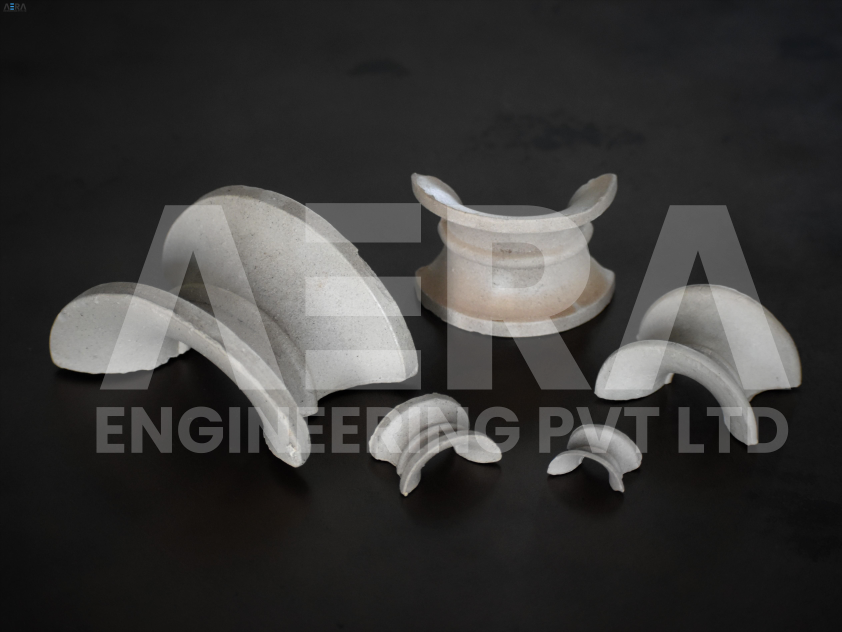
Defending High-Volatility Chemical Systems Against Extreme Exotherms: Sourcing from India’s Premier Alumina Ceramic Intalox Saddle Supplier In the high-stakes layout of global chemical manufacturing corridors, heavy oil refining fractionators, and continuous emission-control scrubbing blocks, maximum production capacity is heavily restricted by the structural, thermal, and chemical limits of random column packings. Inside vertical process columns managing highly volatile reagents at extreme temperatures—such as primary sulfuric acid absorption towers, sulfur dioxide ($SO_2$) gas scrubbers, thermal storage beds, and chlorine gas drying corridors—standard column internals quickly hit their performance thresholds. Exposing standard metallic components to severe oxidizing acids triggers localized micro-scale pitting, material thinning, and catastrophic Chloride Stress Corrosion Cracking (SCC). Conversely, using unreinforced plastic packings in systems subject to unexpected thermal runaway or steam-stripping cycles leads to early polymer softening, structural deformation, and full bed collapse. While completely substituting these materials with high-nickel superalloys manages the metallurgical threat, it introduces an unsustainable spike in upfront project expenditure ($CAPEX$). For plant operations managers, process engineers, and technical procurement directors globally, finding the ultimate balance between asset longevity, elite thermal shock resistance, and uncompromised mass transfer hydraulics requires a dual strategic pivot: shifting to an aerodynamically optimized Intalox Saddle format and specifying the extreme chemical and mechanical defense of High-Alumina Industrial Ceramic. Operating as an ISO-compliant, technically integrated Alumina Ceramic Intalox Saddle supplier in India, Aera Engineering Pvt. Ltd. provides severe-service processing plants worldwide with a verified, audit-ready supply pipeline. Based in the heavy engineering manufacturing hub of Por, Vadodara, Gujarat, we manage the entire material compound validation and automated high-temperature firing processing loops—delivering exceptionally durable, chemically immune random tower packings straight to your project site. 1. Overcoming Hydraulic Limits with Advanced Saddle Geometry The Intalox style saddle represents a significant fluid-dynamic upgrade over classic, solid-walled legacy Raschig rings. While legacy rings rely on rigid vertical walls that block rising vapors, the saddle architecture utilizes an open-arc curved design supplemented with smooth, aerodynamic edges and a highly optimized surface-to-void ratio. Classic Random Rings ───► Rigid Walls ───► High Drag & Nesting ───► Early Tower Flooding Alumina Saddles ───► Open Arcs ───► ~75%-80% Void Volume ──► Low Drag & Lower HETP This structural format entirely transforms the internal fluid mechanics of a packed column bed: • Complete Shield Against Element Nesting: Deep packed beds exert thousands of kilograms of static downward weight on the lower packing layers. In smooth-backed legacy packings, elements easily slide, interlock, or stack inside one another over time under this weight—a phenomenon known as element nesting. Nesting compresses the internal bed, chokes vapor pathways, and forces descending fluids exclusively down the column shell (liquid channeling). This starves the core of your bed, triggers premature column flooding, and ruins component separation purity. The interlocking curvature and profiles of our saddles provide extreme structural rigidity, preventing interlocking and preserving an optimized, completely randomized void matrix ($75%$ to $82%$ free volume). • Significant Reduction in Operating Pressure Drop ($dP$): Vapors pass through smooth, uniform aerodynamic pathways rather than encountering a rigid physical barrier. Cutting column backpressure allows facilities to run downsized utility blowers and vacuum compressors, translating into immediate utility energy savings ($OPEX$). • Continuous Phase Boundary Renewal: As descending liquid solvents trickle down through the bed, the smooth, open-arc profile of the saddle acts as a continuous fluid disruptors. It constantly slices, shears, and redistributes the liquid film into ultra-thin, highly turbulent sheets. This continuous phase boundary renewal maximizes gas-liquid contact kinetics, resulting in an exceptionally low HETP (Height Equivalent to a Theoretical Plate). 2. Advanced Material Science: Why Specify High-Alumina Ceramic? While geometry governs column hydraulics, your material of construction (MOC) dictates long-term hardware survival and plant validation audits. For severe process environments where standard stainless steels face rapid corrosive failure and polymers melt, High-Alumina Industrial Ceramic stands as the ultimate defense shield. Formulated from high-purity, fully vitrified aluminosilicate clay matrices enriched with tightly managed alumina ($text{Al}_2text{O}_3$) fractions, our industrial ceramic saddles supply crucial operational benefits: Complete Acid Corrosion Immunity Our high-alumina ceramic saddles exhibit near-absolute chemical inertness across the entire pH spectrum. They provide uncompromising resistance to all inorganic acids, organic acids, and halogenated gasses at high concentrations—including concentrated Sulfuric Acid ($text{H}_2text{SO}_4$) up to 98%, hot Hydrochloric Acid ($text{HCl}$), fuming Nitric Acid ($text{HNO}_3$), and wet bromine streams—with the single exception of hydrofluoric acid. Outstanding Thermal Shock Resistance and High Thermal Limits Chemical production columns frequently manage intense exothermic reactions and rapid temperature cycling that would crack conventional materials. Our high-alumina ceramic saddles are fired in high-temperature automated kilns, enabling them to comfortably withstand continuous operating thermal boundaries up to 1000°C while preserving absolute resistance to sudden thermal shock. Zero Micro-Porosity and High Compressive Strength Due to complete vitrification control, our ceramic saddles achieve a near-zero water absorption profile ($le0.5%$). This prevents internal acid absorption, stopping localized sub-surface cracking. Furthermore, their high mechanical hardness and compressive strength guarantee that the elements carry massive vertical static bed loads without crushing or generating structural dust that clogs downstream column internals. Sourcing Range & Technical Parameters We supply high-purity Alumina Ceramic Intalox Saddles (Aera Saddles) across multiple standard industrial dimensions to fit your column's specific vapor-liquid ratios and volumetric velocity designs: Primary Applications Across Core Sourcing Segments Our premium Alumina Ceramic Intalox Saddles are systematically integrated into high-load unit operations worldwide: • Sulfuric Acid Manufacturing Plants: Serving inside primary drying towers, inter-pass absorption columns, and final absorption blocks handling hot, concentrated acid loops. • Regenerative Thermal Oxidizers (RTO): Operating reliably as heat-sink mass transfer beds to destroy volatile organic compounds ($text{VOCs}$) at extreme thermal boundaries. • Chlor-Alkali Drying Towers: Managing the multi-stage dehydration of wet chlorine gas streams using dense sulfuric acid washes. • Spent Acid Regeneration Blocks: Enduring severe thermal decomposition and high-temperature chemical recovery loops with zero material degradation. 3. Rigorous Quality Validation and Sourcing Integrity Serving critical global chemical processing pathways requires strict adherence to international quality management frameworks. Sourcing through unvetted channels often leads to components with internal air pockets, poor vitrification, or uneven wall thicknesses. Under the massive static weight of a deep column bed, these structural defects trigger sudden element crushing, bed compaction, and catastrophic liquid channeling. To eliminate this operational risk, Aera Engineering Pvt. Ltd. enforces uncompromised quality validation logs across our complete supply inventory. Every batch passes through thorough internal quality gates to ensure: 1. Chemical Composition Validation: Utilizing advanced analytical testing to verify high alumina ($ge23%$ to $30%+$ optimized grades) and low iron ($le1%$) fraction targets, ensuring complete chemical defense. 2. Acid Resistance Auditing: Testing batch samples in compliance with strict international benchmarks (such as ASTM C515 or equivalent standards) to verify weight-loss indices stay below required limits upon acid exposure. 3. Pristine Dimensional Consistency: Verifying that the aerodynamic profiles match precise industrial tolerances, preserving an optimized, completely randomized free volume matrix to maximize your hydraulic throughput ceiling. 4. Audit-Ready Documentation Pack: Every shipment is paired with a comprehensive validation data pack, including traceable Certificates of Analysis (COA), raw material batch test logs, and standard Certificates of Origin (COO) for seamless global customs clearance. Secure Logistics and Transit Protection Ceramic tower packing elements feature high bulk density and delicate geometric profiles that are highly sensitive to sudden impact or physical shock during transit. Loose container dumping or basic bagging will lead to chipped edges, cracked profiles, or structural dust generation, ruining the bed's void fraction post-installation. To eliminate transit failure points across our global supply chains, Aera Engineering applies a rigorous packaging protocol. All bulk random packing batches are securely packed inside internal multi-wall woven bags to eliminate inner micro-friction, safely loaded into reinforced, fumigated wooden crate boxes, and secured tightly with heavy-duty steel strapping and palletization to guarantee zero cargo shifting during ocean or land transit. Whether supplying regional chemical hubs in Dahej, Por GIDC, Ankleshwar, and Hazira, or executing international shipments from high-capacity Indian maritime export hubs—such as Mundra Port or Nhava Sheva (JNPT)—we guarantee that your high-value mechanical investment arrives at your facility in pristine geometric condition, fully cleared and ready for immediate deployment. Partner with Aera Engineering Pvt. Ltd. Achieving razor-thin process tolerances, expanding volumetric throughput, and lowering capital layouts ($CAPEX$) demands a column internals partner fully committed to absolute material verification, precision tracking, and dependable fulfillment. By working directly with a trusted Indian technical supplier rather than a multi-tier trading broker, your procurement team completely eliminates middle-tier agent markups, optimizing your overall project balance. Partner with Aera Engineering Pvt. Ltd., based in the heavy engineering capital of Vadodara, Gujarat, India, to optimize your next plant turnaround, debottleneck an underperforming mass transfer column, or design a severe-service separation tower from the ground up. Optimize Your Column Capacity Today Let our engineering specialists assist you in minimizing column pressure drops and boosting processing capacity. Contact our technical sales division today for detailed sizing logs, engineering data charts, or a direct commercial proposal tailored to your specific project parameters. • Corporate Website: www.aeraepl.com / www.randomtowerpacking.com • Official Inquiries: tanish@aeraepl.com / info@randomtowerpacking.com • Direct Hotline: +91 97377 73751 • Manufacturing Hub: Shed No - 75, Aatmiya Brookfieldz Industrial Park, Por, Vadodara, Gujarat, India - 391243


This is your website preview.
Currently it only shows your basic business info. Start adding relevant business details such as description, images and products or services to gain your customers attention by using Boost 360 android app / iOS App / web portal.
Alumina Ceramic Intalox Saddle Supplier India
2026-06-22T06:10:36
Defending High-Volatility Chemical Systems Against Extreme Exotherms: Sourcing from India’s Premier Alumina Ceramic Intalox Saddle Supplier In the high-stakes layout of global chemical manufacturing corridors, heavy oil refining fractionators, and continuous emission-control scrubbing blocks, maximum production capacity is heavily restricted by the structural, thermal, and chemical limits of random column packings. Inside vertical process columns managing highly volatile reagents at extreme temperatures—such as primary sulfuric acid absorption towers, sulfur dioxide ($SO_2$) gas scrubbers, thermal storage beds, and chlorine gas drying corridors—standard column internals quickly hit their performance thresholds. Exposing standard metallic components to severe oxidizing acids triggers localized micro-scale pitting, material thinning, and catastrophic Chloride Stress Corrosion Cracking (SCC). Conversely, using unreinforced plastic packings in systems subject to unexpected thermal runaway or steam-stripping cycles leads to early polymer softening, structural deformation, and full bed collapse. While completely substituting these materials with high-nickel superalloys manages the metallurgical threat, it introduces an unsustainable spike in upfront project expenditure ($CAPEX$). For plant operations managers, process engineers, and technical procurement directors globally, finding the ultimate balance between asset longevity, elite thermal shock resistance, and uncompromised mass transfer hydraulics requires a dual strategic pivot: shifting to an aerodynamically optimized Intalox Saddle format and specifying the extreme chemical and mechanical defense of High-Alumina Industrial Ceramic. Operating as an ISO-compliant, technically integrated Alumina Ceramic Intalox Saddle supplier in India, Aera Engineering Pvt. Ltd. provides severe-service processing plants worldwide with a verified, audit-ready supply pipeline. Based in the heavy engineering manufacturing hub of Por, Vadodara, Gujarat, we manage the entire material compound validation and automated high-temperature firing processing loops—delivering exceptionally durable, chemically immune random tower packings straight to your project site. 1. Overcoming Hydraulic Limits with Advanced Saddle Geometry The Intalox style saddle represents a significant fluid-dynamic upgrade over classic, solid-walled legacy Raschig rings. While legacy rings rely on rigid vertical walls that block rising vapors, the saddle architecture utilizes an open-arc curved design supplemented with smooth, aerodynamic edges and a highly optimized surface-to-void ratio. Classic Random Rings ───► Rigid Walls ───► High Drag & Nesting ───► Early Tower Flooding Alumina Saddles ───► Open Arcs ───► ~75%-80% Void Volume ──► Low Drag & Lower HETP This structural format entirely transforms the internal fluid mechanics of a packed column bed: • Complete Shield Against Element Nesting: Deep packed beds exert thousands of kilograms of static downward weight on the lower packing layers. In smooth-backed legacy packings, elements easily slide, interlock, or stack inside one another over time under this weight—a phenomenon known as element nesting. Nesting compresses the internal bed, chokes vapor pathways, and forces descending fluids exclusively down the column shell (liquid channeling). This starves the core of your bed, triggers premature column flooding, and ruins component separation purity. The interlocking curvature and profiles of our saddles provide extreme structural rigidity, preventing interlocking and preserving an optimized, completely randomized void matrix ($75%$ to $82%$ free volume). • Significant Reduction in Operating Pressure Drop ($dP$): Vapors pass through smooth, uniform aerodynamic pathways rather than encountering a rigid physical barrier. Cutting column backpressure allows facilities to run downsized utility blowers and vacuum compressors, translating into immediate utility energy savings ($OPEX$). • Continuous Phase Boundary Renewal: As descending liquid solvents trickle down through the bed, the smooth, open-arc profile of the saddle acts as a continuous fluid disruptors. It constantly slices, shears, and redistributes the liquid film into ultra-thin, highly turbulent sheets. This continuous phase boundary renewal maximizes gas-liquid contact kinetics, resulting in an exceptionally low HETP (Height Equivalent to a Theoretical Plate). 2. Advanced Material Science: Why Specify High-Alumina Ceramic? While geometry governs column hydraulics, your material of construction (MOC) dictates long-term hardware survival and plant validation audits. For severe process environments where standard stainless steels face rapid corrosive failure and polymers melt, High-Alumina Industrial Ceramic stands as the ultimate defense shield. Formulated from high-purity, fully vitrified aluminosilicate clay matrices enriched with tightly managed alumina ($text{Al}_2text{O}_3$) fractions, our industrial ceramic saddles supply crucial operational benefits: Complete Acid Corrosion Immunity Our high-alumina ceramic saddles exhibit near-absolute chemical inertness across the entire pH spectrum. They provide uncompromising resistance to all inorganic acids, organic acids, and halogenated gasses at high concentrations—including concentrated Sulfuric Acid ($text{H}_2text{SO}_4$) up to 98%, hot Hydrochloric Acid ($text{HCl}$), fuming Nitric Acid ($text{HNO}_3$), and wet bromine streams—with the single exception of hydrofluoric acid. Outstanding Thermal Shock Resistance and High Thermal Limits Chemical production columns frequently manage intense exothermic reactions and rapid temperature cycling that would crack conventional materials. Our high-alumina ceramic saddles are fired in high-temperature automated kilns, enabling them to comfortably withstand continuous operating thermal boundaries up to 1000°C while preserving absolute resistance to sudden thermal shock. Zero Micro-Porosity and High Compressive Strength Due to complete vitrification control, our ceramic saddles achieve a near-zero water absorption profile ($le0.5%$). This prevents internal acid absorption, stopping localized sub-surface cracking. Furthermore, their high mechanical hardness and compressive strength guarantee that the elements carry massive vertical static bed loads without crushing or generating structural dust that clogs downstream column internals. Sourcing Range & Technical Parameters We supply high-purity Alumina Ceramic Intalox Saddles (Aera Saddles) across multiple standard industrial dimensions to fit your column's specific vapor-liquid ratios and volumetric velocity designs: Primary Applications Across Core Sourcing Segments Our premium Alumina Ceramic Intalox Saddles are systematically integrated into high-load unit operations worldwide: • Sulfuric Acid Manufacturing Plants: Serving inside primary drying towers, inter-pass absorption columns, and final absorption blocks handling hot, concentrated acid loops. • Regenerative Thermal Oxidizers (RTO): Operating reliably as heat-sink mass transfer beds to destroy volatile organic compounds ($text{VOCs}$) at extreme thermal boundaries. • Chlor-Alkali Drying Towers: Managing the multi-stage dehydration of wet chlorine gas streams using dense sulfuric acid washes. • Spent Acid Regeneration Blocks: Enduring severe thermal decomposition and high-temperature chemical recovery loops with zero material degradation. 3. Rigorous Quality Validation and Sourcing Integrity Serving critical global chemical processing pathways requires strict adherence to international quality management frameworks. Sourcing through unvetted channels often leads to components with internal air pockets, poor vitrification, or uneven wall thicknesses. Under the massive static weight of a deep column bed, these structural defects trigger sudden element crushing, bed compaction, and catastrophic liquid channeling. To eliminate this operational risk, Aera Engineering Pvt. Ltd. enforces uncompromised quality validation logs across our complete supply inventory. Every batch passes through thorough internal quality gates to ensure: 1. Chemical Composition Validation: Utilizing advanced analytical testing to verify high alumina ($ge23%$ to $30%+$ optimized grades) and low iron ($le1%$) fraction targets, ensuring complete chemical defense. 2. Acid Resistance Auditing: Testing batch samples in compliance with strict international benchmarks (such as ASTM C515 or equivalent standards) to verify weight-loss indices stay below required limits upon acid exposure. 3. Pristine Dimensional Consistency: Verifying that the aerodynamic profiles match precise industrial tolerances, preserving an optimized, completely randomized free volume matrix to maximize your hydraulic throughput ceiling. 4. Audit-Ready Documentation Pack: Every shipment is paired with a comprehensive validation data pack, including traceable Certificates of Analysis (COA), raw material batch test logs, and standard Certificates of Origin (COO) for seamless global customs clearance. Secure Logistics and Transit Protection Ceramic tower packing elements feature high bulk density and delicate geometric profiles that are highly sensitive to sudden impact or physical shock during transit. Loose container dumping or basic bagging will lead to chipped edges, cracked profiles, or structural dust generation, ruining the bed's void fraction post-installation. To eliminate transit failure points across our global supply chains, Aera Engineering applies a rigorous packaging protocol. All bulk random packing batches are securely packed inside internal multi-wall woven bags to eliminate inner micro-friction, safely loaded into reinforced, fumigated wooden crate boxes, and secured tightly with heavy-duty steel strapping and palletization to guarantee zero cargo shifting during ocean or land transit. Whether supplying regional chemical hubs in Dahej, Por GIDC, Ankleshwar, and Hazira, or executing international shipments from high-capacity Indian maritime export hubs—such as Mundra Port or Nhava Sheva (JNPT)—we guarantee that your high-value mechanical investment arrives at your facility in pristine geometric condition, fully cleared and ready for immediate deployment. Partner with Aera Engineering Pvt. Ltd. Achieving razor-thin process tolerances, expanding volumetric throughput, and lowering capital layouts ($CAPEX$) demands a column internals partner fully committed to absolute material verification, precision tracking, and dependable fulfillment. By working directly with a trusted Indian technical supplier rather than a multi-tier trading broker, your procurement team completely eliminates middle-tier agent markups, optimizing your overall project balance. Partner with Aera Engineering Pvt. Ltd., based in the heavy engineering capital of Vadodara, Gujarat, India, to optimize your next plant turnaround, debottleneck an underperforming mass transfer column, or design a severe-service separation tower from the ground up. Optimize Your Column Capacity Today Let our engineering specialists assist you in minimizing column pressure drops and boosting processing capacity. Contact our technical sales division today for detailed sizing logs, engineering data charts, or a direct commercial proposal tailored to your specific project parameters. • Corporate Website: www.aeraepl.com / www.randomtowerpacking.com • Official Inquiries: tanish@aeraepl.com / info@randomtowerpacking.com • Direct Hotline: +91 97377 73751 • Manufacturing Hub: Shed No - 75, Aatmiya Brookfieldz Industrial Park, Por, Vadodara, Gujarat, India - 391243
2026-06-22T06:10:36


Submit Your Enquiry