
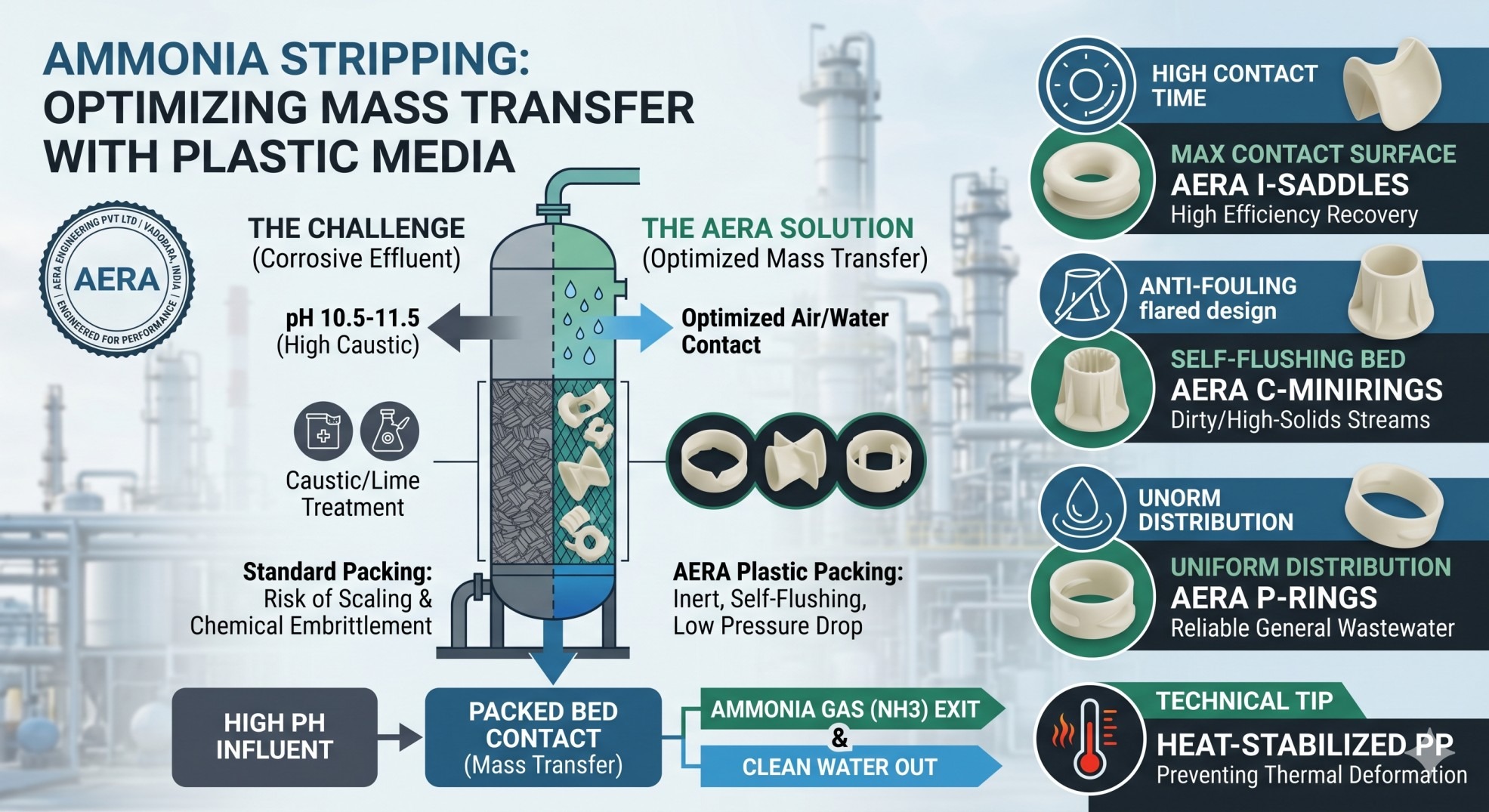
This blog is designed to showcase Aera Engineering Pvt Ltd as a technical specialist in the fertilizer and chemical processing sectors, where ammonia removal is a critical operational and environmental requirement. In the fertilizer, pharmaceutical, and municipal wastewater sectors, managing dissolved ammonia ($NH_3$) is a constant challenge. Whether the goal is resource recovery or meeting stringent environmental discharge limits, Ammonia Stripping remains the most effective large-scale solution. At Aera Engineering Pvt Ltd, we’ve seen that the difference between an efficient stripping tower and a 'bottlenecked' one often comes down to the choice of random packing. Here is how you can optimize your ammonia stripping process using high-performance plastic media. The Science of Ammonia Stripping Ammonia stripping is a mass transfer process where dissolved ammonia is transferred from a liquid phase (wastewater) to a gas phase (air). This is achieved by raising the pH of the water (to convert ammonium ions into free ammonia gas) and providing a massive surface area for contact. To optimize this transfer, the packing inside the tower must satisfy three critical engineering requirements: Uniform Liquid Distribution: Preventing 'dry zones' where no stripping occurs. High Turbulence: Breaking the liquid boundary layer to release the dissolved gas. Low Pressure Drop: Ammonia stripping requires high air-to-water ratios; excessive resistance to air flow leads to massive energy costs. Why Plastic is the Industry Standard for NH_3 Removal While ammonia itself isn't highly corrosive to all metals, the pre-treatment process is. Ammonia stripping typically requires a pH of 10.5 to 11.5, often achieved by adding lime or caustic soda. Chemical Resilience: Standard metals can struggle with high-pH scaling and caustic embrittlement. Polypropylene (PP) and PVC, however, are completely inert in high-pH environments. Scale Management: Lime-treated water is prone to calcium carbonate scaling. Plastic surfaces are 'low-energy' surfaces, meaning scale finds it harder to adhere to plastic than to ceramic or metal. Cost-Efficiency: Given the large volumes of air required for NH_3 removal, the lightweight and high-void-fraction nature of plastic packing keeps both CAPEX and OPEX significantly lower. Choosing the Right Aera Engineering Media 1. For High-Efficiency Recovery: Aera I-Saddles If your goal is to recover ammonia for reuse, you need maximum contact time. The 'open torus' shape of the Aera I-Saddle ensures that 100% of the surface area is utilized. Its aerodynamic profile allows for the high air velocities needed to 'push' the ammonia out of the liquid phase. 2. For Dirty/High-Solids Streams: Aera C-MiniRings If you are stripping ammonia from 'dirty' industrial effluent or lime-softened water, fouling is your biggest enemy. The flared-edge design of the Aera Cascade Mini Ring prevents the packing from nesting and creates a 'self-flushing' bed that resists solid buildup. 3. For General Wastewater: Aera P-Rings (Pall Rings) The Aera Pall Ring remains the reliable workhorse for municipal $NH_3$ stripping. Its internal tabs act as drip points, constantly redistributing the liquid and ensuring that every drop of water is exposed to the stripping air. Operational Tip: Temperature Matters Ammonia stripping efficiency is highly temperature-dependent. Higher temperatures increase the volatility of ammonia. If your stripping process operates near the upper limits of wastewater temperature, Aera Engineering recommends using Heat-Stabilized Polypropylene to prevent packing deformation over time. Partner with Vadodara’s Engineering Leaders At Aera Engineering Pvt Ltd, we don't just supply random packing; we provide the mathematical foundations for your tower's success. From our manufacturing hub in Vadodara, we export precision-molded media that helps plants worldwide meet their environmental targets efficiently. Maximize your NH_3 removal today. Contact our technical desk for packing factor data and material compatibility charts tailored to your specific ammonia stripping requirements. [Consult our Mass Transfer Team] | Aera Engineering Pvt Ltd | Vadodara, India


This is your website preview.
Currently it only shows your basic business info. Start adding relevant business details such as description, images and products or services to gain your customers attention by using Boost 360 android app / iOS App / web portal.
Ammonia Stripping: Optimizing Mass Transfer with Plastic Media
2026-04-25T04:31:38
This blog is designed to showcase Aera Engineering Pvt Ltd as a technical specialist in the fertilizer and chemical processing sectors, where ammonia removal is a critical operational and environmental requirement. In the fertilizer, pharmaceutical, and municipal wastewater sectors, managing dissolved ammonia ($NH_3$) is a constant challenge. Whether the goal is resource recovery or meeting stringent environmental discharge limits, Ammonia Stripping remains the most effective large-scale solution. At Aera Engineering Pvt Ltd, we’ve seen that the difference between an efficient stripping tower and a 'bottlenecked' one often comes down to the choice of random packing. Here is how you can optimize your ammonia stripping process using high-performance plastic media. The Science of Ammonia Stripping Ammonia stripping is a mass transfer process where dissolved ammonia is transferred from a liquid phase (wastewater) to a gas phase (air). This is achieved by raising the pH of the water (to convert ammonium ions into free ammonia gas) and providing a massive surface area for contact. To optimize this transfer, the packing inside the tower must satisfy three critical engineering requirements: Uniform Liquid Distribution: Preventing 'dry zones' where no stripping occurs. High Turbulence: Breaking the liquid boundary layer to release the dissolved gas. Low Pressure Drop: Ammonia stripping requires high air-to-water ratios; excessive resistance to air flow leads to massive energy costs. Why Plastic is the Industry Standard for NH_3 Removal While ammonia itself isn't highly corrosive to all metals, the pre-treatment process is. Ammonia stripping typically requires a pH of 10.5 to 11.5, often achieved by adding lime or caustic soda. Chemical Resilience: Standard metals can struggle with high-pH scaling and caustic embrittlement. Polypropylene (PP) and PVC, however, are completely inert in high-pH environments. Scale Management: Lime-treated water is prone to calcium carbonate scaling. Plastic surfaces are 'low-energy' surfaces, meaning scale finds it harder to adhere to plastic than to ceramic or metal. Cost-Efficiency: Given the large volumes of air required for NH_3 removal, the lightweight and high-void-fraction nature of plastic packing keeps both CAPEX and OPEX significantly lower. Choosing the Right Aera Engineering Media 1. For High-Efficiency Recovery: Aera I-Saddles If your goal is to recover ammonia for reuse, you need maximum contact time. The 'open torus' shape of the Aera I-Saddle ensures that 100% of the surface area is utilized. Its aerodynamic profile allows for the high air velocities needed to 'push' the ammonia out of the liquid phase. 2. For Dirty/High-Solids Streams: Aera C-MiniRings If you are stripping ammonia from 'dirty' industrial effluent or lime-softened water, fouling is your biggest enemy. The flared-edge design of the Aera Cascade Mini Ring prevents the packing from nesting and creates a 'self-flushing' bed that resists solid buildup. 3. For General Wastewater: Aera P-Rings (Pall Rings) The Aera Pall Ring remains the reliable workhorse for municipal $NH_3$ stripping. Its internal tabs act as drip points, constantly redistributing the liquid and ensuring that every drop of water is exposed to the stripping air. Operational Tip: Temperature Matters Ammonia stripping efficiency is highly temperature-dependent. Higher temperatures increase the volatility of ammonia. If your stripping process operates near the upper limits of wastewater temperature, Aera Engineering recommends using Heat-Stabilized Polypropylene to prevent packing deformation over time. Partner with Vadodara’s Engineering Leaders At Aera Engineering Pvt Ltd, we don't just supply random packing; we provide the mathematical foundations for your tower's success. From our manufacturing hub in Vadodara, we export precision-molded media that helps plants worldwide meet their environmental targets efficiently. Maximize your NH_3 removal today. Contact our technical desk for packing factor data and material compatibility charts tailored to your specific ammonia stripping requirements. [Consult our Mass Transfer Team] | Aera Engineering Pvt Ltd | Vadodara, India
2026-04-25T04:31:38


Submit Your Enquiry