
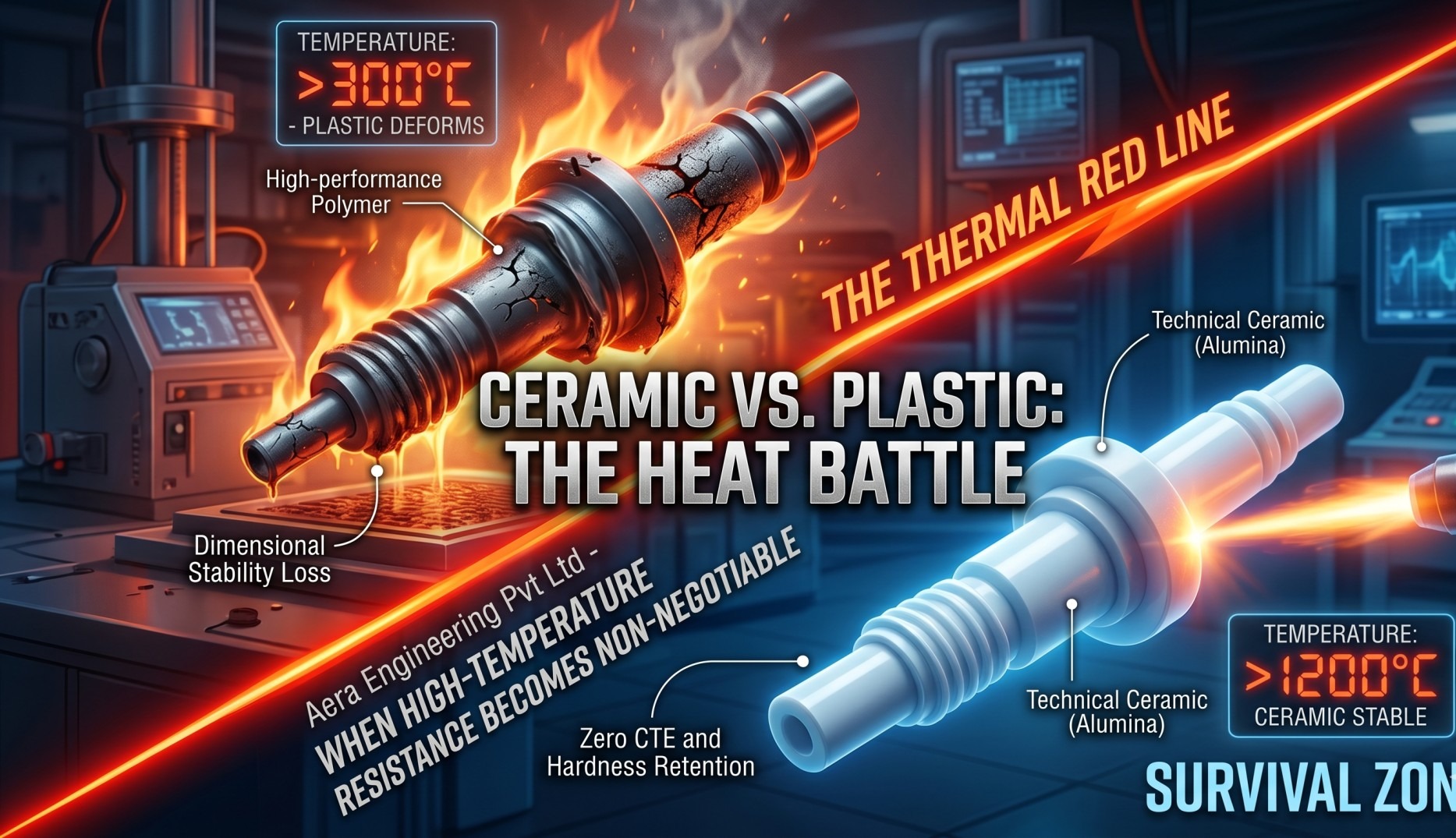
In the world of precision engineering, the 'material of choice' is often a battle between versatility and survivability. For a manufacturing powerhouse like Aera Engineering Pvt Ltd , selecting the right component material isn't just about cost—it’s about preventing catastrophic system failure. As we push the boundaries of industrial automation and sheet metal pressed components, we often encounter a critical crossroads: Ceramic or Plastic? While advanced polymers have made leaps in durability, there is a thermal 'red line' where plastic fails and ceramic thrives. The Thermal Threshold: Why 'Heat-Resistant' Plastic Isn't Enough Modern high-performance plastics, such as PEEK or PTFE, are engineering marvels. They are lightweight, chemical-resistant, and relatively easy to mold. However, every polymer has a glass transition temperature and a melting point . The Plastic Limit: Even high-tier engineering plastics generally begin to lose structural integrity, soften, or outgas once they surpass 250°C to 300°C . In high-speed pressing operations or heat-treatment environments, these temperatures are reached in seconds. The Ceramic Advantage: Technical ceramics like Alumina (Al_2O_3) or Zirconia (ZrO_2) are forged in fire. They maintain their shape, hardness, and electrical insulation properties at temperatures exceeding 1000°C to 1600°C. When Ceramic Becomes Non-Negotiable at Aera Engineering At Aera Engineering , our focus on high-quality pressed components means our tooling and insulation must withstand extreme stress. Here are the three scenarios where ceramic is the only viable option: 1. High-Voltage Electrical Insulation In many of our precision assemblies, components must act as electrical insulators while being subjected to friction-induced heat. The Risk: Plastic insulators can carbonize under high heat, creating a conductive path that leads to electrical shorts. The Solution: Ceramics are inherently non-conductive and thermally stable, ensuring safety in high-voltage environments where plastic would melt and fail. 2. Dimensional Stability in Precision Pressing Precision is the heartbeat of our operations in Vadodara . Metals and plastics expand at different rates when they get hot. The Risk: A plastic guide or shim might expand by several microns when a machine reaches operating temperature, throwing off the tolerances of a sheet metal part. The Solution: Ceramics have an incredibly low Coefficient of Thermal Expansion (CTE) . This means the part you measure at room temperature stays the exact same size at 500°C, ensuring 'Aera-standard' precision every time. 3. Wear Resistance in Abrasive Environments Heat isn't the only enemy; friction is its accomplice. The Risk: High temperatures soften plastics, making them highly susceptible to abrasion and 'galling' during high-speed metal forming. The Solution: Ceramic components retain their extreme hardness even when glowing red. This makes them ideal for nozzles, guides, and pins that face constant mechanical wear. For Aera Engineering Pvt Ltd, the choice isn't about which material is 'better' in a vacuum—it’s about matching the material to the thermal reality of the application. Plastic is excellent for weight reduction and complex geometries in moderate temperatures. However, when the environment demands thermal survivability, zero expansion, and electrical integrity under fire, ceramic becomes non-negotiable. By integrating these high-performance materials into our manufacturing workflows, we ensure that every component leaving our facility in Gujarat is built to endure the most demanding industrial conditions in the world. --- Do you have a project requiring extreme heat resistance? Consult with the technical team at Aera Engineering Pvt Ltd today. We specialize in selecting and manufacturing components that don't just meet specifications—they exceed them, no matter the temperature.


This is your website preview.
Currently it only shows your basic business info. Start adding relevant business details such as description, images and products or services to gain your customers attention by using Boost 360 android app / iOS App / web portal.
Ceramic vs. Plastic: When High-Temperature Resistance Becomes Non-Negotiable
2026-04-25T09:00:09
In the world of precision engineering, the 'material of choice' is often a battle between versatility and survivability. For a manufacturing powerhouse like Aera Engineering Pvt Ltd , selecting the right component material isn't just about cost—it’s about preventing catastrophic system failure. As we push the boundaries of industrial automation and sheet metal pressed components, we often encounter a critical crossroads: Ceramic or Plastic? While advanced polymers have made leaps in durability, there is a thermal 'red line' where plastic fails and ceramic thrives. The Thermal Threshold: Why 'Heat-Resistant' Plastic Isn't Enough Modern high-performance plastics, such as PEEK or PTFE, are engineering marvels. They are lightweight, chemical-resistant, and relatively easy to mold. However, every polymer has a glass transition temperature and a melting point . The Plastic Limit: Even high-tier engineering plastics generally begin to lose structural integrity, soften, or outgas once they surpass 250°C to 300°C . In high-speed pressing operations or heat-treatment environments, these temperatures are reached in seconds. The Ceramic Advantage: Technical ceramics like Alumina (Al_2O_3) or Zirconia (ZrO_2) are forged in fire. They maintain their shape, hardness, and electrical insulation properties at temperatures exceeding 1000°C to 1600°C. When Ceramic Becomes Non-Negotiable at Aera Engineering At Aera Engineering , our focus on high-quality pressed components means our tooling and insulation must withstand extreme stress. Here are the three scenarios where ceramic is the only viable option: 1. High-Voltage Electrical Insulation In many of our precision assemblies, components must act as electrical insulators while being subjected to friction-induced heat. The Risk: Plastic insulators can carbonize under high heat, creating a conductive path that leads to electrical shorts. The Solution: Ceramics are inherently non-conductive and thermally stable, ensuring safety in high-voltage environments where plastic would melt and fail. 2. Dimensional Stability in Precision Pressing Precision is the heartbeat of our operations in Vadodara . Metals and plastics expand at different rates when they get hot. The Risk: A plastic guide or shim might expand by several microns when a machine reaches operating temperature, throwing off the tolerances of a sheet metal part. The Solution: Ceramics have an incredibly low Coefficient of Thermal Expansion (CTE) . This means the part you measure at room temperature stays the exact same size at 500°C, ensuring 'Aera-standard' precision every time. 3. Wear Resistance in Abrasive Environments Heat isn't the only enemy; friction is its accomplice. The Risk: High temperatures soften plastics, making them highly susceptible to abrasion and 'galling' during high-speed metal forming. The Solution: Ceramic components retain their extreme hardness even when glowing red. This makes them ideal for nozzles, guides, and pins that face constant mechanical wear. For Aera Engineering Pvt Ltd, the choice isn't about which material is 'better' in a vacuum—it’s about matching the material to the thermal reality of the application. Plastic is excellent for weight reduction and complex geometries in moderate temperatures. However, when the environment demands thermal survivability, zero expansion, and electrical integrity under fire, ceramic becomes non-negotiable. By integrating these high-performance materials into our manufacturing workflows, we ensure that every component leaving our facility in Gujarat is built to endure the most demanding industrial conditions in the world. --- Do you have a project requiring extreme heat resistance? Consult with the technical team at Aera Engineering Pvt Ltd today. We specialize in selecting and manufacturing components that don't just meet specifications—they exceed them, no matter the temperature.
2026-04-25T09:00:09


Submit Your Enquiry