
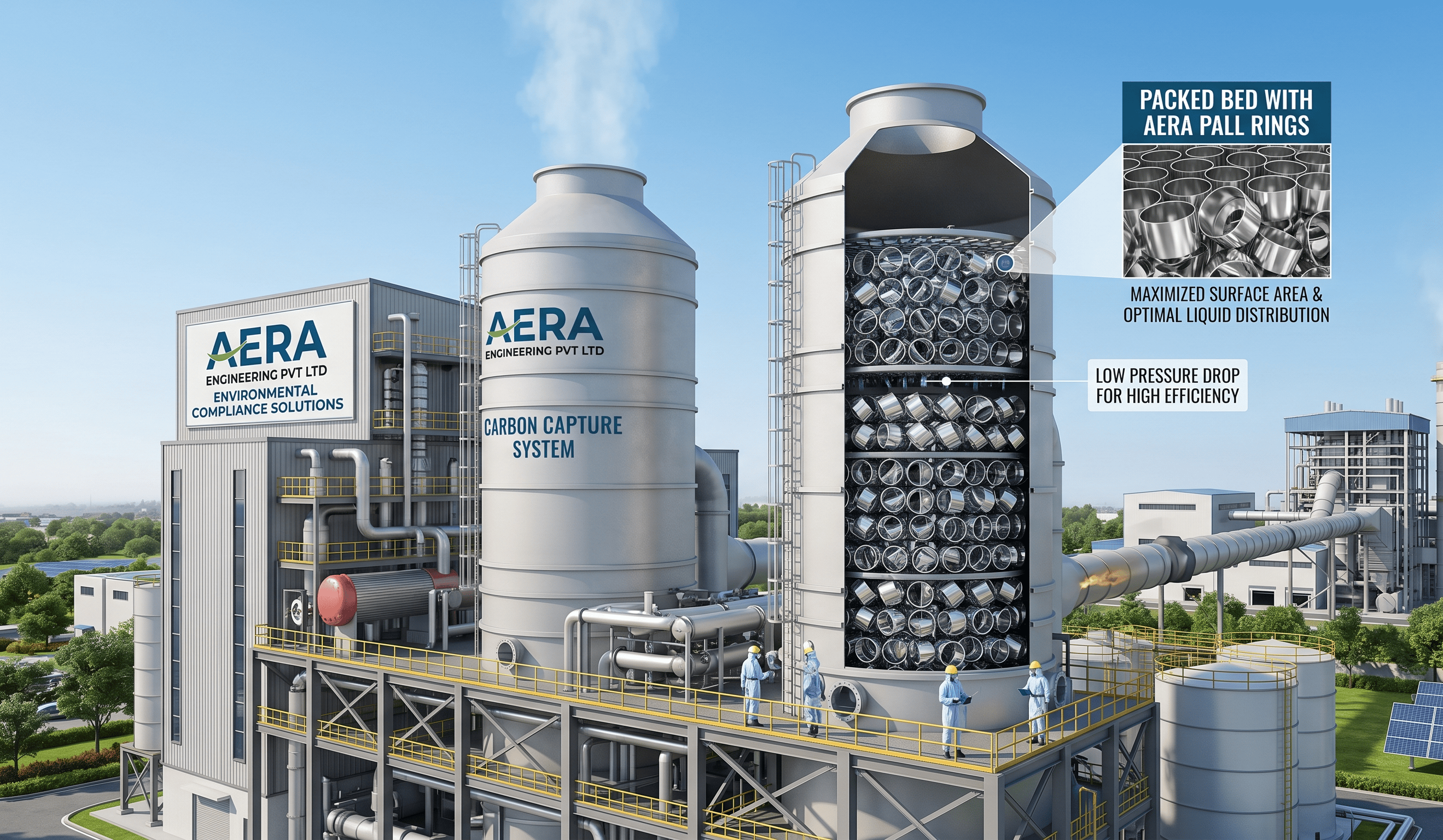
As global industries face tightening regulations on carbon emissions, the pressure to implement efficient environmental compliance strategies has never been higher. For Aera Engineering Pvt Ltd, staying ahead of these mandates means mastering the mechanical components that make carbon capture possible. One of the most critical, yet often overlooked, components in this process is the Pall Ring. These small, cylindrical structures are the unsung heroes of modern CO_2 scrubbing towers. Here is how they drive efficiency and help industries meet environmental standards. What is CO_2 Scrubbing? Before diving into the hardware, it’s essential to understand the process. CO_2 scrubbing (or carbon capture) typically involves passing flue gas through a packed bed tower. Inside, a liquid solvent (often an amine solution) absorbs the CO_2 from the gas stream. The goal is to maximize the contact between the rising gas and the falling liquid. This is where Pall Rings come into play. 1. Maximizing Surface Area for Mass Transfer The efficiency of a scrubber is defined by its Mass Transfer Rate. Pall Rings are designed with a unique 'open' structure featuring internal cross-braces and multiple openings in the cylinder wall. Increased Contact: This design ensures that the liquid solvent spreads into a thin film over a massive surface area. Enhanced Interaction: By increasing the area where gas meets liquid, Pall Rings allow for more CO_2 molecules to be absorbed in a shorter amount of time. 2. Minimizing Pressure Drop In mass production and large-scale power plants, pushing gas through a scrubbing tower requires energy. If the packing material is too dense, it creates a high 'pressure drop, ' forcing fans and pumps to work harder and increasing operational costs. Because Pall Rings have an extremely high void fraction (the amount of open space within the ring), they allow gas and liquid to flow freely with minimal resistance. This makes the scrubbing process not only effective but also energy-efficient. 3. Durability in Harsh Chemical Environments Environmental compliance isn't a one-time event; it’s a long-term commitment. Scrubbing towers often operate in highly corrosive environments due to the presence of moisture, heat, and chemical solvents. At Aera Engineering, we manufacture Pall Rings in a variety of high-performance materials: Stainless Steel (304/316L): For high-temperature and high-strength applications. Polypropylene/PPH: For superior chemical resistance in lower-temperature scrubbers. Specialty Alloys: For extreme industrial conditions. 4. Achieving Environmental Compliance Regulatory bodies (like the CPCB or EPA) set strict limits on the parts-per-million (PPM) of carbon and pollutants that can be released into the atmosphere. Using high-quality Pall Rings ensures that the scrubbing tower operates at its design capacity. Without precise, well-manufactured packing: CO_2 'slips' through the tower without being absorbed. The plant risks heavy fines and legal repercussions. The environmental footprint remains unnecessarily high. Reliable packing is the difference between meeting a mandate and failing an inspection. Engineering the Future with Aera At Aera Engineering Pvt Ltd, we don't just supply components; we provide the building blocks for a cleaner planet. Our Pall Rings are engineered with precision to ensure uniform liquid distribution and optimal gas-to-liquid ratios. By choosing Aera’s mass transfer solutions, you are investing in a system that guarantees performance, longevity, and total environmental compliance. Is your scrubbing system performing at peak efficiency? Contact the experts at Aera Engineering today to learn more about our Pall Ring specifications and how we can optimize your carbon capture process.


This is your website preview.
Currently it only shows your basic business info. Start adding relevant business details such as description, images and products or services to gain your customers attention by using Boost 360 android app / iOS App / web portal.
Clearing the Air: The Role of Pall Rings in Modern CO_2 Scrubbing
2026-04-20T15:30:03
As global industries face tightening regulations on carbon emissions, the pressure to implement efficient environmental compliance strategies has never been higher. For Aera Engineering Pvt Ltd, staying ahead of these mandates means mastering the mechanical components that make carbon capture possible. One of the most critical, yet often overlooked, components in this process is the Pall Ring. These small, cylindrical structures are the unsung heroes of modern CO_2 scrubbing towers. Here is how they drive efficiency and help industries meet environmental standards. What is CO_2 Scrubbing? Before diving into the hardware, it’s essential to understand the process. CO_2 scrubbing (or carbon capture) typically involves passing flue gas through a packed bed tower. Inside, a liquid solvent (often an amine solution) absorbs the CO_2 from the gas stream. The goal is to maximize the contact between the rising gas and the falling liquid. This is where Pall Rings come into play. 1. Maximizing Surface Area for Mass Transfer The efficiency of a scrubber is defined by its Mass Transfer Rate. Pall Rings are designed with a unique 'open' structure featuring internal cross-braces and multiple openings in the cylinder wall. Increased Contact: This design ensures that the liquid solvent spreads into a thin film over a massive surface area. Enhanced Interaction: By increasing the area where gas meets liquid, Pall Rings allow for more CO_2 molecules to be absorbed in a shorter amount of time. 2. Minimizing Pressure Drop In mass production and large-scale power plants, pushing gas through a scrubbing tower requires energy. If the packing material is too dense, it creates a high 'pressure drop, ' forcing fans and pumps to work harder and increasing operational costs. Because Pall Rings have an extremely high void fraction (the amount of open space within the ring), they allow gas and liquid to flow freely with minimal resistance. This makes the scrubbing process not only effective but also energy-efficient. 3. Durability in Harsh Chemical Environments Environmental compliance isn't a one-time event; it’s a long-term commitment. Scrubbing towers often operate in highly corrosive environments due to the presence of moisture, heat, and chemical solvents. At Aera Engineering, we manufacture Pall Rings in a variety of high-performance materials: Stainless Steel (304/316L): For high-temperature and high-strength applications. Polypropylene/PPH: For superior chemical resistance in lower-temperature scrubbers. Specialty Alloys: For extreme industrial conditions. 4. Achieving Environmental Compliance Regulatory bodies (like the CPCB or EPA) set strict limits on the parts-per-million (PPM) of carbon and pollutants that can be released into the atmosphere. Using high-quality Pall Rings ensures that the scrubbing tower operates at its design capacity. Without precise, well-manufactured packing: CO_2 'slips' through the tower without being absorbed. The plant risks heavy fines and legal repercussions. The environmental footprint remains unnecessarily high. Reliable packing is the difference between meeting a mandate and failing an inspection. Engineering the Future with Aera At Aera Engineering Pvt Ltd, we don't just supply components; we provide the building blocks for a cleaner planet. Our Pall Rings are engineered with precision to ensure uniform liquid distribution and optimal gas-to-liquid ratios. By choosing Aera’s mass transfer solutions, you are investing in a system that guarantees performance, longevity, and total environmental compliance. Is your scrubbing system performing at peak efficiency? Contact the experts at Aera Engineering today to learn more about our Pall Ring specifications and how we can optimize your carbon capture process.
2026-04-20T15:30:03


Keywords
- Top rated IMTP saddles in India
- Low pressure drop IMTP saddle specifications
- Corrosion-resistant random packing for chemical plants
- Tower packing for petrochemical distillation India
- Equivalent CMR rings for VOC removal
- High-efficiency IMTP packing for solvent recovery
- SS 316L Pall Rings for acid scrubbing
- Custom CMR ring design services
- Plastic Pall Ring 50mm price India
- Industrial tower internals price list
- Metal CMR rings for distillation columns India
- Bulk IMTP saddle tower packing for sale
- Stainless Steel Pall Ring price per piece
- Mass transfer equipment manufacturers in Mumbai
- Random packing suppliers in Pune
- CMR rings price in India
- Tower packing manufacturers near me
- IMTP saddle suppliers in Gujarat
- Pall rings manufacturer in Vadodara
- Random Packing Surface Area Comparison
- Metal vs Plastic Pall Ring Application
- CMR Rings Equivalent for Chemical Processing
- IMTP vs Pall Rings Performance
- Acid Gas Scrubbing Packing Solutions
- High Void Fraction Packing Materials
- Liquid Distribution in Packed Columns
- Mass Transfer Efficiency Optimization
- Low Pressure Drop Tower Packing
- Metal Saddle Packing Suppliers
- Random Tower Packing Manufacturers
- CMR Rings for Distillation Columns
- High-Performance IMTP Saddles
- Stainless Steel Pall Rings
- Pall Ring packing material
- CO2 scrubbing tower efficiency
- Pall Ring specifications
- Aera Engineering Pall Rings
- packed bed mass transfer
Submit Your Enquiry