
In the operation of a packed tower, there is a delicate balance between the upward force of vapor and the downward flow of liquid. When this balance is disrupted, the tower hits its hydraulic limit, leading to a phenomenon known as flooding. For maintenance and process engineers, flooding is a worst-case scenario. It causes a sharp spike in pressure drop, a collapse in separation efficiency, and can even lead to physical damage to the tower internals. At Aera Engineering Pvt Ltd, we design hardware specifically to widen the operating window and prevent these costly disruptions. 1. What Exactly is 'Flooding'? Flooding occurs when the velocity of the upward-moving vapor is so high that it physically prevents the liquid from trickling down through the packing. Instead of a thin film of liquid coating the packing, the liquid begins to accumulate, filling the 'void spaces' in the tower. Key Indicators of a Flooding Tower: Rapid Pressure Drop : A sudden, non-linear increase in the pressure difference between the bottom and top of the tower. Loss of Separation: Product purity drops instantly as the gas-liquid contact is disrupted. Liquid Carryover: Liquid is literally blown out of the top of the tower into the overhead condensers. 2. Common Causes of Flooding A. Excessive Vapor or Liquid Loads The most common cause is simply pushing the tower beyond its design capacity. If production demands require a higher feed rate, the vapor velocity may eventually reach the 'entrainment point, ' where liquid can no longer descend. B. Fouling and Blockages If the packing becomes clogged with polymers, salts, or corrosion products, the available area for flow (the void fraction) decreases. With less space to move, even a 'normal' vapor rate becomes high-velocity, triggering premature flooding. C. Improper Liquid Distribution If liquid is fed into the tower in concentrated streams rather than a uniform spray, it can 'choke' certain sections of the packing. This localized flooding eventually spreads across the entire cross-section of the tower. 3. How High-Performance Internals Prevent Flooding Engineering out the risk of flooding starts with selecting the right internals. At Aera Engineering, we focus on three specific hardware solutions to keep your towers stable: I. High Void Fraction Packing The 'void fraction' is the percentage of the tower volume that is open space. Traditional packing like Raschig rings has a lower void fraction. By switching to Pall Rings or IMTP (Metal Saddles), you increase the open area. The Result: More room for vapor to pass through, significantly raising the 'flooding point' and allowing for higher throughput. II. Advanced Liquid Distributors To prevent localized choking, we manufacture high-precision trough and deck-style distributors. These ensure that the liquid is distributed with sub-millimeter accuracy across the entire packing surface. The Result: Uniform flow prevents liquid from 'piling up' in one area, maintaining a steady pressure profile. III. High-Capacity Support Grids The support grid at the bottom of the packing bed must be more 'open' than the packing itself. If the grid is restrictive, liquid will back up at the base of the bed. Our Gas-Injection Support Grids allow vapor to enter the bed through separate paths from the descending liquid. The Result: Smooth counter-current flow even at high velocities. 4. Operational Tips for Engineers Monitor the Trend: Don't just look at the current pressure; look at the rate of change. A creeping pressure drop often signals slow-onset fouling. Check the Feed Temperature: Sometimes, an overheated feed increases the vapor load unexpectedly, pushing a stable tower into a flooded state. Conduct Gamma Scans: If you suspect flooding, a Gamma Scan can confirm exactly where the liquid is backing up without needing to shut down the unit. Conclusion: Engineering for Stability At Aera Engineering Pvt Ltd, we believe that a well-designed tower should be 'forgiving.' Our range of Pall Rings, Saddles, and Internals are engineered to provide maximum capacity and a low pressure drop, giving you a wider safety margin against flooding. When your internals are designed for precision, your process stays under control—even when the pressure is on. Is your tower nearing its hydraulic limit? Contact Aera Engineering today for a technical audit of your internals. We’ll help you upgrade your hardware to boost capacity and eliminate flooding risks for good. Do you need a technical datasheet for our high-capacity IMTP Saddles? Reach out to our engineering team at Por, Vadodara.


This is your website preview.
Currently it only shows your basic business info. Start adding relevant business details such as description, images and products or services to gain your customers attention by using Boost 360 android app / iOS App / web portal.
Common Causes of Flooding in Packed Towers and How Internals Prevent It
2026-04-23T04:30:34
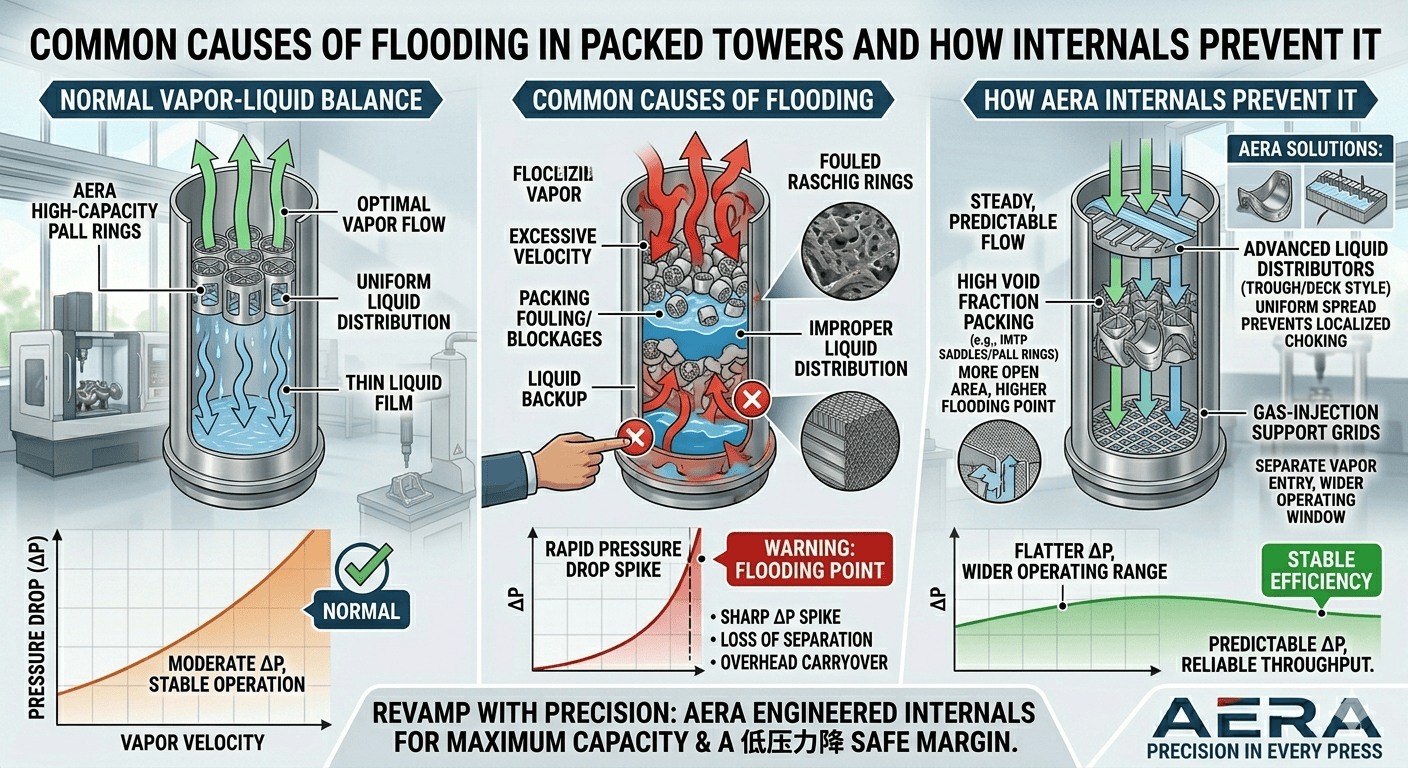
In the operation of a packed tower, there is a delicate balance between the upward force of vapor and the downward flow of liquid. When this balance is disrupted, the tower hits its hydraulic limit, leading to a phenomenon known as flooding. For maintenance and process engineers, flooding is a worst-case scenario. It causes a sharp spike in pressure drop, a collapse in separation efficiency, and can even lead to physical damage to the tower internals. At Aera Engineering Pvt Ltd, we design hardware specifically to widen the operating window and prevent these costly disruptions. 1. What Exactly is 'Flooding'? Flooding occurs when the velocity of the upward-moving vapor is so high that it physically prevents the liquid from trickling down through the packing. Instead of a thin film of liquid coating the packing, the liquid begins to accumulate, filling the 'void spaces' in the tower. Key Indicators of a Flooding Tower: Rapid Pressure Drop : A sudden, non-linear increase in the pressure difference between the bottom and top of the tower. Loss of Separation: Product purity drops instantly as the gas-liquid contact is disrupted. Liquid Carryover: Liquid is literally blown out of the top of the tower into the overhead condensers. 2. Common Causes of Flooding A. Excessive Vapor or Liquid Loads The most common cause is simply pushing the tower beyond its design capacity. If production demands require a higher feed rate, the vapor velocity may eventually reach the 'entrainment point, ' where liquid can no longer descend. B. Fouling and Blockages If the packing becomes clogged with polymers, salts, or corrosion products, the available area for flow (the void fraction) decreases. With less space to move, even a 'normal' vapor rate becomes high-velocity, triggering premature flooding. C. Improper Liquid Distribution If liquid is fed into the tower in concentrated streams rather than a uniform spray, it can 'choke' certain sections of the packing. This localized flooding eventually spreads across the entire cross-section of the tower. 3. How High-Performance Internals Prevent Flooding Engineering out the risk of flooding starts with selecting the right internals. At Aera Engineering, we focus on three specific hardware solutions to keep your towers stable: I. High Void Fraction Packing The 'void fraction' is the percentage of the tower volume that is open space. Traditional packing like Raschig rings has a lower void fraction. By switching to Pall Rings or IMTP (Metal Saddles), you increase the open area. The Result: More room for vapor to pass through, significantly raising the 'flooding point' and allowing for higher throughput. II. Advanced Liquid Distributors To prevent localized choking, we manufacture high-precision trough and deck-style distributors. These ensure that the liquid is distributed with sub-millimeter accuracy across the entire packing surface. The Result: Uniform flow prevents liquid from 'piling up' in one area, maintaining a steady pressure profile. III. High-Capacity Support Grids The support grid at the bottom of the packing bed must be more 'open' than the packing itself. If the grid is restrictive, liquid will back up at the base of the bed. Our Gas-Injection Support Grids allow vapor to enter the bed through separate paths from the descending liquid. The Result: Smooth counter-current flow even at high velocities. 4. Operational Tips for Engineers Monitor the Trend: Don't just look at the current pressure; look at the rate of change. A creeping pressure drop often signals slow-onset fouling. Check the Feed Temperature: Sometimes, an overheated feed increases the vapor load unexpectedly, pushing a stable tower into a flooded state. Conduct Gamma Scans: If you suspect flooding, a Gamma Scan can confirm exactly where the liquid is backing up without needing to shut down the unit. Conclusion: Engineering for Stability At Aera Engineering Pvt Ltd, we believe that a well-designed tower should be 'forgiving.' Our range of Pall Rings, Saddles, and Internals are engineered to provide maximum capacity and a low pressure drop, giving you a wider safety margin against flooding. When your internals are designed for precision, your process stays under control—even when the pressure is on. Is your tower nearing its hydraulic limit? Contact Aera Engineering today for a technical audit of your internals. We’ll help you upgrade your hardware to boost capacity and eliminate flooding risks for good. Do you need a technical datasheet for our high-capacity IMTP Saddles? Reach out to our engineering team at Por, Vadodara.
2026-04-23T04:30:34


Submit Your Enquiry