
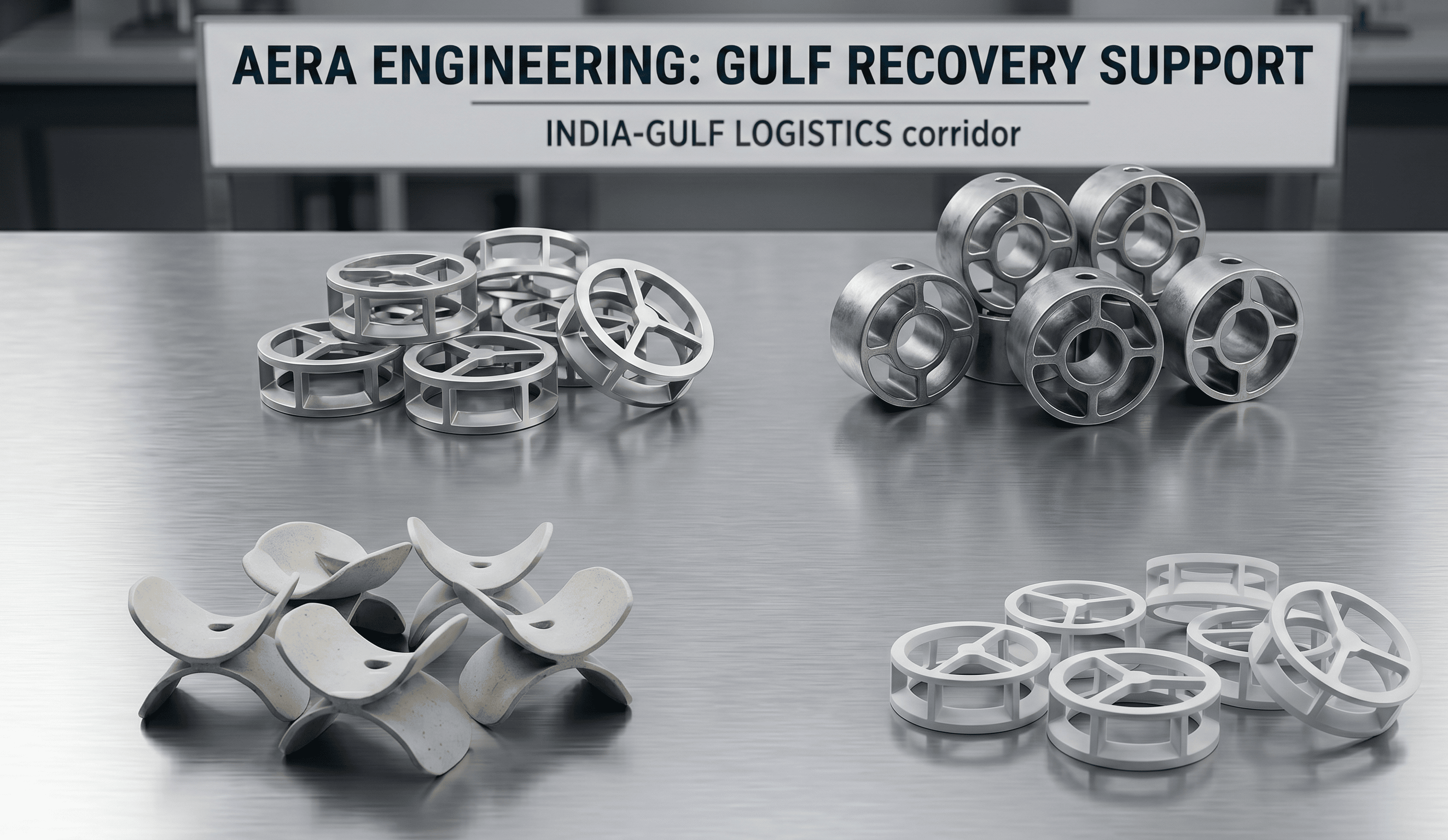
In the aftermath of the significant regional disruptions in 2026, the Middle East petrochemical sector is entering a massive reconstruction phase. With nearly 40 key energy assets across nine countries requiring repair, the 'race to restore' is on. For facilities like the Ruwais Industrial Complex and the South Pars gas field, the primary challenge isn't just funding—it’s the supply chain for specialized high-performance internals. At Aera Engineering Pvt Ltd, we are seeing a transformative shift: Indian manufacturers are no longer just regional suppliers; they are becoming the strategic backbone of the Gulf’s industrial recovery. The Strategic Corridor: Why India? The proximity of India's western industrial hubs—particularly Vadodara, Gujarat—to the major ports of the UAE, Qatar, and Saudi Arabia creates a logistics 'expressway' that Western manufacturers simply cannot match in a post-conflict timeline. 1. Rapid Response and Logistics While global supply chains remain strained by elevated freight costs and insurance premiums in the Persian Gulf, Indian manufacturers offer: Short Sea Shipping: Direct routes from Mundra or Kandla to Jebel Ali or Hamad Port reduce transit times by 60-70% compared to European or American shipments. Customized Priority Manufacturing: Agile firms like Aera Engineering can pivot production schedules to meet emergency turnaround (shutdown) requirements, delivering SS 316L CMR Rings or Ceramic Saddles in weeks rather than months. 2. Technical Parity at Competitive Costs Indian engineering has reached a point of global excellence. By utilizing state-of-the-art VMC machinery and 4th Axis technology, Aera Engineering produces mass transfer equipment that meets or exceeds international ISO 9001:2015 standards. Essential Hardware for the Gulf’s Recovery The recovery effort is focused on 'Resid Upgradation' and 'Bottom Upgradation'—processes that turn heavy, damaged feedstocks into high-value products. This requires a specific suite of equipment where Indian manufacturers excel. Key Equipment Driving the Recovery: High-Performance Random Packing: Essential for de-bottlenecking towers. Replacing damaged internals with Aera P-Rings or High-Efficiency Mini Rings can increase plant capacity by 15-20% without major structural changes. Corrosion-Resistant Materials: Post-war feedstocks are often sour and corrosive. Aera’s specialized production of Titanium, Hastelloy, and Duplex SS packing ensures that the rebuilt infrastructure is more durable than the original. Column Internals: From liquid distributors to bed limiters, the precise engineering required to restore mass transfer efficiency is being handled by Indian detailed-engineering teams. The Efficiency Metric: Many Gulf plants are using this recovery to lower their HETP (Height Equivalent to a Theoretical Plate). By engineering packing with optimized $Z$ (height) and $N$ (theoretical stages), Aera Engineering helps refineries achieve higher purity levels, such as Euro VI fuel standards, as they come back online. Aera Engineering: Your Partner in Middle East Reconstruction Based in the engineering hub of Vadodara, Aera Engineering Pvt Ltd is proud to be part of India’s 'Local to Global' vision. We understand that a refinery restart in 2026 is a race against time and a test of resilience. Our range of products—from SS 316 CMR Rings to Ceramic Super Saddles—is currently supporting the most demanding industrial environments in the world. We don't just supply packing; we provide the technical consultancy and precision engineering that ensures your facility restarts stronger, more efficient, and fully optimized for the future. Are you managing a turnaround or reconstruction in the Gulf? Partner with Aera Engineering for world-class mass transfer solutions. Visit www.aeraepl.com or www.randomtowerpacking.com to learn how we can support your facility’s revival.


This is your website preview.
Currently it only shows your basic business info. Start adding relevant business details such as description, images and products or services to gain your customers attention by using Boost 360 android app / iOS App / web portal.
Engineering the Revival: How Indian Manufacturers Support Middle East Refinery Recovery
2026-04-16T07:30:12
In the aftermath of the significant regional disruptions in 2026, the Middle East petrochemical sector is entering a massive reconstruction phase. With nearly 40 key energy assets across nine countries requiring repair, the 'race to restore' is on. For facilities like the Ruwais Industrial Complex and the South Pars gas field, the primary challenge isn't just funding—it’s the supply chain for specialized high-performance internals. At Aera Engineering Pvt Ltd, we are seeing a transformative shift: Indian manufacturers are no longer just regional suppliers; they are becoming the strategic backbone of the Gulf’s industrial recovery. The Strategic Corridor: Why India? The proximity of India's western industrial hubs—particularly Vadodara, Gujarat—to the major ports of the UAE, Qatar, and Saudi Arabia creates a logistics 'expressway' that Western manufacturers simply cannot match in a post-conflict timeline. 1. Rapid Response and Logistics While global supply chains remain strained by elevated freight costs and insurance premiums in the Persian Gulf, Indian manufacturers offer: Short Sea Shipping: Direct routes from Mundra or Kandla to Jebel Ali or Hamad Port reduce transit times by 60-70% compared to European or American shipments. Customized Priority Manufacturing: Agile firms like Aera Engineering can pivot production schedules to meet emergency turnaround (shutdown) requirements, delivering SS 316L CMR Rings or Ceramic Saddles in weeks rather than months. 2. Technical Parity at Competitive Costs Indian engineering has reached a point of global excellence. By utilizing state-of-the-art VMC machinery and 4th Axis technology, Aera Engineering produces mass transfer equipment that meets or exceeds international ISO 9001:2015 standards. Essential Hardware for the Gulf’s Recovery The recovery effort is focused on 'Resid Upgradation' and 'Bottom Upgradation'—processes that turn heavy, damaged feedstocks into high-value products. This requires a specific suite of equipment where Indian manufacturers excel. Key Equipment Driving the Recovery: High-Performance Random Packing: Essential for de-bottlenecking towers. Replacing damaged internals with Aera P-Rings or High-Efficiency Mini Rings can increase plant capacity by 15-20% without major structural changes. Corrosion-Resistant Materials: Post-war feedstocks are often sour and corrosive. Aera’s specialized production of Titanium, Hastelloy, and Duplex SS packing ensures that the rebuilt infrastructure is more durable than the original. Column Internals: From liquid distributors to bed limiters, the precise engineering required to restore mass transfer efficiency is being handled by Indian detailed-engineering teams. The Efficiency Metric: Many Gulf plants are using this recovery to lower their HETP (Height Equivalent to a Theoretical Plate). By engineering packing with optimized $Z$ (height) and $N$ (theoretical stages), Aera Engineering helps refineries achieve higher purity levels, such as Euro VI fuel standards, as they come back online. Aera Engineering: Your Partner in Middle East Reconstruction Based in the engineering hub of Vadodara, Aera Engineering Pvt Ltd is proud to be part of India’s 'Local to Global' vision. We understand that a refinery restart in 2026 is a race against time and a test of resilience. Our range of products—from SS 316 CMR Rings to Ceramic Super Saddles—is currently supporting the most demanding industrial environments in the world. We don't just supply packing; we provide the technical consultancy and precision engineering that ensures your facility restarts stronger, more efficient, and fully optimized for the future. Are you managing a turnaround or reconstruction in the Gulf? Partner with Aera Engineering for world-class mass transfer solutions. Visit www.aeraepl.com or www.randomtowerpacking.com to learn how we can support your facility’s revival.
2026-04-16T07:30:12


Submit Your Enquiry