
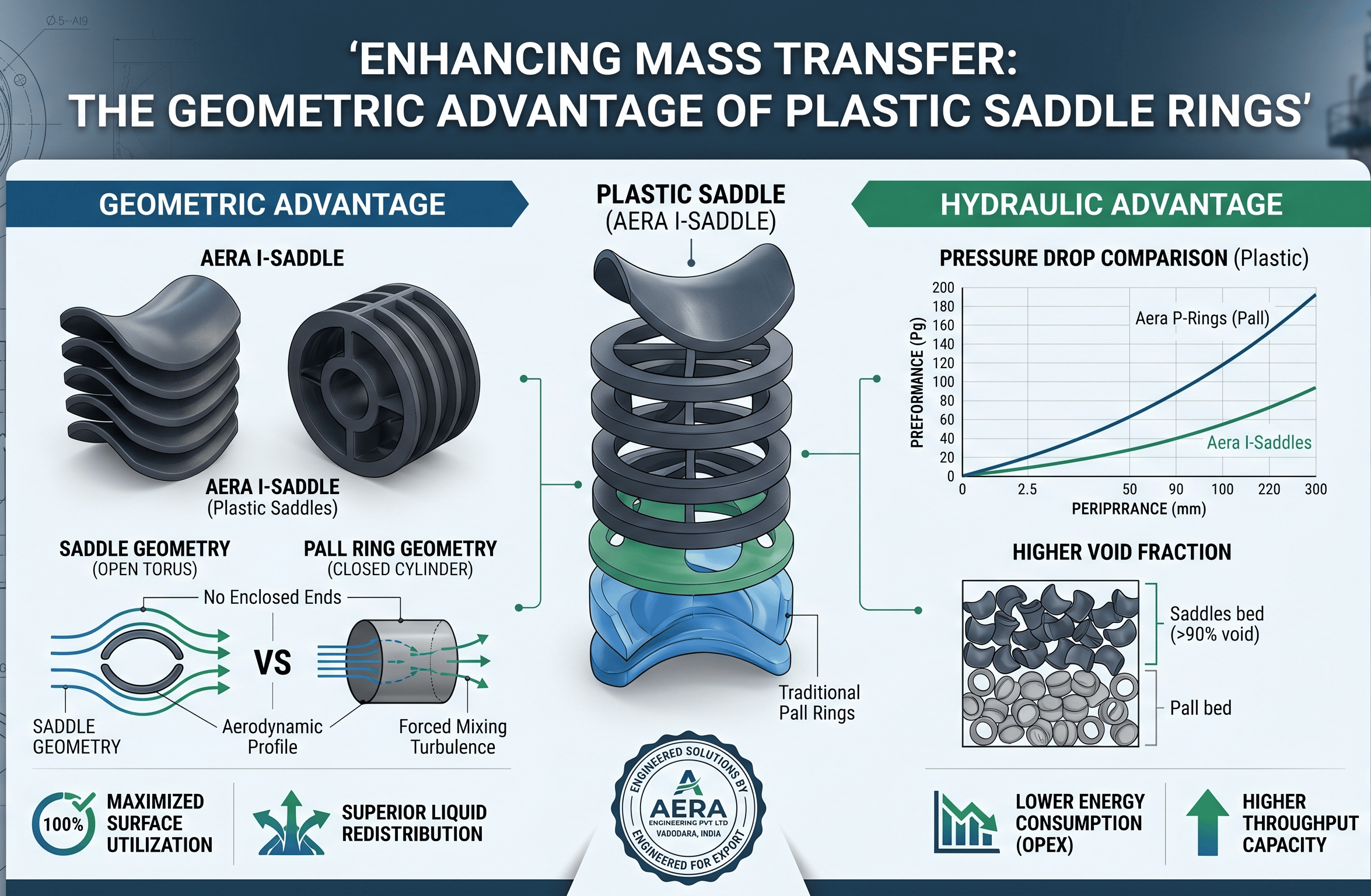
Here is a technical blog post crafted for Aera Engineering Pvt Ltd, designed to position your company as an authority on high-performance plastic random packings for global export. In the demanding world of chemical processing, gas scrubbing, and environmental engineering, the quest for the 'perfect' random packing is perpetual. Engineers are constantly balancing the need for maximum surface area (to enhance mass transfer) against the physical reality of pressure drop (which drives energy costs). While Pall Rings and Raschig Rings are industry staples, there is one geometric design that consistently offers a superior mathematical and hydraulic advantage in high-load scenarios: the Plastic Saddle Ring. At Aera Engineering Pvt Ltd, based in the industrial hub of Vadodara, India, we manufacture high-performance Plastic Saddles (specifically the Aera I-Saddle design, comparable to the traditional Intalox® style) to help our global clients achieve unprecedented efficiency in their packed towers. Here is why the unique geometry of the Plastic Saddle Ring is a game-changer for mass transfer. The Geometry of Performance: Breaking Down the Design Unlike cylindrical packings (Pall/Raschig), which rely on internal openings to improve flow, the Saddle Ring utilizes an entirely different shape: the Torus. A Saddle Ring resembles a cut section of a donut, creating an open, aerodynamic profile. This unique shape provides three distinct geometric advantages that cylindrical packings cannot replicate: 1. Eliminate the 'Closed Cylinder' Effect Cylindrical packings have a 'closed' profile when viewed from the end. If liquid channels down the tower, it can bypass the packing's internal surfaces. The Saddle Advantage: The open, 'cut Torus' shape means there are no enclosed ends. Gas and liquid are forced to engage with 100% of the surface area, regardless of how the saddle lands in the tower bed. Every square meter of packing is actively utilized for mass transfer. 2. Aerodynamic Profile for Minimal Pressure Drop The smooth, curved profile of a saddle offers the path of least resistance to rising gases. The Saddle Advantage: For the same given surface area, a Plastic Saddle Ring generates significantly lower pressure drop than a cylindrical packing. This directly translates to lower energy consumption by the blower systems, reducing operating expenditures (OPEX) for the facility. 3. Superior Liquid and Gas Redistribution One of the main failures of packed towers is 'channeling'—where gas rises up the center and liquid flows down the walls. The Saddle Advantage: The geometry of the saddle acts as a natural flow redistributor. As liquid hits a saddle, it is naturally spread outward across the curved surface to the next piece of packing. Simultaneously, gas is forced into a turbulent flow pattern, ensuring maximum turbulence and breaking boundary layers. Why Material Matters: Plastic vs. Ceramic While Saddle Rings are traditionally associated with ceramic (for extreme high-acid/high-heat environments), Plastic Saddles (in PP, PVC, and PVDF) offer massive advantages in terms of throughput. Higher Void Fraction: Plastic can be molded into thinner cross-sections than ceramic. This creates a more open, 'holey' packing bed with a higher void fraction (often >90%). This allows for significantly higher gas and liquid loads before the tower begins to 'flood.' Lower Weight: Plastic Saddles are dramatically lighter than ceramic equivalents. This reduces the structural load on the tower internals, supports, and foundations, offering a savings on capital expenditure (CAPEX). Breakage Resistance: Unlike ceramic, which can break during installation or handling, plastic saddles are extremely resilient, ensuring long-term bed stability. Key Applications for Aera Plastic Saddles The combination of geometric efficiency and plastic resilience makes Aera I-Saddles ideal for several critical processes: Acid Gas Scrubbing (CO2, H2S, SOx): In gas sweetening and environmental compliance. Ammonia Absorption/Stripping: Essential in fertilizer and chemical processing. VOC Stripping: Critical for wastewater treatment and environmental cleanup. Chlorine and HCI Scrubbing: Where low pressure drop is required under corrosive loads (utilizing our PVC and PVDF formulations). Global Export and Engineering Consultation from Vadodara At Aera Engineering Pvt Ltd, we understand that every tower is unique. Whether you are replacing old-generation packing in a refinery turnaround in the Middle East or designing a new scrubbing system in Southeast Asia, our engineering team provides full compatibility consultation. By choosing Aera's I-Saddles, you are not just buying packing; you are investing in a calculated, mathematically superior geometry designed to enhance the mass transfer efficiency of your vital infrastructure. Ready to enhance your tower performance? Contact Aera Engineering's technical export desk today for a detailed comparison of Saddle vs. Pall Ring performance and compatibility data sheets. Explore our Plastic Packing Range | Vadodara, Gujarat, India


This is your website preview.
Currently it only shows your basic business info. Start adding relevant business details such as description, images and products or services to gain your customers attention by using Boost 360 android app / iOS App / web portal.
Enhancing Mass Transfer: The Geometric Advantage of Plastic Saddle Rings
2026-04-24T11:00:04
Here is a technical blog post crafted for Aera Engineering Pvt Ltd, designed to position your company as an authority on high-performance plastic random packings for global export. In the demanding world of chemical processing, gas scrubbing, and environmental engineering, the quest for the 'perfect' random packing is perpetual. Engineers are constantly balancing the need for maximum surface area (to enhance mass transfer) against the physical reality of pressure drop (which drives energy costs). While Pall Rings and Raschig Rings are industry staples, there is one geometric design that consistently offers a superior mathematical and hydraulic advantage in high-load scenarios: the Plastic Saddle Ring. At Aera Engineering Pvt Ltd, based in the industrial hub of Vadodara, India, we manufacture high-performance Plastic Saddles (specifically the Aera I-Saddle design, comparable to the traditional Intalox® style) to help our global clients achieve unprecedented efficiency in their packed towers. Here is why the unique geometry of the Plastic Saddle Ring is a game-changer for mass transfer. The Geometry of Performance: Breaking Down the Design Unlike cylindrical packings (Pall/Raschig), which rely on internal openings to improve flow, the Saddle Ring utilizes an entirely different shape: the Torus. A Saddle Ring resembles a cut section of a donut, creating an open, aerodynamic profile. This unique shape provides three distinct geometric advantages that cylindrical packings cannot replicate: 1. Eliminate the 'Closed Cylinder' Effect Cylindrical packings have a 'closed' profile when viewed from the end. If liquid channels down the tower, it can bypass the packing's internal surfaces. The Saddle Advantage: The open, 'cut Torus' shape means there are no enclosed ends. Gas and liquid are forced to engage with 100% of the surface area, regardless of how the saddle lands in the tower bed. Every square meter of packing is actively utilized for mass transfer. 2. Aerodynamic Profile for Minimal Pressure Drop The smooth, curved profile of a saddle offers the path of least resistance to rising gases. The Saddle Advantage: For the same given surface area, a Plastic Saddle Ring generates significantly lower pressure drop than a cylindrical packing. This directly translates to lower energy consumption by the blower systems, reducing operating expenditures (OPEX) for the facility. 3. Superior Liquid and Gas Redistribution One of the main failures of packed towers is 'channeling'—where gas rises up the center and liquid flows down the walls. The Saddle Advantage: The geometry of the saddle acts as a natural flow redistributor. As liquid hits a saddle, it is naturally spread outward across the curved surface to the next piece of packing. Simultaneously, gas is forced into a turbulent flow pattern, ensuring maximum turbulence and breaking boundary layers. Why Material Matters: Plastic vs. Ceramic While Saddle Rings are traditionally associated with ceramic (for extreme high-acid/high-heat environments), Plastic Saddles (in PP, PVC, and PVDF) offer massive advantages in terms of throughput. Higher Void Fraction: Plastic can be molded into thinner cross-sections than ceramic. This creates a more open, 'holey' packing bed with a higher void fraction (often >90%). This allows for significantly higher gas and liquid loads before the tower begins to 'flood.' Lower Weight: Plastic Saddles are dramatically lighter than ceramic equivalents. This reduces the structural load on the tower internals, supports, and foundations, offering a savings on capital expenditure (CAPEX). Breakage Resistance: Unlike ceramic, which can break during installation or handling, plastic saddles are extremely resilient, ensuring long-term bed stability. Key Applications for Aera Plastic Saddles The combination of geometric efficiency and plastic resilience makes Aera I-Saddles ideal for several critical processes: Acid Gas Scrubbing (CO2, H2S, SOx): In gas sweetening and environmental compliance. Ammonia Absorption/Stripping: Essential in fertilizer and chemical processing. VOC Stripping: Critical for wastewater treatment and environmental cleanup. Chlorine and HCI Scrubbing: Where low pressure drop is required under corrosive loads (utilizing our PVC and PVDF formulations). Global Export and Engineering Consultation from Vadodara At Aera Engineering Pvt Ltd, we understand that every tower is unique. Whether you are replacing old-generation packing in a refinery turnaround in the Middle East or designing a new scrubbing system in Southeast Asia, our engineering team provides full compatibility consultation. By choosing Aera's I-Saddles, you are not just buying packing; you are investing in a calculated, mathematically superior geometry designed to enhance the mass transfer efficiency of your vital infrastructure. Ready to enhance your tower performance? Contact Aera Engineering's technical export desk today for a detailed comparison of Saddle vs. Pall Ring performance and compatibility data sheets. Explore our Plastic Packing Range | Vadodara, Gujarat, India
2026-04-24T11:00:04


Submit Your Enquiry