
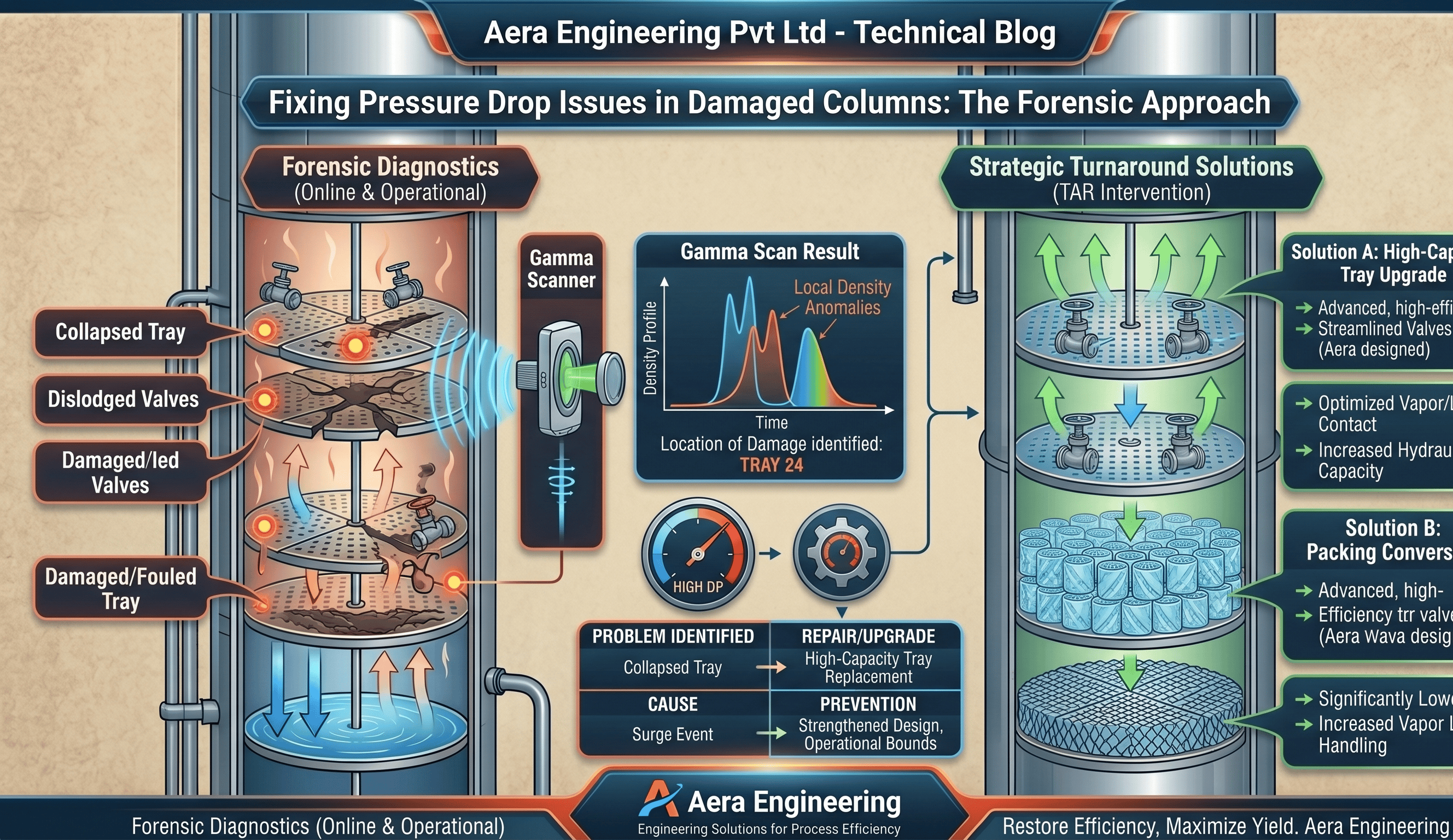
A high pressure drop ($Delta P$) across a distillation column is never good news. It is the signature of efficiency loss, reduced capacity, and increased energy consumption. While a high Delta often points to a capacity bottleneck (as discussed in our post on Debottlenecking Throughput), a sudden or erratic spike in pressure drop often points to something far more critical: Internal Mechanical Damage. When a column is damaged, it stops behaving predictably. Troubleshooting this scenario requires more than just process modeling; it requires forensic engineering. At Aera Engineering, we specialize in diagnosing and surgically repairing columns that have lost their hydraulic integrity. Understanding the Mechanism of Damage How do internals, designed for steady-state operation, fail? Pressure Surges: Startups, shutdowns, or sudden feed vaporization events can create massive pressure waves that can literally 'dislodge' or buckle tray decks. Corrosion & Erosion: Chemical attack or high-velocity liquid impingement thins the metal, leading to catastrophic failure under normal stress. Fouling/Plugging: Paradoxically, excessive fouling on a tray can create higher resistance, leading to a local pressure drop increase that eventually collapses the tray below it. The Forensic Toolkit: Gamma Scanning and Beyond When a column is online and efficiency has plummeted alongside a high Delta , you cannot simply guess which tray is damaged. You need actionable data before a turnaround (TAR) begins. Gamma Scanning (The X-Ray of the Tower): This is the single most powerful tool for diagnosing internal damage while the column is operating. By scanning the tower vertically, we can generate a real-time density profile. A damaged tray (e.g., collapsed, missing valves, or tipped) shows a distinct, localized density anomaly compared to a healthy tray. We don't just know that the tower is damaged; we know exactly where. Delta-P Profiling: Installing additional pressure transmitters across specific sections (instead of just the whole tower) helps narrow down the damaged zone. Vapor-Liquid Correlation (VLC): We analyze the temperature profile (using localized thermocouples) against thermodynamic predictions to identify zones of poor mass transfer, which often correlates with hydraulic damage. Strategic Turnaround (TAR) Solutions Once the location and nature of the damage are identified (ideally pre-TAR using Gamma Scanning), the intervention can be surgical. 1. Tray Repair or Replacement If a tray deck is buckled or valves are missing, the fix is physical. However, simply replacing like-for-like might miss an opportunity. Aera Engineering specializes in High-Capacity Tray Upgrades during repair. By replacing damaged standard trays with advanced designs (e.g., high-performance valves or larger downcomers), you can not only restore original performance but potentially increase capacity. 2. Cleaning and De-Scaling If the damage was preceded by fouling (as seen in the 'Fouling Analysis' panel), specialized chemical or mechanical cleaning is required for the affected zone and adjacent trays to prevent recurrence. 3. Structured Packing (The Alternative to Trays) In cases where high vapor load or frequent pressure surges keep damaging trays, structured packing may be the long-term solution. Structured packing offers significantly lower pressure drop and higher capacity per foot of bed height compared to trays. If the vessel geometry permits, converting a damaged tray section to a packed bed can drastically improve future reliability and efficiency. Summary: Data Over Guesswork A high pressure drop in a damaged column is a process emergency. The Aera Engineering approach ensures that your turnaround is data-driven, minimizing guesswork and maximizing results. We diagnose the Type of problem (e.g., damaged tray vs. fouling). We identify the Location of the problem (e.g., Tray 15 vs. Bed 2). We engineer the best Fix (e.g., high-capacity repair vs. packing conversion). Don't wait for a complete shutdown. If you are seeing erratic pressure drop issues, contact Aera Engineering Pvt Ltd today for a professional Gamma Scan and forensic analysis. Engineering Solutions for Process Efficiency. Aera Engineering Pvt Ltd.


This is your website preview.
Currently it only shows your basic business info. Start adding relevant business details such as description, images and products or services to gain your customers attention by using Boost 360 android app / iOS App / web portal.
Fixing Pressure Drop Issues in Damaged Columns: The Forensic Approach
2026-04-19T03:30:27
A high pressure drop ($Delta P$) across a distillation column is never good news. It is the signature of efficiency loss, reduced capacity, and increased energy consumption. While a high Delta often points to a capacity bottleneck (as discussed in our post on Debottlenecking Throughput), a sudden or erratic spike in pressure drop often points to something far more critical: Internal Mechanical Damage. When a column is damaged, it stops behaving predictably. Troubleshooting this scenario requires more than just process modeling; it requires forensic engineering. At Aera Engineering, we specialize in diagnosing and surgically repairing columns that have lost their hydraulic integrity. Understanding the Mechanism of Damage How do internals, designed for steady-state operation, fail? Pressure Surges: Startups, shutdowns, or sudden feed vaporization events can create massive pressure waves that can literally 'dislodge' or buckle tray decks. Corrosion & Erosion: Chemical attack or high-velocity liquid impingement thins the metal, leading to catastrophic failure under normal stress. Fouling/Plugging: Paradoxically, excessive fouling on a tray can create higher resistance, leading to a local pressure drop increase that eventually collapses the tray below it. The Forensic Toolkit: Gamma Scanning and Beyond When a column is online and efficiency has plummeted alongside a high Delta , you cannot simply guess which tray is damaged. You need actionable data before a turnaround (TAR) begins. Gamma Scanning (The X-Ray of the Tower): This is the single most powerful tool for diagnosing internal damage while the column is operating. By scanning the tower vertically, we can generate a real-time density profile. A damaged tray (e.g., collapsed, missing valves, or tipped) shows a distinct, localized density anomaly compared to a healthy tray. We don't just know that the tower is damaged; we know exactly where. Delta-P Profiling: Installing additional pressure transmitters across specific sections (instead of just the whole tower) helps narrow down the damaged zone. Vapor-Liquid Correlation (VLC): We analyze the temperature profile (using localized thermocouples) against thermodynamic predictions to identify zones of poor mass transfer, which often correlates with hydraulic damage. Strategic Turnaround (TAR) Solutions Once the location and nature of the damage are identified (ideally pre-TAR using Gamma Scanning), the intervention can be surgical. 1. Tray Repair or Replacement If a tray deck is buckled or valves are missing, the fix is physical. However, simply replacing like-for-like might miss an opportunity. Aera Engineering specializes in High-Capacity Tray Upgrades during repair. By replacing damaged standard trays with advanced designs (e.g., high-performance valves or larger downcomers), you can not only restore original performance but potentially increase capacity. 2. Cleaning and De-Scaling If the damage was preceded by fouling (as seen in the 'Fouling Analysis' panel), specialized chemical or mechanical cleaning is required for the affected zone and adjacent trays to prevent recurrence. 3. Structured Packing (The Alternative to Trays) In cases where high vapor load or frequent pressure surges keep damaging trays, structured packing may be the long-term solution. Structured packing offers significantly lower pressure drop and higher capacity per foot of bed height compared to trays. If the vessel geometry permits, converting a damaged tray section to a packed bed can drastically improve future reliability and efficiency. Summary: Data Over Guesswork A high pressure drop in a damaged column is a process emergency. The Aera Engineering approach ensures that your turnaround is data-driven, minimizing guesswork and maximizing results. We diagnose the Type of problem (e.g., damaged tray vs. fouling). We identify the Location of the problem (e.g., Tray 15 vs. Bed 2). We engineer the best Fix (e.g., high-capacity repair vs. packing conversion). Don't wait for a complete shutdown. If you are seeing erratic pressure drop issues, contact Aera Engineering Pvt Ltd today for a professional Gamma Scan and forensic analysis. Engineering Solutions for Process Efficiency. Aera Engineering Pvt Ltd.
2026-04-19T03:30:27


Submit Your Enquiry