
In the refinery and petrochemical world, few metrics are as critical as Differential Pressure . A sudden, unexplained spike in your column’s pressure drop isn't just a number on a screen; it's a direct signal that the internals are failing. When damage occurs inside a distillation tower, the internal resistance chokes the vapor flow, leading to immediate throughput reduction and unstable product quality. At Aera Engineering Pvt Ltd, we are frequently called in to analyze and correct these hydraulic crises. While a full shutdown and internal redesign is the ideal, often the immediate need is a surgical fix to restore operation. Here is how we troubleshoot and repair pressure drop issues when your tower internals are compromised. 1. The First Step: Real-Time Gamma Scanning Before we plan an intervention, we must know the exact location of the bottleneck. Gamma Scanning is an essential first step for troubleshooting a tower with a high pressure drop. This non-invasive 'X-ray' allows us to see the density profile along the entire length of the column while it is still running. Identifying Bed Settling: A scan can reveal bed settling, a common result of thermal shock or pressure surges, where the packing compresses at the base, crushing the lower layers and blocking the vapor path. Locating Flooding: The scan will pinpoint exactly where liquid is pooling and backing up. If a distributor has shifted or damaged packing is present, the scan will show massive liquid accumulation at that point. 2. Fixing Damaged Trays: The Hydraulic Nightmare If Step 1 reveals the bottleneck is on a tray level, the root cause is almost always mechanical damage or deformation. The Damage: Pressure drop across a tray is caused by the resistance of the valves, the liquid height on the deck, and the clarity of the down-comers. When trays are shifted, warped, or valves are dislodged (creating a 'dumping' or 'vapor bypassing' effect), the hydraulic profile is shattered. Vapor cannot easily pass through the deck, forcing it into down-comers, which quickly flood. The Aera Solution: We specialize in modernizing damaged tray towers. Instead of standard replacements, we recommend a retrofit with High-Capacity Valve Trays. These are engineered to provide a wider 'operating window, ' resisting weeping and flooding. We can also reinforce support rings to prevent future mechanical deformation from pressure surges. 3. Packing Failures: When Random Packing Goes Bad In packed towers, a high is often caused by packing migration or fouling. Mechanical Crushing: If high-temperature operation causes standard packing—like legacy Raschig Rings—to thin and lose hoop strength, the bed will collapse under its own weight. This eliminates the 'void fraction' needed for vapor to pass. Aera’s Precision Fix: We provide high-strength random packing options including Aera Cascade Mini Rings (CMR) and Saddles, manufactured from robust metals including SS 316L, 410, and Carbon Steel. Our modern designs prioritize structural geometry to prevent nesting and maintain void fraction, even under high hydraulic loads. Switching from a high-aspect-ratio Pall ring to a lower-aspect-ratio Aera CMR can immediately reduce $Delta P$ by 15-20% at the same capacity. [Image comparing clean tower packing to crushed and settled packing] 4. Addressing the Liquid Distributor Failure Sometimes, a column’s pressure drop isn't from the packing itself, but from the liquid distributor above it. If a distributor—especially a spray-type design—becomes dislodged, damaged, or severely unlevel, it will dump liquid unevenly. This creates massive localized flooding zones that the vapor simply cannot traverse. The Action: The distributor must be reset, re-leveled, or replaced. Aera Engineering designs custom Gravity and Trough Distributors tailored to your specific flow rates to ensure uniform liquid wetting across the entire bed, maximizing mass transfer while minimizing hydraulic resistance. Why Choose Aera Engineering for Your Recovery? At Aera Engineering Pvt Ltd, based in the industrial heart of Vadodara, we specialize in precision mass transfer components. We understand the high cost of a column bottleneck. We don't just supply random parts; we provide a technical audit. When you contact us with a high $Delta P$ crisis, we assist with: Interpreting your gamma scan data. Selecting the correct metallurgy for your process. Manufacturing custom trays or precision packing (Aera SADDLES, CMR, Pall Rings) that reduce hydraulic resistance. Optimizing your distributors and collectors to eliminate channeling. Don't operate in the dark. If your column is choking, it’s not an operating problem—it’s an engineering failure of the internals. Let Aera help you restore your tower’s performance. Aera Engineering Pvt Ltd | Bending Metal, Creating Possibilities. Visit us: www.aeraepl.com | Consult: sales@aeraepl.com | Call: +91 97377 73751 Is your current high pressure drop limiting your feed rate to 90% or below your original design capacity?


This is your website preview.
Currently it only shows your basic business info. Start adding relevant business details such as description, images and products or services to gain your customers attention by using Boost 360 android app / iOS App / web portal.
Fixing Pressure Drop Issues in Damaged Columns
2026-04-18T00:30:10
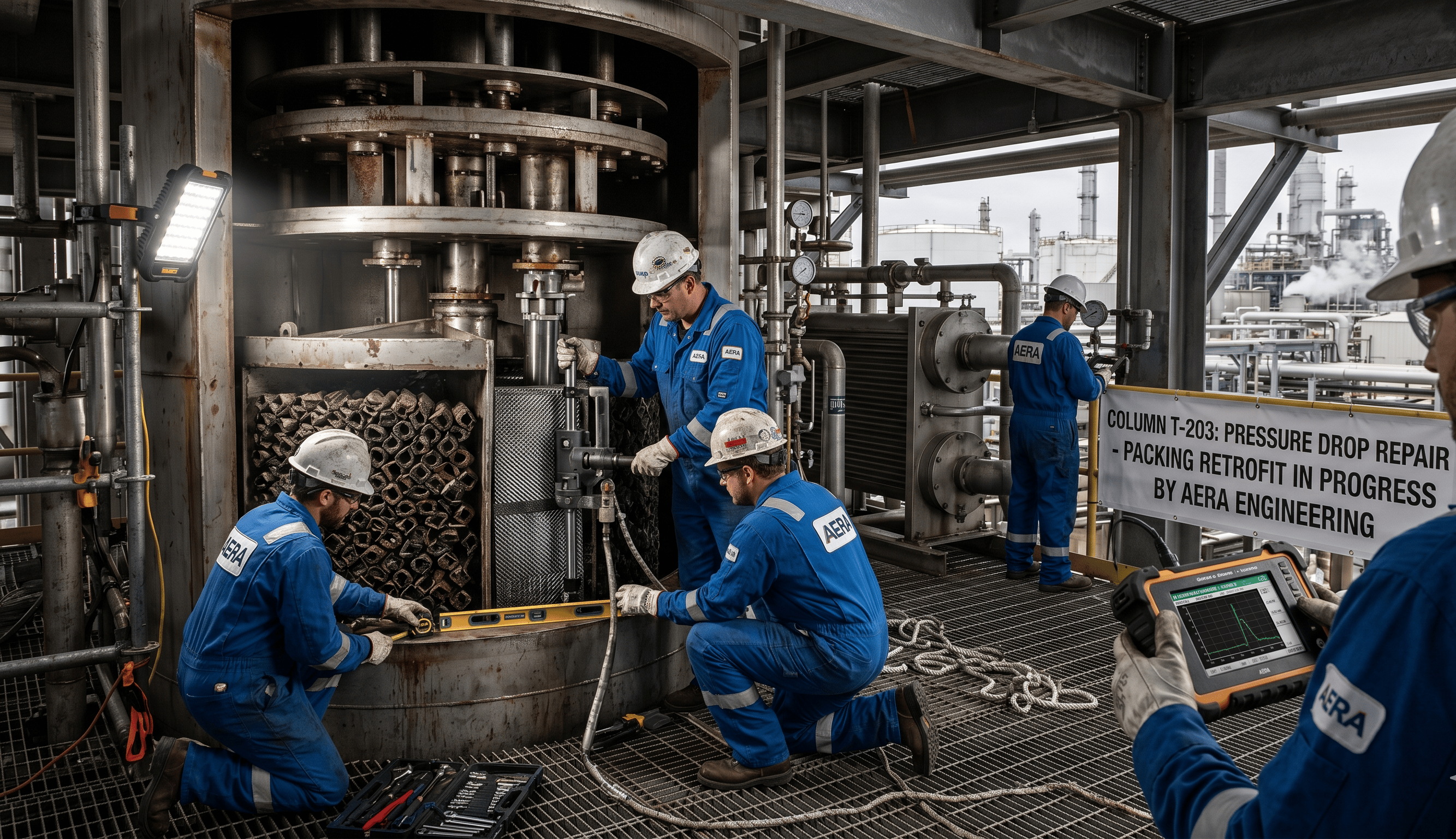
In the refinery and petrochemical world, few metrics are as critical as Differential Pressure . A sudden, unexplained spike in your column’s pressure drop isn't just a number on a screen; it's a direct signal that the internals are failing. When damage occurs inside a distillation tower, the internal resistance chokes the vapor flow, leading to immediate throughput reduction and unstable product quality. At Aera Engineering Pvt Ltd, we are frequently called in to analyze and correct these hydraulic crises. While a full shutdown and internal redesign is the ideal, often the immediate need is a surgical fix to restore operation. Here is how we troubleshoot and repair pressure drop issues when your tower internals are compromised. 1. The First Step: Real-Time Gamma Scanning Before we plan an intervention, we must know the exact location of the bottleneck. Gamma Scanning is an essential first step for troubleshooting a tower with a high pressure drop. This non-invasive 'X-ray' allows us to see the density profile along the entire length of the column while it is still running. Identifying Bed Settling: A scan can reveal bed settling, a common result of thermal shock or pressure surges, where the packing compresses at the base, crushing the lower layers and blocking the vapor path. Locating Flooding: The scan will pinpoint exactly where liquid is pooling and backing up. If a distributor has shifted or damaged packing is present, the scan will show massive liquid accumulation at that point. 2. Fixing Damaged Trays: The Hydraulic Nightmare If Step 1 reveals the bottleneck is on a tray level, the root cause is almost always mechanical damage or deformation. The Damage: Pressure drop across a tray is caused by the resistance of the valves, the liquid height on the deck, and the clarity of the down-comers. When trays are shifted, warped, or valves are dislodged (creating a 'dumping' or 'vapor bypassing' effect), the hydraulic profile is shattered. Vapor cannot easily pass through the deck, forcing it into down-comers, which quickly flood. The Aera Solution: We specialize in modernizing damaged tray towers. Instead of standard replacements, we recommend a retrofit with High-Capacity Valve Trays. These are engineered to provide a wider 'operating window, ' resisting weeping and flooding. We can also reinforce support rings to prevent future mechanical deformation from pressure surges. 3. Packing Failures: When Random Packing Goes Bad In packed towers, a high is often caused by packing migration or fouling. Mechanical Crushing: If high-temperature operation causes standard packing—like legacy Raschig Rings—to thin and lose hoop strength, the bed will collapse under its own weight. This eliminates the 'void fraction' needed for vapor to pass. Aera’s Precision Fix: We provide high-strength random packing options including Aera Cascade Mini Rings (CMR) and Saddles, manufactured from robust metals including SS 316L, 410, and Carbon Steel. Our modern designs prioritize structural geometry to prevent nesting and maintain void fraction, even under high hydraulic loads. Switching from a high-aspect-ratio Pall ring to a lower-aspect-ratio Aera CMR can immediately reduce $Delta P$ by 15-20% at the same capacity. [Image comparing clean tower packing to crushed and settled packing] 4. Addressing the Liquid Distributor Failure Sometimes, a column’s pressure drop isn't from the packing itself, but from the liquid distributor above it. If a distributor—especially a spray-type design—becomes dislodged, damaged, or severely unlevel, it will dump liquid unevenly. This creates massive localized flooding zones that the vapor simply cannot traverse. The Action: The distributor must be reset, re-leveled, or replaced. Aera Engineering designs custom Gravity and Trough Distributors tailored to your specific flow rates to ensure uniform liquid wetting across the entire bed, maximizing mass transfer while minimizing hydraulic resistance. Why Choose Aera Engineering for Your Recovery? At Aera Engineering Pvt Ltd, based in the industrial heart of Vadodara, we specialize in precision mass transfer components. We understand the high cost of a column bottleneck. We don't just supply random parts; we provide a technical audit. When you contact us with a high $Delta P$ crisis, we assist with: Interpreting your gamma scan data. Selecting the correct metallurgy for your process. Manufacturing custom trays or precision packing (Aera SADDLES, CMR, Pall Rings) that reduce hydraulic resistance. Optimizing your distributors and collectors to eliminate channeling. Don't operate in the dark. If your column is choking, it’s not an operating problem—it’s an engineering failure of the internals. Let Aera help you restore your tower’s performance. Aera Engineering Pvt Ltd | Bending Metal, Creating Possibilities. Visit us: www.aeraepl.com | Consult: sales@aeraepl.com | Call: +91 97377 73751 Is your current high pressure drop limiting your feed rate to 90% or below your original design capacity?
2026-04-18T00:30:10


Submit Your Enquiry