
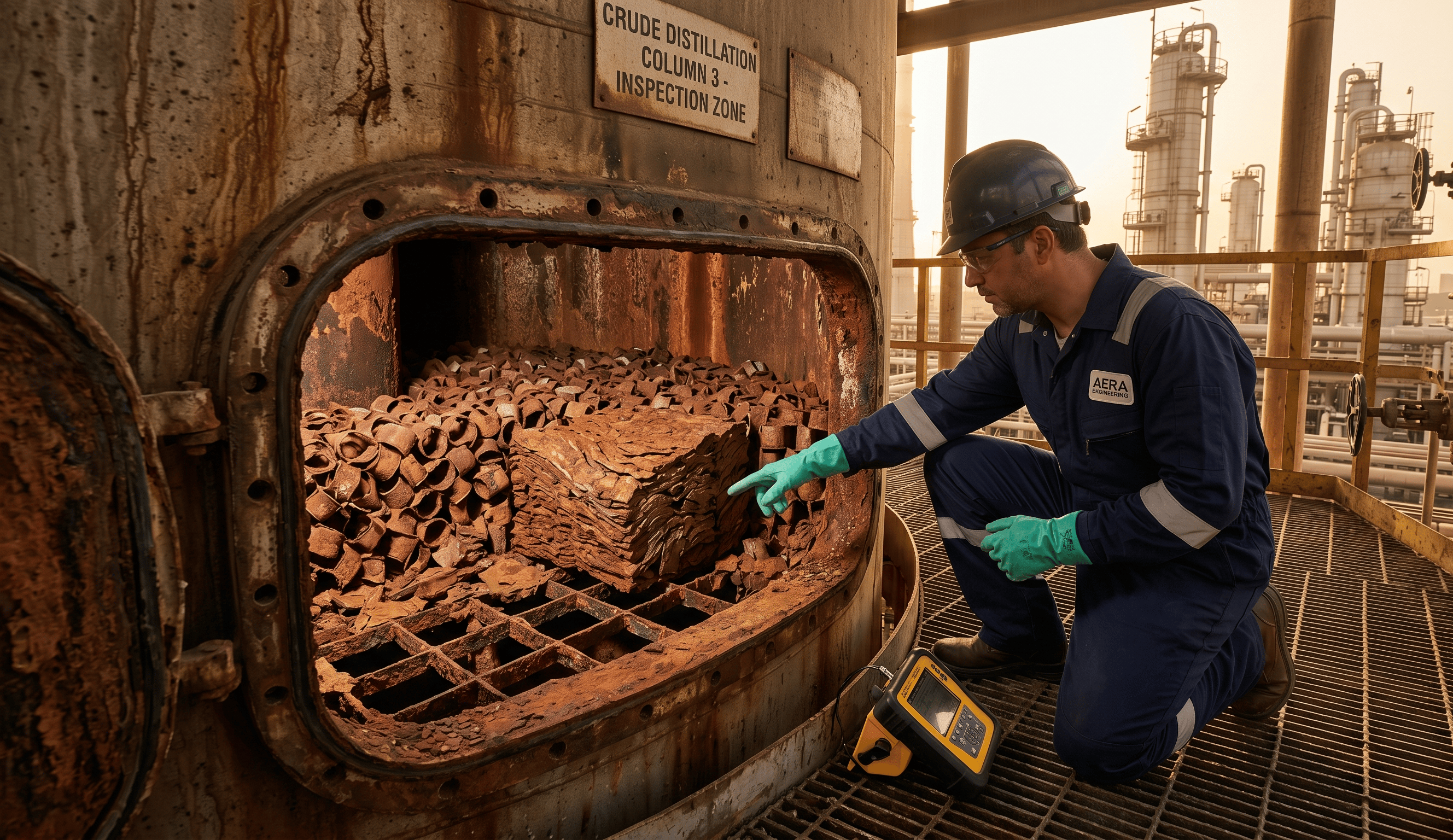
In the harsh, saline environment of the Gulf, refineries face a relentless silent enemy: corrosion. While exterior infrastructure is visible, the most critical damage often happens deep within the distillation columns. Tower packing—the 'lungs' of your refinery—is uniquely vulnerable to the aggressive chemistry of Middle Eastern crude. At Aera Engineering Pvt Ltd, we’ve seen how unchecked corrosion in Gulf facilities leads to millions in lost production. Understanding how these mechanisms affect your internals is the first step toward building a more resilient plant. 1. The 'Big Three' Corrosion Drivers in the Gulf Gulf refineries process some of the most complex crudes in the world, often high in sulfur and chlorides. These factors create a perfect storm for three primary types of internal degradation: Sulfidation (High-Temperature Corrosion): In vacuum distillation units (VDUs) and hydrocrackers, sulfur compounds react with metal surfaces at temperatures exceeding 250°C. This thins the walls of Pall Rings and Saddles, eventually leading to structural collapse. Chloride Stress Corrosion Cracking (CSCC): Coastal refineries in the UAE, Qatar, and Saudi Arabia use desalinated water that can still carry trace chlorides. These ions attack stainless steel packing, causing microscopic cracks that turn brittle and shatter under the weight of the bed. Sour Water Attack: In Sour Water Strippers (SWS), the combination of creates an exceptionally corrosive environment that can dissolve standard carbon steel packing in months rather than years. 2. The Domino Effect: From Micro-Pitting to Macro-Failure Corrosion doesn't just 'eat' metal; it disrupts the entire physics of mass transfer. Here is the typical progression of failure: Surface Roughening: Corrosion creates 'pits' on the packing. This increases surface friction, which might seem good for contact, but it actually promotes fouling as coke and scale get trapped in the pits. Wall Thinning: As metal is lost, the packing loses its mechanical 'hoop strength.' Bed Settling: The weakened packing at the bottom of the bed is crushed by the weight above. Pressure Drop Spike: The crushed packing chokes vapor flow, causing a massive increase in differential pressure ($Delta P$) and forcing a decrease in throughput. 3. Strategic Material Selection for Gulf Environments Standard SS 304 is rarely enough for the Gulf's aggressive service. At Aera Engineering, we specialize in high-performance metallurgy designed to extend turnaround cycles: Environment Recommended Material Benefit Crude Overhead SS 316L / Duplex Superior resistance to localized pitting. High Sulfur / VDU Monel / Hastelloy Immune to high-temp sulfidation. Acid Gas Removal Titanium / PP Exceptional life in low-pH scrubbing. Emergency Recovery Aera SS 410 High strength-to-weight ratio for damaged towers. 4. Why 'Random' is Better for Corrosive Service While structured packing offers high efficiency, it is notoriously difficult to inspect and clean once corrosion-based fouling sets in. Random Tower Packing (like our Aera Cascade Mini Rings or Saddle Rings) provides a critical advantage in the Gulf: Easier Replacement: If a localized 'hot spot' of corrosion occurs, random packing can be vacuumed out and replaced far faster than structured blocks. Fouling Resilience: The open geometry of CMR Rings allows corrosive scale to wash through the bed rather than sticking to the surfaces. Cost-Effective Upgrades: Switching to a higher-grade alloy is significantly more affordable with random packing than with structured alternatives. Partnering with Aera Engineering for Global Resilience Based in the industrial hub of Vadodara, Aera Engineering Pvt Ltd is a leading manufacturer and exporter of precision mass transfer internals. We don't just ship parts; we provide the metallurgical expertise needed to survive the Gulf's toughest conditions. From SS 316L Pall Rings to Titanium Saddles, our products are engineered to ensure that your next shutdown is a planned success, not a corrosion-driven emergency. Protect your production. Upgrade your internals. Contact the Aera Engineering technical team today for a comprehensive corrosion audit of your tower internals. Aera Engineering Pvt Ltd | Precision Engineering for Global Refineries Website: www.aeraepl.com | Call: +91 97377 73751 When was the last time you performed a chemical analysis of your stripper's bottoms to check for high iron or nickel content—a classic sign of internal packing corrosion?


This is your website preview.
Currently it only shows your basic business info. Start adding relevant business details such as description, images and products or services to gain your customers attention by using Boost 360 android app / iOS App / web portal.
How Corrosion Impacts Tower Packing in Gulf Refineries
2026-04-17T14:30:04
In the harsh, saline environment of the Gulf, refineries face a relentless silent enemy: corrosion. While exterior infrastructure is visible, the most critical damage often happens deep within the distillation columns. Tower packing—the 'lungs' of your refinery—is uniquely vulnerable to the aggressive chemistry of Middle Eastern crude. At Aera Engineering Pvt Ltd, we’ve seen how unchecked corrosion in Gulf facilities leads to millions in lost production. Understanding how these mechanisms affect your internals is the first step toward building a more resilient plant. 1. The 'Big Three' Corrosion Drivers in the Gulf Gulf refineries process some of the most complex crudes in the world, often high in sulfur and chlorides. These factors create a perfect storm for three primary types of internal degradation: Sulfidation (High-Temperature Corrosion): In vacuum distillation units (VDUs) and hydrocrackers, sulfur compounds react with metal surfaces at temperatures exceeding 250°C. This thins the walls of Pall Rings and Saddles, eventually leading to structural collapse. Chloride Stress Corrosion Cracking (CSCC): Coastal refineries in the UAE, Qatar, and Saudi Arabia use desalinated water that can still carry trace chlorides. These ions attack stainless steel packing, causing microscopic cracks that turn brittle and shatter under the weight of the bed. Sour Water Attack: In Sour Water Strippers (SWS), the combination of creates an exceptionally corrosive environment that can dissolve standard carbon steel packing in months rather than years. 2. The Domino Effect: From Micro-Pitting to Macro-Failure Corrosion doesn't just 'eat' metal; it disrupts the entire physics of mass transfer. Here is the typical progression of failure: Surface Roughening: Corrosion creates 'pits' on the packing. This increases surface friction, which might seem good for contact, but it actually promotes fouling as coke and scale get trapped in the pits. Wall Thinning: As metal is lost, the packing loses its mechanical 'hoop strength.' Bed Settling: The weakened packing at the bottom of the bed is crushed by the weight above. Pressure Drop Spike: The crushed packing chokes vapor flow, causing a massive increase in differential pressure ($Delta P$) and forcing a decrease in throughput. 3. Strategic Material Selection for Gulf Environments Standard SS 304 is rarely enough for the Gulf's aggressive service. At Aera Engineering, we specialize in high-performance metallurgy designed to extend turnaround cycles: Environment Recommended Material Benefit Crude Overhead SS 316L / Duplex Superior resistance to localized pitting. High Sulfur / VDU Monel / Hastelloy Immune to high-temp sulfidation. Acid Gas Removal Titanium / PP Exceptional life in low-pH scrubbing. Emergency Recovery Aera SS 410 High strength-to-weight ratio for damaged towers. 4. Why 'Random' is Better for Corrosive Service While structured packing offers high efficiency, it is notoriously difficult to inspect and clean once corrosion-based fouling sets in. Random Tower Packing (like our Aera Cascade Mini Rings or Saddle Rings) provides a critical advantage in the Gulf: Easier Replacement: If a localized 'hot spot' of corrosion occurs, random packing can be vacuumed out and replaced far faster than structured blocks. Fouling Resilience: The open geometry of CMR Rings allows corrosive scale to wash through the bed rather than sticking to the surfaces. Cost-Effective Upgrades: Switching to a higher-grade alloy is significantly more affordable with random packing than with structured alternatives. Partnering with Aera Engineering for Global Resilience Based in the industrial hub of Vadodara, Aera Engineering Pvt Ltd is a leading manufacturer and exporter of precision mass transfer internals. We don't just ship parts; we provide the metallurgical expertise needed to survive the Gulf's toughest conditions. From SS 316L Pall Rings to Titanium Saddles, our products are engineered to ensure that your next shutdown is a planned success, not a corrosion-driven emergency. Protect your production. Upgrade your internals. Contact the Aera Engineering technical team today for a comprehensive corrosion audit of your tower internals. Aera Engineering Pvt Ltd | Precision Engineering for Global Refineries Website: www.aeraepl.com | Call: +91 97377 73751 When was the last time you performed a chemical analysis of your stripper's bottoms to check for high iron or nickel content—a classic sign of internal packing corrosion?
2026-04-17T14:30:04


Submit Your Enquiry