
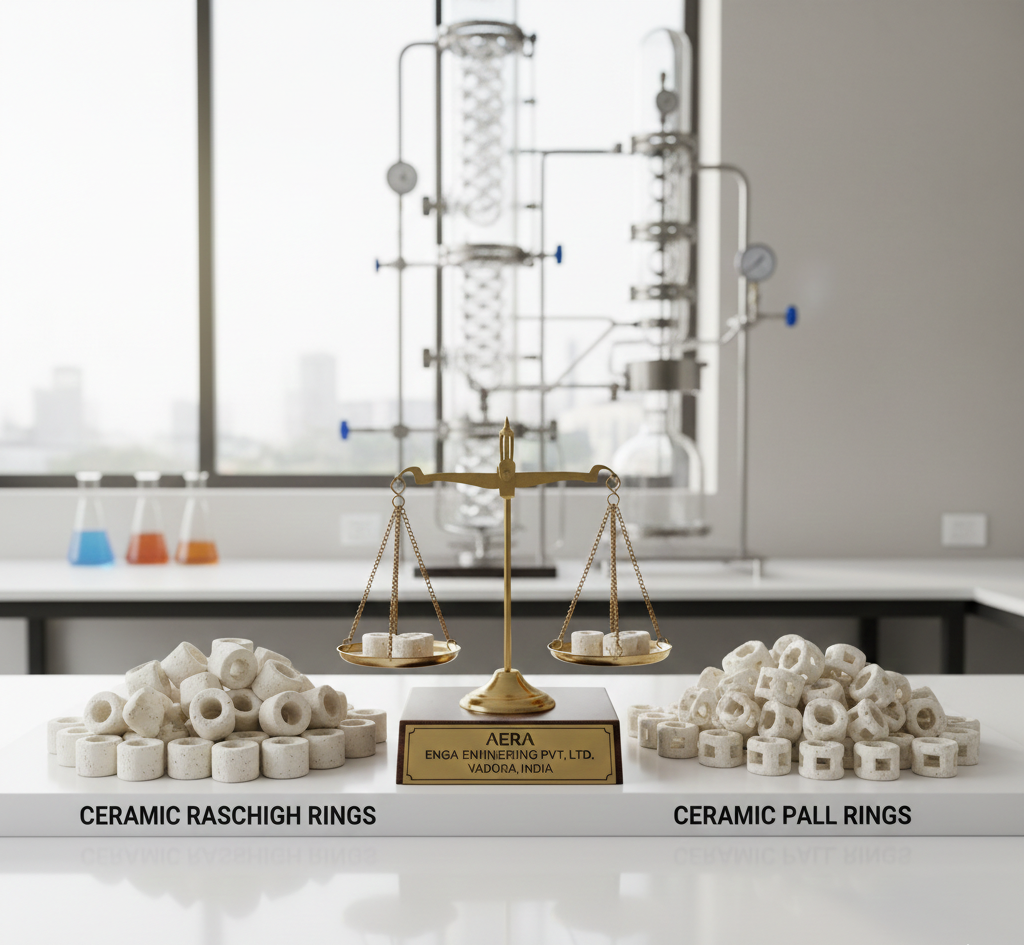
Choosing the right tower packing is a decision that dictates the efficiency, pressure drop, and overall lifespan of your mass transfer equipment. At Aera Engineering Pvt Ltd, we often get asked by our clients in Vadodara: 'Should I stick with the classic Raschig Ring or upgrade to the Pall Ring?' While both are 'random packing' staples, the design evolution between them is significant. Here is a guide to help you choose the right ceramic packing for your specific industrial application. 1. Understanding the Design Difference Ceramic Raschig Rings The Raschig Ring is the 'grandfather' of tower packing. It is a simple hollow cylinder with equal length and diameter. • Mechanism: It provides a surface area for gas-liquid contact but has a closed-wall design. • Best For: Simple applications where cost is the primary concern and high efficiency isn't strictly required. Ceramic Pall Rings The Pall Ring is a direct evolution of the Raschig Ring. It features 'windows' or openings cut into the cylinder walls, with internal tabs that bend inward toward the center. • Mechanism: These openings allow the gas and liquid to flow through the walls of the ring, not just around them. • Best For: Modern plants requiring high throughput and low energy consumption. 2. Key Factors for Your Decision When deciding for your facility in Vadodara or beyond, evaluate these four performance metrics: Efficiency and Mass Transfer Because Pall Rings have internal tabs and wall openings, they offer significantly better 'surface utilization.' In a Raschig Ring, the inner surface is often poorly wetted. In a Pall Ring, the internal area is fully active. • Verdict: Pall Rings offer roughly 50% to 80% higher mass transfer efficiency than Raschig Rings of the same size. Pressure Drop In a distillation or absorption tower, 'pressure drop' equals energy cost. The 'windows' in Pall Rings reduce the resistance to gas flow. • Verdict: Pall Rings can reduce pressure drop by nearly 30% to 50% compared to Raschig Rings. This allows for smaller blowers and lower power consumption. Capacity (Throughput) If you need to process more volume through an existing tower, the packing choice is key. Because Pall Rings allow for better gas-liquid distribution, they can handle higher flow rates before 'flooding' occurs. • Verdict: Pall Rings allow for a higher vapor velocity, meaning you can process more material in the same size column. Initial Cost vs. ROI • Raschig Rings are cheaper to manufacture because of their simple shape. • Pall Rings have a higher upfront cost but pay for themselves through energy savings and higher production rates. 3. Which One Should You Choose? Choose Ceramic Raschig Rings if: • You are working with a very tight budget for a non-critical process. • The tower is small, and high efficiency isn't a priority. • The application is a simple, old-school scrubbing system where the design was originally built for Raschig rings. Choose Ceramic Pall Rings if: • You want to reduce energy costs (via lower pressure drop). • You need to increase the capacity of an existing tower without replacing the vessel. • You are dealing with sensitive chemical reactions that require high mass transfer efficiency. Your Partner in Tower Packing: Aera Engineering Pvt Ltd Whether you need the classic reliability of Raschig Rings or the high-performance efficiency of Pall Rings, Aera Engineering Pvt Ltd in Vadodara provides high-grade, acid-resistant ceramic solutions tailored to your plant's needs. Not sure which size to pick? We can help you calculate the exact packing volume and size (15mm to 75mm) required for your project.


This is your website preview.
Currently it only shows your basic business info. Start adding relevant business details such as description, images and products or services to gain your customers attention by using Boost 360 android app / iOS App / web portal.
How to choose between Ceramic Raschig and Pall Rings
2026-01-27T04:22:53
Choosing the right tower packing is a decision that dictates the efficiency, pressure drop, and overall lifespan of your mass transfer equipment. At Aera Engineering Pvt Ltd, we often get asked by our clients in Vadodara: 'Should I stick with the classic Raschig Ring or upgrade to the Pall Ring?' While both are 'random packing' staples, the design evolution between them is significant. Here is a guide to help you choose the right ceramic packing for your specific industrial application. 1. Understanding the Design Difference Ceramic Raschig Rings The Raschig Ring is the 'grandfather' of tower packing. It is a simple hollow cylinder with equal length and diameter. • Mechanism: It provides a surface area for gas-liquid contact but has a closed-wall design. • Best For: Simple applications where cost is the primary concern and high efficiency isn't strictly required. Ceramic Pall Rings The Pall Ring is a direct evolution of the Raschig Ring. It features 'windows' or openings cut into the cylinder walls, with internal tabs that bend inward toward the center. • Mechanism: These openings allow the gas and liquid to flow through the walls of the ring, not just around them. • Best For: Modern plants requiring high throughput and low energy consumption. 2. Key Factors for Your Decision When deciding for your facility in Vadodara or beyond, evaluate these four performance metrics: Efficiency and Mass Transfer Because Pall Rings have internal tabs and wall openings, they offer significantly better 'surface utilization.' In a Raschig Ring, the inner surface is often poorly wetted. In a Pall Ring, the internal area is fully active. • Verdict: Pall Rings offer roughly 50% to 80% higher mass transfer efficiency than Raschig Rings of the same size. Pressure Drop In a distillation or absorption tower, 'pressure drop' equals energy cost. The 'windows' in Pall Rings reduce the resistance to gas flow. • Verdict: Pall Rings can reduce pressure drop by nearly 30% to 50% compared to Raschig Rings. This allows for smaller blowers and lower power consumption. Capacity (Throughput) If you need to process more volume through an existing tower, the packing choice is key. Because Pall Rings allow for better gas-liquid distribution, they can handle higher flow rates before 'flooding' occurs. • Verdict: Pall Rings allow for a higher vapor velocity, meaning you can process more material in the same size column. Initial Cost vs. ROI • Raschig Rings are cheaper to manufacture because of their simple shape. • Pall Rings have a higher upfront cost but pay for themselves through energy savings and higher production rates. 3. Which One Should You Choose? Choose Ceramic Raschig Rings if: • You are working with a very tight budget for a non-critical process. • The tower is small, and high efficiency isn't a priority. • The application is a simple, old-school scrubbing system where the design was originally built for Raschig rings. Choose Ceramic Pall Rings if: • You want to reduce energy costs (via lower pressure drop). • You need to increase the capacity of an existing tower without replacing the vessel. • You are dealing with sensitive chemical reactions that require high mass transfer efficiency. Your Partner in Tower Packing: Aera Engineering Pvt Ltd Whether you need the classic reliability of Raschig Rings or the high-performance efficiency of Pall Rings, Aera Engineering Pvt Ltd in Vadodara provides high-grade, acid-resistant ceramic solutions tailored to your plant's needs. Not sure which size to pick? We can help you calculate the exact packing volume and size (15mm to 75mm) required for your project.
2026-01-27T04:22:53


Keywords
- Raschig vs Pall Ring benefits
- capacity improvement packing
- energy-saving tower packing
- high throughput ceramic rings
- small tower packing solutions
- tower packing cost comparison
- mass transfer efficiency rings
- acid resistant ceramic packing
- industrial chemical tower packing
- gas-liquid contact media
- pressure drop reduction ceramic rings
- high efficiency tower packing
- tower packing material selection
- ceramic Pall Rings Vadodara
- ceramic Raschig Rings Vadodara
Submit Your Enquiry