
The Chemical Defense Formula: How to Choose Packing Material for Chemical Plants in India In the operating blueprint of a chemical synthesis plant, industrial gas scrubber, or acid stripping tower, the packed column is the epicenter of production. Whether you are separating volatile organic compounds, absorbing hazardous emissions, or managing deep vacuum fractional distillations, the random packing elements resting inside your tower dictate your process efficiency, pressure drop, and plant safety. India’s chemical manufacturing sectors are growing rapidly. Across mega industrial clusters like Dahej, Bharuch, Ankleshwar, and Hazira, processing facilities frequently push their columns to the absolute limit. In these high-stakes chemical loops, selecting an unoptimized tower packing material is an expensive mistake. The wrong media can quickly lead to thermal softening, severe localized pitting, or structural bed compaction—triggering fluid choking, column flooding, and premature shutdowns that cost millions of rupees in lost daily production. As a premier manufacturer and complete mass transfer partner based in Vadodara, Gujarat, Aera Engineering Pvt. Ltd. has compiled this strategic technical guide to help engineering, procurement, and operations teams across India choose the perfect tower packing material for their chemical plant layouts. Step 1: Chart Your Process Chemistry (Corrosion Profiling) The primary rule of choosing a tower packing material is matching the material's metallurgy or polymer structure to the specific corrosive profile of your process stream. Chemical fluids generally fall into three severe operating zones: A. Mild Hydrocarbons and Solvents (The Industrial Workhorses) For standard solvent recovery lines, atmospheric organic acid distillations, and general hydrocarbon fractionations, standard stainless steels offer the ideal balance of mechanical strength and cost efficiency. • Stainless Steel 304/304L: Excellent for general, non-corrosive chemical lines. • Stainless Steel 316/316L: Enhanced with 2–3% molybdenum, SS 316 provides premium protection against localized crevice corrosion and pitting in mild acid loops or chloride-heavy utility zones. B. Highly Reducing Acids and Halogens (The Superalloy Zone) When process chemistry introduces aggressive mineral acids, hot brines, wet halogens, or alternating oxidizing/reducing cycles, standard stainless steels suffer from rapid stress corrosion cracking ($SCC$). Here, elite nickel-based superalloys are mandatory: • Monel 400 (Alloy 400): Exceptionally optimized for reducing environments, hydrofluoric acid ($HF$) alkylation loops, and hot maritime brine handling systems. • Hastelloy C-276 / C-22: The ultimate frontline defense against severe chemical aggression. Hastelloy remains completely immune to wet chlorine gas, ferric and cupric chlorides, bleaching agents, hypochlorite solutions, and roaring mineral acids. C. Strong Caustics, Alkalis, and Bleaches (The Polymer Matrix) For low-to-medium temperature utility towers handling aggressive caustics or alkaline washes, metals can be unnecessarily expensive, while ceramics can face chemical degradation. Advanced polymers excel in these specific chemical environments. Step 2: Establish Your Operating Temperature Thresholds A material might be completely immune to chemical attack at ambient room temperature, but it can quickly fail when thermal loads spike. Thermal profiles narrow your selection down to three distinct material families: 1. Engineered Plastics (Up to 100°C – 140°C) For low-to-medium temperature lines, polymers offer incredible structural economy and total chemical inertness. • Polypropylene (PP): Highly cost-effective for general operations up to 100°C. Its lightweight nature minimizes the static downward load on your tower's foundation. • Glass-Reinforced Polypropylene (RPP): Enhanced with glass fibers to boost compressive crushing strength and prevent early bed flattening under heavy liquid weights. • Polyvinylidene Fluoride (PVDF): The elite fluoropolymer benchmark. PVDF maintains its rigid mechanical shape and high compressive rigidity at continuous operating temperatures up to 140°C. Containing zero additives or stabilizers, its ultra-low extraction profile makes it ideal for high-purity pharmaceutical separations and semiconductor chemical loops. 2. High-Alloy Metals (Up to 500°C – 900°C+) When temperatures push past the limits of plastics, metals become necessary to support the structure of the bed. For extreme refining environments or chemical cracking furnaces experiencing severe thermal stress alongside chemical attack, superalloys like Inconel 625 retain excellent yield strength and resist high-temperature sulfidation or oxidation at profiles exceeding 700°C. 3. Industrial Ceramics and Porcelain (Up to 1000°C+) When columns face extreme heat combined with highly concentrated, roaring mineral acids, plastics melt and metals dissolve. Here, ceramics reign supreme. • Chemical Porcelain Saddles: Vitrified at extreme kiln temperatures to ensure zero chemical reactivity and absolute immunity to virtually all organic and inorganic acids (except hydrofluoric acid). They are the definitive global benchmark for sulfuric acid drying and absorbing towers, as well as Regenerative Thermal Oxidizers (RTOs). Step 3: Evaluate Column Footprints and Aerodynamic Geometries Material choice governs chemical longevity, but the physical shape of the packing dictates your tower's fluid dynamics, throughput capacity, and energy costs. Modern chemical plants are rapidly moving away from legacy, closed cylindrical rings to advanced, high-capacity geometries: High-Efficiency Saddles (Intalox Metal Tower Packing / IMTP Equivalents) Advanced shapes, such as our signature Aera Saddles, masterfully combine the aerodynamic curve of a traditional saddle with internal projecting fingers. This specialized configuration ensures individual pieces preferentially orient themselves within a column to completely eliminate element interlocking or nesting. This open matrix provides 92% to 98% free volume, which delivers three massive operational benefits: • Eliminates Liquid Channeling: Fluids spread evenly across the core rather than bypassing along the tower walls. • Minimizes Pressure Drops: Upward vapor streams move smoothly with minimal resistance, significantly lowering blower and compressor energy bills. • Boosts Column Throughput: Upgrades your existing columns to handle up to 10–30% higher vapor capacity, allowing chemical plants to easily debottleneck their operations. Step 4: Verify Structural Loads and Internal Component Integration A complete packed bed configuration requires a comprehensive, holistic approach. Before finalizing your tower packing selection, your technical and procurement teams must analyze the complete structural weight: • Custom Wall Thicknesses: Deep packed beds exert intense compressive static weight on the random packing resting at the bottom of a tower. If your tower layout features exceptional bed depth, choose a manufacturer that can stamp metallic packings with custom, reinforced wall thicknesses (e.g., from 0.4 mm up to 1.0 mm) to boost mechanical crushing strength and prevent early bed compaction. • Tower Internals Cohesion: To prevent liquid bypassing or vapor maldistribution, your packing must work seamlessly with your column internals. Sourcing your random packing alongside custom sheet metal pressed components, liquid distributors, support plates, and bed hold-down grids ensures an optimized weight-to-strength ratio across the entire layout. Summary Selection Matrix for Quick Reference Process Constraint Best Material Choice Recommended Geometry Mild Solvents / Hydrocarbons (<150°C) Stainless Steel 316L Aera Saddles / Pall Rings Wet Chlorine / Contaminated Mineral Acids Hastelloy C-276 Aera Saddles / Pall Rings HF Alkylation / Reducing Media Monel 400 High-Capacity Saddles Strong Alkalis / Water Utilities (<100°C) Virgin Polypropylene (PP) Plastic Saddles / Pall Rings Aggressive Oxidizers / Pure Pharma (<140°C) Pure Virgin PVDF PVDF Pall Rings / Saddles Sulfuric Acid Absorbers / RTOs (>1000°C) Chemical Chemical Porcelain Ceramic Intalox Saddles Why Partner with Aera Engineering Pvt. Ltd.? Operating an advanced industrial manufacturing hub in Vadodara, Gujarat, Aera Engineering Pvt. Ltd. eliminates supply chain friction for India's chemical manufacturing corridors. Sourcing your tower packing through our ecosystem provides distinct operational and economic advantages: • In-House Tooling Precision: We cut, design, and maintain 100% of our progressive stamping dies entirely in-house. This centralized control allows us to strictly monitor tool wear and ensure absolute dimensional uniformity across millions of individual high-alloy pieces. • 100% Verified Material Traceability: As an ISO 9001:2015 certified organization, we mandate rigid Positive Material Identification (PMI) testing on 100% of incoming raw coils and utilize only certified virgin polymer resins, backing every consignment with comprehensive Material Test Certificates (MTCs). • Factory-Direct Pricing Economics: Operating as a direct, end-to-end manufacturer, we eliminate multi-tier trading markups and distributor fees, passing structural cost savings directly onto your capital budget. • Turnaround Agility: We dramatically compress lead times, ensuring your bulk random packing or custom sheet metal components arrive at your facility gate exactly on schedule to meet tight turnaround maintenance windows. Optimize Your Chemical Column Performance Today Don't let rigid component catalogs, unverified material tracking, or fragmented supply chains compromise your plant's processing capacity and long-term asset integrity. Investing in tailored random packing reduces long-term equipment wear, minimizes catastrophic material failures, and vastly improves your process efficiency. Connect with the technical sourcing desk at Aera Engineering Pvt. Ltd. today. Submit your column diameters, share your volume requirements (in cubic meters or cubic feet) or structural drawings with our sales engineers, and receive a comprehensive, precision-aligned factory-direct quotation. Keywords Regarding This Guide • How to Choose Packing Material for Chemical Plants India • Aera Engineering Pvt Ltd • Chemical Plant Distillation Column Sourcing • Intalox Metal Tower Packing India • Sheet Metal Pressed Components Vadodara • Plastic and Metal Pall Ring Manufacturer India • High Alloy Column Packing Suppliers Gujarat • Monel and Hastelloy IMTP Sourcing India • Industrial Random Packing Sourcing Dahej


This is your website preview.
Currently it only shows your basic business info. Start adding relevant business details such as description, images and products or services to gain your customers attention by using Boost 360 android app / iOS App / web portal.
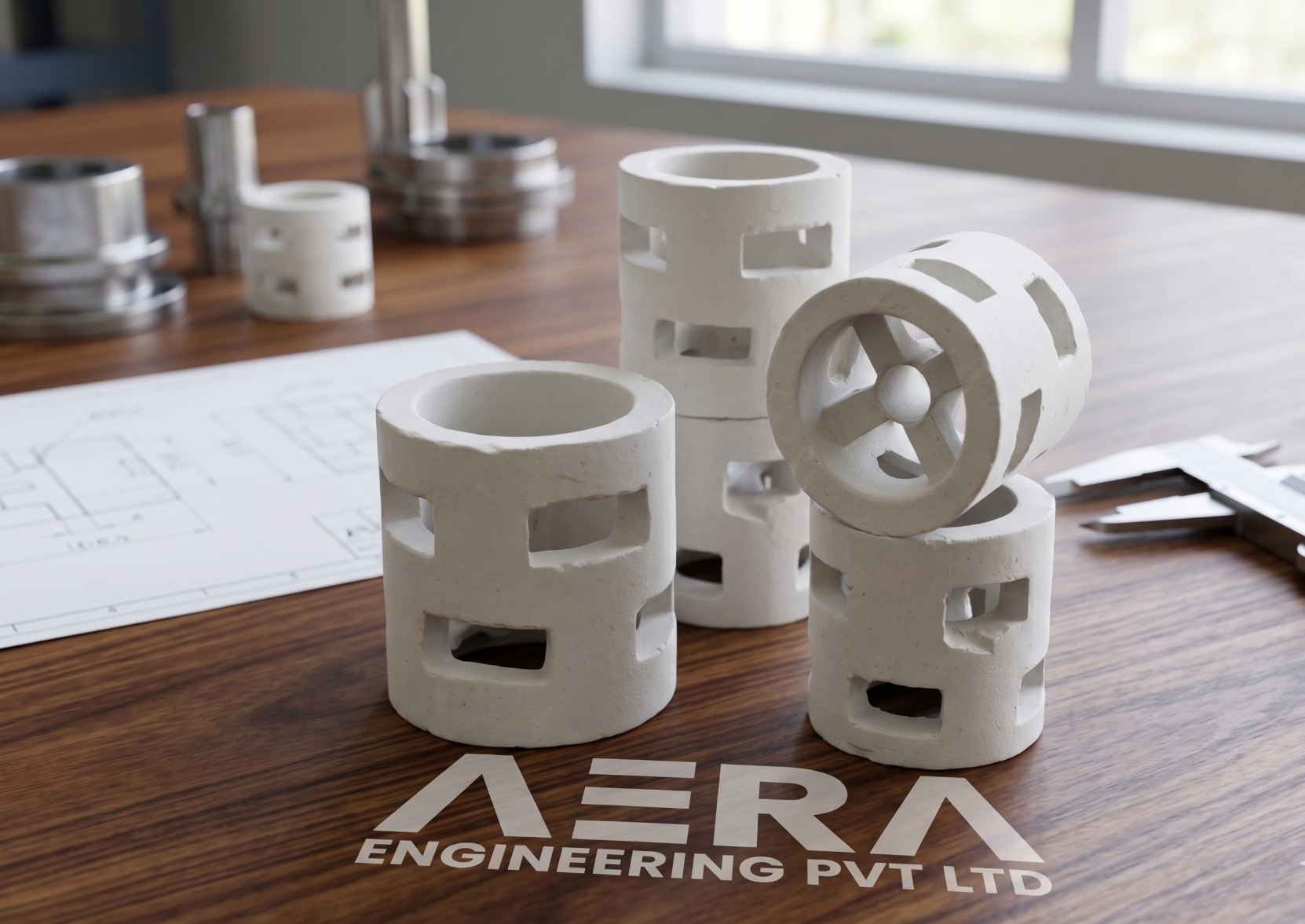
How to Choose Packing Material for Chemical Plants India
2026-06-15T10:53:56
The Chemical Defense Formula: How to Choose Packing Material for Chemical Plants in India In the operating blueprint of a chemical synthesis plant, industrial gas scrubber, or acid stripping tower, the packed column is the epicenter of production. Whether you are separating volatile organic compounds, absorbing hazardous emissions, or managing deep vacuum fractional distillations, the random packing elements resting inside your tower dictate your process efficiency, pressure drop, and plant safety. India’s chemical manufacturing sectors are growing rapidly. Across mega industrial clusters like Dahej, Bharuch, Ankleshwar, and Hazira, processing facilities frequently push their columns to the absolute limit. In these high-stakes chemical loops, selecting an unoptimized tower packing material is an expensive mistake. The wrong media can quickly lead to thermal softening, severe localized pitting, or structural bed compaction—triggering fluid choking, column flooding, and premature shutdowns that cost millions of rupees in lost daily production. As a premier manufacturer and complete mass transfer partner based in Vadodara, Gujarat, Aera Engineering Pvt. Ltd. has compiled this strategic technical guide to help engineering, procurement, and operations teams across India choose the perfect tower packing material for their chemical plant layouts. Step 1: Chart Your Process Chemistry (Corrosion Profiling) The primary rule of choosing a tower packing material is matching the material's metallurgy or polymer structure to the specific corrosive profile of your process stream. Chemical fluids generally fall into three severe operating zones: A. Mild Hydrocarbons and Solvents (The Industrial Workhorses) For standard solvent recovery lines, atmospheric organic acid distillations, and general hydrocarbon fractionations, standard stainless steels offer the ideal balance of mechanical strength and cost efficiency. • Stainless Steel 304/304L: Excellent for general, non-corrosive chemical lines. • Stainless Steel 316/316L: Enhanced with 2–3% molybdenum, SS 316 provides premium protection against localized crevice corrosion and pitting in mild acid loops or chloride-heavy utility zones. B. Highly Reducing Acids and Halogens (The Superalloy Zone) When process chemistry introduces aggressive mineral acids, hot brines, wet halogens, or alternating oxidizing/reducing cycles, standard stainless steels suffer from rapid stress corrosion cracking ($SCC$). Here, elite nickel-based superalloys are mandatory: • Monel 400 (Alloy 400): Exceptionally optimized for reducing environments, hydrofluoric acid ($HF$) alkylation loops, and hot maritime brine handling systems. • Hastelloy C-276 / C-22: The ultimate frontline defense against severe chemical aggression. Hastelloy remains completely immune to wet chlorine gas, ferric and cupric chlorides, bleaching agents, hypochlorite solutions, and roaring mineral acids. C. Strong Caustics, Alkalis, and Bleaches (The Polymer Matrix) For low-to-medium temperature utility towers handling aggressive caustics or alkaline washes, metals can be unnecessarily expensive, while ceramics can face chemical degradation. Advanced polymers excel in these specific chemical environments. Step 2: Establish Your Operating Temperature Thresholds A material might be completely immune to chemical attack at ambient room temperature, but it can quickly fail when thermal loads spike. Thermal profiles narrow your selection down to three distinct material families: 1. Engineered Plastics (Up to 100°C – 140°C) For low-to-medium temperature lines, polymers offer incredible structural economy and total chemical inertness. • Polypropylene (PP): Highly cost-effective for general operations up to 100°C. Its lightweight nature minimizes the static downward load on your tower's foundation. • Glass-Reinforced Polypropylene (RPP): Enhanced with glass fibers to boost compressive crushing strength and prevent early bed flattening under heavy liquid weights. • Polyvinylidene Fluoride (PVDF): The elite fluoropolymer benchmark. PVDF maintains its rigid mechanical shape and high compressive rigidity at continuous operating temperatures up to 140°C. Containing zero additives or stabilizers, its ultra-low extraction profile makes it ideal for high-purity pharmaceutical separations and semiconductor chemical loops. 2. High-Alloy Metals (Up to 500°C – 900°C+) When temperatures push past the limits of plastics, metals become necessary to support the structure of the bed. For extreme refining environments or chemical cracking furnaces experiencing severe thermal stress alongside chemical attack, superalloys like Inconel 625 retain excellent yield strength and resist high-temperature sulfidation or oxidation at profiles exceeding 700°C. 3. Industrial Ceramics and Porcelain (Up to 1000°C+) When columns face extreme heat combined with highly concentrated, roaring mineral acids, plastics melt and metals dissolve. Here, ceramics reign supreme. • Chemical Porcelain Saddles: Vitrified at extreme kiln temperatures to ensure zero chemical reactivity and absolute immunity to virtually all organic and inorganic acids (except hydrofluoric acid). They are the definitive global benchmark for sulfuric acid drying and absorbing towers, as well as Regenerative Thermal Oxidizers (RTOs). Step 3: Evaluate Column Footprints and Aerodynamic Geometries Material choice governs chemical longevity, but the physical shape of the packing dictates your tower's fluid dynamics, throughput capacity, and energy costs. Modern chemical plants are rapidly moving away from legacy, closed cylindrical rings to advanced, high-capacity geometries: High-Efficiency Saddles (Intalox Metal Tower Packing / IMTP Equivalents) Advanced shapes, such as our signature Aera Saddles, masterfully combine the aerodynamic curve of a traditional saddle with internal projecting fingers. This specialized configuration ensures individual pieces preferentially orient themselves within a column to completely eliminate element interlocking or nesting. This open matrix provides 92% to 98% free volume, which delivers three massive operational benefits: • Eliminates Liquid Channeling: Fluids spread evenly across the core rather than bypassing along the tower walls. • Minimizes Pressure Drops: Upward vapor streams move smoothly with minimal resistance, significantly lowering blower and compressor energy bills. • Boosts Column Throughput: Upgrades your existing columns to handle up to 10–30% higher vapor capacity, allowing chemical plants to easily debottleneck their operations. Step 4: Verify Structural Loads and Internal Component Integration A complete packed bed configuration requires a comprehensive, holistic approach. Before finalizing your tower packing selection, your technical and procurement teams must analyze the complete structural weight: • Custom Wall Thicknesses: Deep packed beds exert intense compressive static weight on the random packing resting at the bottom of a tower. If your tower layout features exceptional bed depth, choose a manufacturer that can stamp metallic packings with custom, reinforced wall thicknesses (e.g., from 0.4 mm up to 1.0 mm) to boost mechanical crushing strength and prevent early bed compaction. • Tower Internals Cohesion: To prevent liquid bypassing or vapor maldistribution, your packing must work seamlessly with your column internals. Sourcing your random packing alongside custom sheet metal pressed components, liquid distributors, support plates, and bed hold-down grids ensures an optimized weight-to-strength ratio across the entire layout. Summary Selection Matrix for Quick Reference Process Constraint Best Material Choice Recommended Geometry Mild Solvents / Hydrocarbons (<150°C) Stainless Steel 316L Aera Saddles / Pall Rings Wet Chlorine / Contaminated Mineral Acids Hastelloy C-276 Aera Saddles / Pall Rings HF Alkylation / Reducing Media Monel 400 High-Capacity Saddles Strong Alkalis / Water Utilities (<100°C) Virgin Polypropylene (PP) Plastic Saddles / Pall Rings Aggressive Oxidizers / Pure Pharma (<140°C) Pure Virgin PVDF PVDF Pall Rings / Saddles Sulfuric Acid Absorbers / RTOs (>1000°C) Chemical Chemical Porcelain Ceramic Intalox Saddles Why Partner with Aera Engineering Pvt. Ltd.? Operating an advanced industrial manufacturing hub in Vadodara, Gujarat, Aera Engineering Pvt. Ltd. eliminates supply chain friction for India's chemical manufacturing corridors. Sourcing your tower packing through our ecosystem provides distinct operational and economic advantages: • In-House Tooling Precision: We cut, design, and maintain 100% of our progressive stamping dies entirely in-house. This centralized control allows us to strictly monitor tool wear and ensure absolute dimensional uniformity across millions of individual high-alloy pieces. • 100% Verified Material Traceability: As an ISO 9001:2015 certified organization, we mandate rigid Positive Material Identification (PMI) testing on 100% of incoming raw coils and utilize only certified virgin polymer resins, backing every consignment with comprehensive Material Test Certificates (MTCs). • Factory-Direct Pricing Economics: Operating as a direct, end-to-end manufacturer, we eliminate multi-tier trading markups and distributor fees, passing structural cost savings directly onto your capital budget. • Turnaround Agility: We dramatically compress lead times, ensuring your bulk random packing or custom sheet metal components arrive at your facility gate exactly on schedule to meet tight turnaround maintenance windows. Optimize Your Chemical Column Performance Today Don't let rigid component catalogs, unverified material tracking, or fragmented supply chains compromise your plant's processing capacity and long-term asset integrity. Investing in tailored random packing reduces long-term equipment wear, minimizes catastrophic material failures, and vastly improves your process efficiency. Connect with the technical sourcing desk at Aera Engineering Pvt. Ltd. today. Submit your column diameters, share your volume requirements (in cubic meters or cubic feet) or structural drawings with our sales engineers, and receive a comprehensive, precision-aligned factory-direct quotation. Keywords Regarding This Guide • How to Choose Packing Material for Chemical Plants India • Aera Engineering Pvt Ltd • Chemical Plant Distillation Column Sourcing • Intalox Metal Tower Packing India • Sheet Metal Pressed Components Vadodara • Plastic and Metal Pall Ring Manufacturer India • High Alloy Column Packing Suppliers Gujarat • Monel and Hastelloy IMTP Sourcing India • Industrial Random Packing Sourcing Dahej
2026-06-15T10:53:56


Submit Your Enquiry