
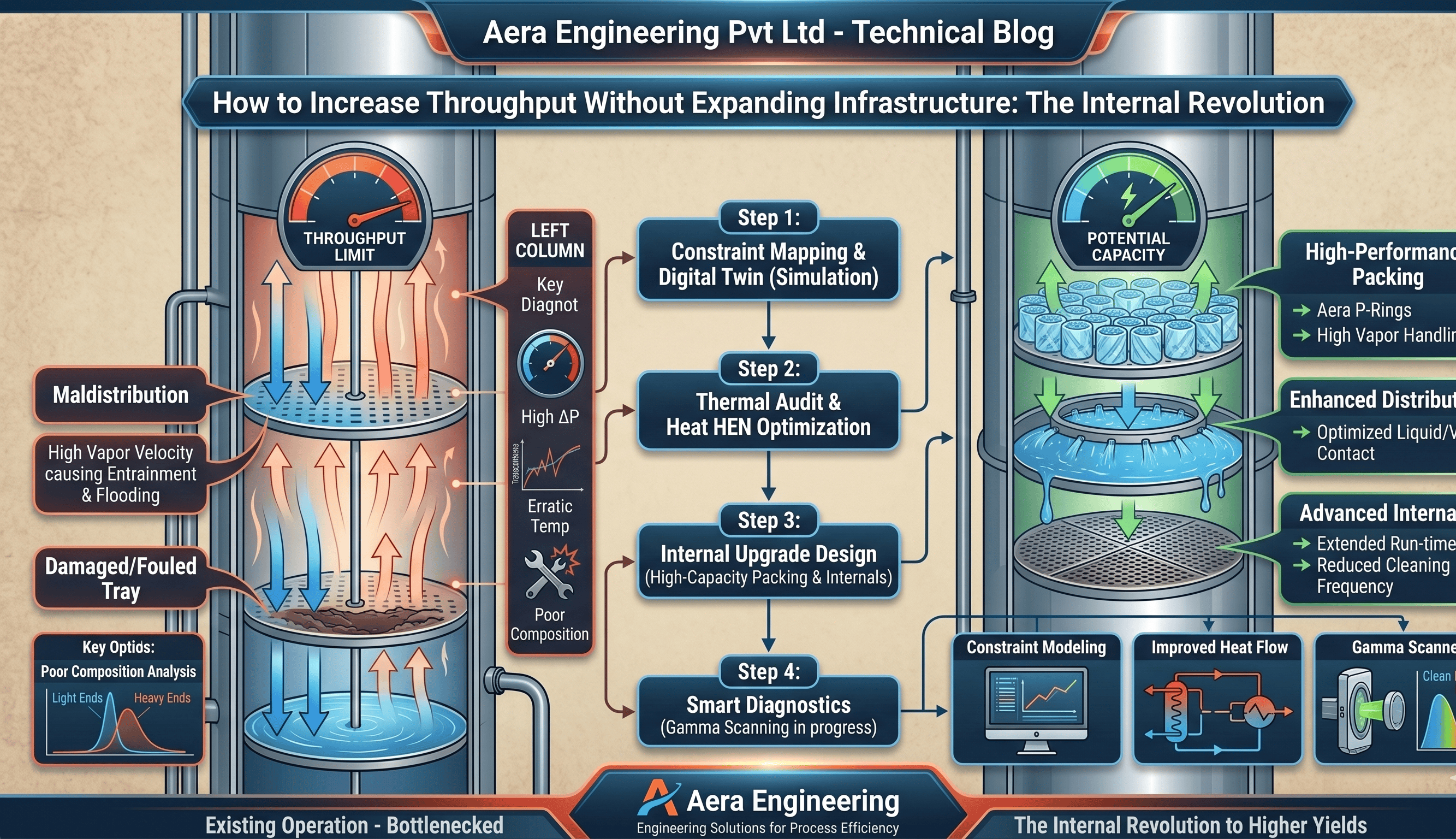
In today’s volatile market, refinery and petrochemical plant managers face a common dilemma: the need for more volume without the luxury of a multi-year, multi-million dollar capital expansion. The 'build your way out' mentality is being replaced by a more surgical approach—Debottlenecking. At Aera Engineering, we believe the most cost-effective 'new' capacity is already sitting inside your existing vessels. Here is how you can unlock it. 1. Optimize Your Internals (The Low-Hanging Fruit) Before considering a new tower, look at the efficiency of your current mass transfer equipment. Traditional trays or older packing can often be the primary bottleneck limiting throughput. High-Capacity Packing: Replacing standard Pall rings with advanced designs like Aera P-Rings or Mini Rings can significantly reduce pressure drop . Lower pressure drop allows for higher vapor velocities, effectively increasing the tower's 'speed limit' without causing flooding. Anti-Fouling Internals: If throughput is limited by run-time due to fouling, switching to specialized grids or high-performance distributors can extend the time between turnarounds, increasing your annual cumulative throughput. 2. Identify and Relieve Thermal Bottlenecks Oftentimes, a tower can handle more feed, but the heat exchange network (HEN) cannot. Heat Exchange Cleaning & Upgrades: A 10% improvement in pre-heat train efficiency can sometimes allow for a 5-8% increase in throughput because the furnace is no longer the limiting factor. Bypass Optimization: Strategically using bypasses on heat exchangers during peak loads can help manage pressure drops and keep the process moving faster, provided the downstream separation can handle the slight temperature shift. 3. Data-Driven Debottlenecking You cannot fix what you cannot measure. Modern refineries are moving toward Real-Time Optimization (RTO). Constraint Mapping: Use process simulation software to create a 'digital twin' of your unit. This helps identify which specific valve, pump, or tray is the 'true' bottleneck. Advanced Process Control (APC): By tightening control loops, you can operate closer to the equipment's physical limits (the 'shaving the peaks' approach) without risking safety or off-spec product. 4. Advanced Diagnostics: Gamma Scanning How do you know if a tray is damaged or just poorly loaded? Gamma Scanning provides a real-time density profile of your tower while it’s operating. The Advantage: It allows us to identify liquid holdup or missing internals without a shutdown. This 'surgical' diagnostic ensures that when you do go into a turnaround, you are only fixing what is actually broken, saving time and getting back to full throughput faster. Summary: The Path to 'Hidden' Capacity Increasing throughput doesn't always require more steel and concrete. Often, it requires: High-performance internals to reduce pressure drop. Thermal audits to ensure furnaces and exchangers aren't lagging. Smart diagnostics to eliminate guesswork. Are you pushing your equipment to its theoretical limit? At Aera Engineering Pvt Ltd, we specialize in the 'Internal Revolution.' From Vadodara to the global market, we provide the hardware and the expertise to help you produce more with what you already have. Engineering Solutions for Process Efficiency. Aera Engineering Pvt Ltd. What part of your process is currently the primary bottleneck for your production goals?


This is your website preview.
Currently it only shows your basic business info. Start adding relevant business details such as description, images and products or services to gain your customers attention by using Boost 360 android app / iOS App / web portal.
How to Increase Throughput Without Expanding Infrastructure
2026-04-19T15:30:01
In today’s volatile market, refinery and petrochemical plant managers face a common dilemma: the need for more volume without the luxury of a multi-year, multi-million dollar capital expansion. The 'build your way out' mentality is being replaced by a more surgical approach—Debottlenecking. At Aera Engineering, we believe the most cost-effective 'new' capacity is already sitting inside your existing vessels. Here is how you can unlock it. 1. Optimize Your Internals (The Low-Hanging Fruit) Before considering a new tower, look at the efficiency of your current mass transfer equipment. Traditional trays or older packing can often be the primary bottleneck limiting throughput. High-Capacity Packing: Replacing standard Pall rings with advanced designs like Aera P-Rings or Mini Rings can significantly reduce pressure drop . Lower pressure drop allows for higher vapor velocities, effectively increasing the tower's 'speed limit' without causing flooding. Anti-Fouling Internals: If throughput is limited by run-time due to fouling, switching to specialized grids or high-performance distributors can extend the time between turnarounds, increasing your annual cumulative throughput. 2. Identify and Relieve Thermal Bottlenecks Oftentimes, a tower can handle more feed, but the heat exchange network (HEN) cannot. Heat Exchange Cleaning & Upgrades: A 10% improvement in pre-heat train efficiency can sometimes allow for a 5-8% increase in throughput because the furnace is no longer the limiting factor. Bypass Optimization: Strategically using bypasses on heat exchangers during peak loads can help manage pressure drops and keep the process moving faster, provided the downstream separation can handle the slight temperature shift. 3. Data-Driven Debottlenecking You cannot fix what you cannot measure. Modern refineries are moving toward Real-Time Optimization (RTO). Constraint Mapping: Use process simulation software to create a 'digital twin' of your unit. This helps identify which specific valve, pump, or tray is the 'true' bottleneck. Advanced Process Control (APC): By tightening control loops, you can operate closer to the equipment's physical limits (the 'shaving the peaks' approach) without risking safety or off-spec product. 4. Advanced Diagnostics: Gamma Scanning How do you know if a tray is damaged or just poorly loaded? Gamma Scanning provides a real-time density profile of your tower while it’s operating. The Advantage: It allows us to identify liquid holdup or missing internals without a shutdown. This 'surgical' diagnostic ensures that when you do go into a turnaround, you are only fixing what is actually broken, saving time and getting back to full throughput faster. Summary: The Path to 'Hidden' Capacity Increasing throughput doesn't always require more steel and concrete. Often, it requires: High-performance internals to reduce pressure drop. Thermal audits to ensure furnaces and exchangers aren't lagging. Smart diagnostics to eliminate guesswork. Are you pushing your equipment to its theoretical limit? At Aera Engineering Pvt Ltd, we specialize in the 'Internal Revolution.' From Vadodara to the global market, we provide the hardware and the expertise to help you produce more with what you already have. Engineering Solutions for Process Efficiency. Aera Engineering Pvt Ltd. What part of your process is currently the primary bottleneck for your production goals?
2026-04-19T15:30:01


Keywords
- Packed Bed Reactor Design for Aera
- Petrochemical Distillation Packing Upgrades
- VOC Removal Tower Internals
- CO2 Absorption Column Packing
- Random Packing Surface Area Comparison
- Metal vs Plastic Pall Ring Application
- CMR Rings Equivalent for Chemical Processing
- IMTP vs Pall Rings Performance
- Acid Gas Scrubbing Packing Solutions
- High Void Fraction Packing Materials
- Liquid Distribution in Packed Columns
- Mass Transfer Efficiency Optimization
- Low Pressure Drop Tower Packing
- Metal Saddle Packing Suppliers
- Random Tower Packing Manufacturers
- CMR Rings for Distillation Columns
- High-Performance IMTP Saddles
- Stainless Steel Pall Rings
- high-capacity packing for distillation
Submit Your Enquiry