
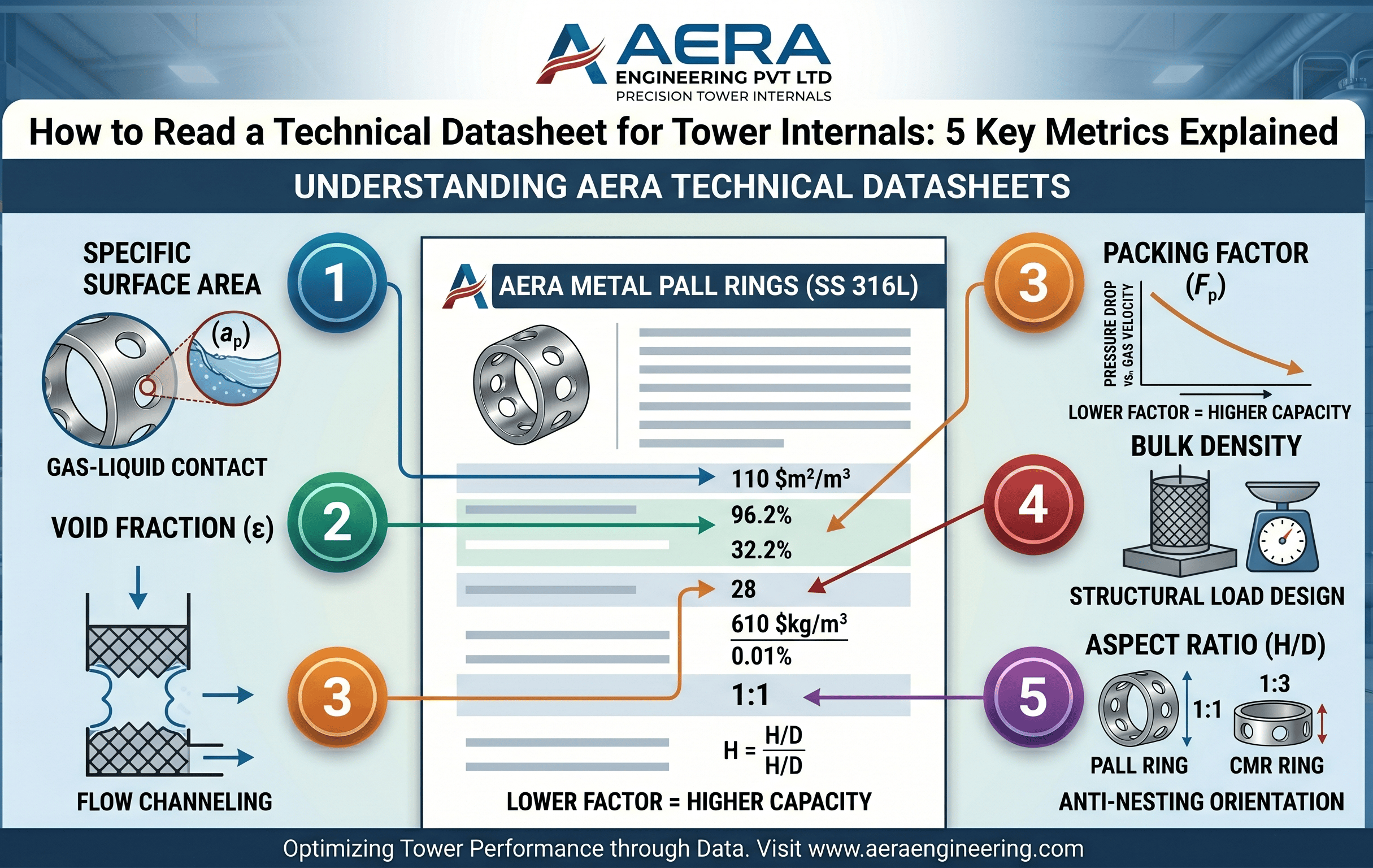
Technical datasheets can often feel like a wall of numbers, but for a process engineer, they are the blueprint for tower efficiency. At Aera Engineering Pvt Ltd, we believe that transparency in data leads to excellence in operation. Whether you are looking at a datasheet for Pall Rings, IMTP Saddles, or CMR Rings, here are the five critical metrics you must master to ensure your tower performs as designed. 1. Specific Surface Area Measured in $m^2/m^3$, this represents the total area available for gas-liquid contact within a cubic meter of packed volume. Why it matters: Higher surface area generally leads to higher mass transfer efficiency (lower HETP). Pro Tip: Don't just look for the highest number. Ensure the geometry allows the liquid to actually 'wet' that surface; otherwise, the area is 'dead' and provides no benefit. 2. Void Fraction Expressed as a percentage (usually 95% to 98% for high-performance metal packing), this is the percentage of the tower volume that remains open for gas and liquid flow. Why it matters: A high void fraction ensures a low pressure drop. If your void fraction is too low, your tower will 'flood' much earlier, severely limiting your throughput. 3. Packing Factor This is a dimensionless or empirical constant used in pressure drop correlations (like the Eckert generalized correlation). Why it matters: It characterizes the resistance to gas flow. The Rule of Thumb: The lower the Packing Factor, the higher the capacity of the column. IMTP Saddles typically boast lower packing factors compared to traditional rings of the same size. 4. Bulk Density Measured in $kg/m^3$, this tells you the weight of the packing per unit of volume. Why it matters: This is a critical metric for vessel structural design. Your tower's support grids and the vessel shell itself must be rated to handle the total weight of the packing when it is 'soaked' with liquid. Material Impact: A datasheet for Stainless Steel 316L will show a significantly higher bulk density than one for Polypropylene (PP) rings. 5. Aspect Ratio (Height to Diameter) Particularly important for CMR Rings (Cascade Mini Rings). Why it matters: Traditional Pall Rings have a 1:1 aspect ratio. CMR Rings have a lower aspect ratio (usually 1:3), which encourages the rings to lay flat. The Result: This orientation exposes the most efficient surface to the gas stream and reduces the 'nesting' effect that can cause channeling. Metric Comparison Table: Aera Internals Metric Pall Rings (Metal) IMTP Saddles CMR Rings Primary Advantage Versatility & Strength Ultra-Low Pressure Drop High Capacity/Anti-Fouling Typical Voidage ~95-96% ~97-98% ~96-97% Best For General Distillation Vacuum Distillation High Liquid Loading Conclusion: Data-Driven Decisions A datasheet is more than a technical formality; it’s a performance guarantee. At Aera Engineering Pvt Ltd, we provide comprehensive datasheets that include mechanical tolerances and material certificates, ensuring that what you see on paper is exactly what you get in your tower. Do you have a specific datasheet from a project that you'd like me to help interpret or compare against Aera's standards?


This is your website preview.
Currently it only shows your basic business info. Start adding relevant business details such as description, images and products or services to gain your customers attention by using Boost 360 android app / iOS App / web portal.
How to Read a Technical Datasheet for Tower Internals: 5 Key Metrics Explained
2026-04-23T13:00:01
Technical datasheets can often feel like a wall of numbers, but for a process engineer, they are the blueprint for tower efficiency. At Aera Engineering Pvt Ltd, we believe that transparency in data leads to excellence in operation. Whether you are looking at a datasheet for Pall Rings, IMTP Saddles, or CMR Rings, here are the five critical metrics you must master to ensure your tower performs as designed. 1. Specific Surface Area Measured in $m^2/m^3$, this represents the total area available for gas-liquid contact within a cubic meter of packed volume. Why it matters: Higher surface area generally leads to higher mass transfer efficiency (lower HETP). Pro Tip: Don't just look for the highest number. Ensure the geometry allows the liquid to actually 'wet' that surface; otherwise, the area is 'dead' and provides no benefit. 2. Void Fraction Expressed as a percentage (usually 95% to 98% for high-performance metal packing), this is the percentage of the tower volume that remains open for gas and liquid flow. Why it matters: A high void fraction ensures a low pressure drop. If your void fraction is too low, your tower will 'flood' much earlier, severely limiting your throughput. 3. Packing Factor This is a dimensionless or empirical constant used in pressure drop correlations (like the Eckert generalized correlation). Why it matters: It characterizes the resistance to gas flow. The Rule of Thumb: The lower the Packing Factor, the higher the capacity of the column. IMTP Saddles typically boast lower packing factors compared to traditional rings of the same size. 4. Bulk Density Measured in $kg/m^3$, this tells you the weight of the packing per unit of volume. Why it matters: This is a critical metric for vessel structural design. Your tower's support grids and the vessel shell itself must be rated to handle the total weight of the packing when it is 'soaked' with liquid. Material Impact: A datasheet for Stainless Steel 316L will show a significantly higher bulk density than one for Polypropylene (PP) rings. 5. Aspect Ratio (Height to Diameter) Particularly important for CMR Rings (Cascade Mini Rings). Why it matters: Traditional Pall Rings have a 1:1 aspect ratio. CMR Rings have a lower aspect ratio (usually 1:3), which encourages the rings to lay flat. The Result: This orientation exposes the most efficient surface to the gas stream and reduces the 'nesting' effect that can cause channeling. Metric Comparison Table: Aera Internals Metric Pall Rings (Metal) IMTP Saddles CMR Rings Primary Advantage Versatility & Strength Ultra-Low Pressure Drop High Capacity/Anti-Fouling Typical Voidage ~95-96% ~97-98% ~96-97% Best For General Distillation Vacuum Distillation High Liquid Loading Conclusion: Data-Driven Decisions A datasheet is more than a technical formality; it’s a performance guarantee. At Aera Engineering Pvt Ltd, we provide comprehensive datasheets that include mechanical tolerances and material certificates, ensuring that what you see on paper is exactly what you get in your tower. Do you have a specific datasheet from a project that you'd like me to help interpret or compare against Aera's standards?
2026-04-23T13:00:01


Submit Your Enquiry