
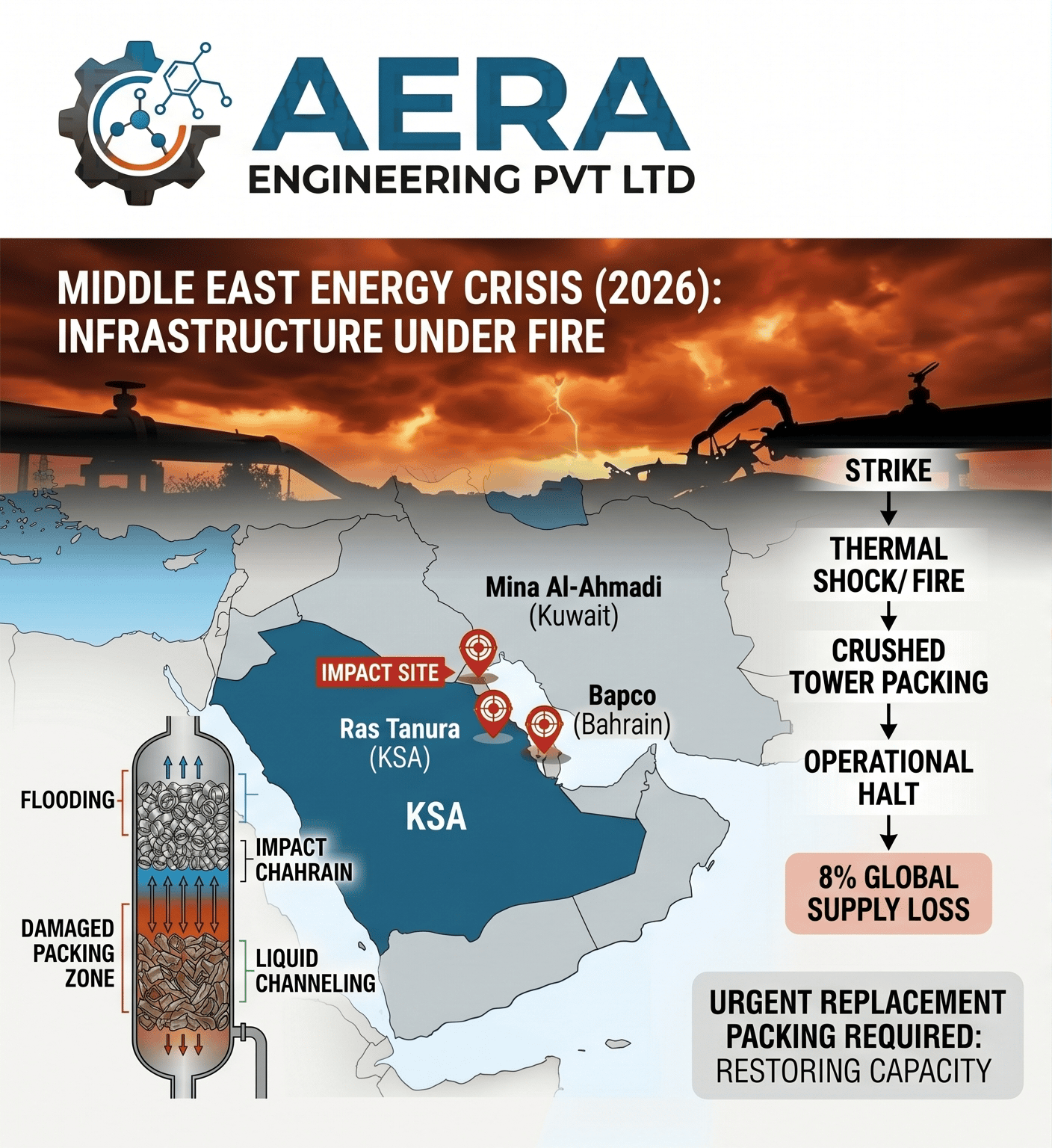
In the complex landscape of 2026, the global energy sector is facing an unprecedented challenge. Conflict in the Middle East has moved beyond geopolitical tension into a direct 'economic war' on energy infrastructure. For refineries and petrochemical plants across the Gulf, the damage is no longer theoretical—it is physical, structural, and urgent. At Aera Engineering Pvt Ltd, we are seeing a critical spike in demand for tower internals—specifically random packing and support grids—as the region races to repair damaged distillation units and secure the global energy supply. The Current Crisis: Infrastructure Under Fire Recent reports from the first half of 2026 highlight a staggering reality: over 40 major energy assets across nine countries have been severely impacted by missile and drone strikes. Key refining hubs like Ras Tanura (Saudi Arabia), Mina Al-Ahmadi (Kuwait), and the Bapco Sitra Refinery (Bahrain) have faced operational halts due to direct hits on their distillation columns. When a missile or drone strike impacts a refinery, the damage to a distillation tower is twofold: Thermal Shock and Fire: High temperatures warp the precision-engineered internals, rendering the packing useless for mass transfer. Pressure Surges: Explosive forces can crush ceramic and thin-gauge metal packing into a solid mass, creating catastrophic blockages. Why Tower Internals are the 'Critical Path' to Recovery The International Energy Agency (IEA) has noted that global oil markets have lost approximately 8% of pre-crisis supply. Restoring this capacity isn't just about patching holes in a vessel; it’s about the rapid re-engineering of the tower's interior. 1. The Bottleneck of Damaged Packing Damaged packing leads to 'flooding' and 'liquid channeling, ' where the column fails to separate crude into usable fuels. Replacing these internals is the fastest way to get a refinery back to 'on-spec' production. 2. High-Efficiency Upgrades for Energy Security In a war-torn energy market, efficiency is a strategic asset. By replacing damaged 20th-century internals with modern, high-efficiency Aera P-Rings or Saddle Rings, refineries can actually increase their throughput beyond original design capacities, helping to offset the loss of other offline facilities. 3. Supply Chain Resilience With the Strait of Hormuz facing periodic closures, the logistical challenge of moving heavy equipment is immense. Aera Engineering, based in Vadodara, serves as a vital secondary supply hub. Our ability to manufacture and export precision Metal and Plastic Random Packing via alternate routes (like the Red Sea or Fujairah) is helping fill the gap left by primary OEMs currently facing 2-to-4-year production backlogs. Recovery by the Numbers Metric Impact of Current Conflict (2026) Infrastructure Damage Over $25 Billion in estimated repair costs. Supply Loss ~20 million barrels per day disrupted at Hormuz. Recovery Timeline 3 to 5 years for full restoration of major LNG/Refinery trains. Urgent Need Replacement internals for immediate distillation restarts. Aera Engineering: Your Partner in Resilience At Aera Engineering Pvt Ltd, we understand that every day a column sits idle is a day the global economy feels the pinch of $114/barrel oil. We are committed to supporting the Middle East's energy recovery with: Rapid Manufacturing: Prioritizing emergency orders for war-damaged refineries. Durable Materials: Supplying internals in SS316L, Monel, and Titanium to withstand the harsh, high-utilization environments of current operations. Engineering Support: Providing the technical data needed to swap failed trays for high-performance random packing to accelerate restart times. Turning Conflict into Capacity The road to energy stability in 2026 is paved with precision engineering. As the Middle East begins the long process of rebuilding, Aera Engineering is ready to supply the internals that keep the world's most vital industry moving. Contact Aera Engineering Pvt Ltd today to discuss fast-track procurement for international projects and refinery revamps. Source Context: Based on reported energy infrastructure status as of April 2026.


This is your website preview.
Currently it only shows your basic business info. Start adding relevant business details such as description, images and products or services to gain your customers attention by using Boost 360 android app / iOS App / web portal.
How War Has Created Urgent Demand for Tower Internals in the Middle East
2026-04-16T18:32:04
In the complex landscape of 2026, the global energy sector is facing an unprecedented challenge. Conflict in the Middle East has moved beyond geopolitical tension into a direct 'economic war' on energy infrastructure. For refineries and petrochemical plants across the Gulf, the damage is no longer theoretical—it is physical, structural, and urgent. At Aera Engineering Pvt Ltd, we are seeing a critical spike in demand for tower internals—specifically random packing and support grids—as the region races to repair damaged distillation units and secure the global energy supply. The Current Crisis: Infrastructure Under Fire Recent reports from the first half of 2026 highlight a staggering reality: over 40 major energy assets across nine countries have been severely impacted by missile and drone strikes. Key refining hubs like Ras Tanura (Saudi Arabia), Mina Al-Ahmadi (Kuwait), and the Bapco Sitra Refinery (Bahrain) have faced operational halts due to direct hits on their distillation columns. When a missile or drone strike impacts a refinery, the damage to a distillation tower is twofold: Thermal Shock and Fire: High temperatures warp the precision-engineered internals, rendering the packing useless for mass transfer. Pressure Surges: Explosive forces can crush ceramic and thin-gauge metal packing into a solid mass, creating catastrophic blockages. Why Tower Internals are the 'Critical Path' to Recovery The International Energy Agency (IEA) has noted that global oil markets have lost approximately 8% of pre-crisis supply. Restoring this capacity isn't just about patching holes in a vessel; it’s about the rapid re-engineering of the tower's interior. 1. The Bottleneck of Damaged Packing Damaged packing leads to 'flooding' and 'liquid channeling, ' where the column fails to separate crude into usable fuels. Replacing these internals is the fastest way to get a refinery back to 'on-spec' production. 2. High-Efficiency Upgrades for Energy Security In a war-torn energy market, efficiency is a strategic asset. By replacing damaged 20th-century internals with modern, high-efficiency Aera P-Rings or Saddle Rings, refineries can actually increase their throughput beyond original design capacities, helping to offset the loss of other offline facilities. 3. Supply Chain Resilience With the Strait of Hormuz facing periodic closures, the logistical challenge of moving heavy equipment is immense. Aera Engineering, based in Vadodara, serves as a vital secondary supply hub. Our ability to manufacture and export precision Metal and Plastic Random Packing via alternate routes (like the Red Sea or Fujairah) is helping fill the gap left by primary OEMs currently facing 2-to-4-year production backlogs. Recovery by the Numbers Metric Impact of Current Conflict (2026) Infrastructure Damage Over $25 Billion in estimated repair costs. Supply Loss ~20 million barrels per day disrupted at Hormuz. Recovery Timeline 3 to 5 years for full restoration of major LNG/Refinery trains. Urgent Need Replacement internals for immediate distillation restarts. Aera Engineering: Your Partner in Resilience At Aera Engineering Pvt Ltd, we understand that every day a column sits idle is a day the global economy feels the pinch of $114/barrel oil. We are committed to supporting the Middle East's energy recovery with: Rapid Manufacturing: Prioritizing emergency orders for war-damaged refineries. Durable Materials: Supplying internals in SS316L, Monel, and Titanium to withstand the harsh, high-utilization environments of current operations. Engineering Support: Providing the technical data needed to swap failed trays for high-performance random packing to accelerate restart times. Turning Conflict into Capacity The road to energy stability in 2026 is paved with precision engineering. As the Middle East begins the long process of rebuilding, Aera Engineering is ready to supply the internals that keep the world's most vital industry moving. Contact Aera Engineering Pvt Ltd today to discuss fast-track procurement for international projects and refinery revamps. Source Context: Based on reported energy infrastructure status as of April 2026.
2026-04-16T18:32:04


Keywords
- Urgent Tower Packing Replacement for Ruwais Refinery UAE
- Emergency Column Internals Supply for Ras Tanura Saudi Arabia
- Refinery Tower Refurbishment Solutions Kuwait (Mina Al-Ahmadi)
- Corrosion Resistant Pall Rings for Bapco Energies Bahrain
- Satorp Refinery Maintenance Packing and Internals Procurement
- Mass Transfer Equipment for Ras Laffan LNG Repair Qatar
- Sami-Refinery Jeddah Tower Packing Upgrade and Repair
- Chemical Grade Random Packing for GPIC Bahrain Reconstruction
- Distillation Column Internals Suppliers for Yanbu Industrial Port
- Replacement SS316L Packing for Damaged Scrubbers in Basra Iraq
- tower internals for refineries in Middle East
- random packing and support grids supply
- emergency refinery restart components
- SS316L Monel Titanium internals
- rapid manufacturing for war damaged refineries
Submit Your Enquiry