
This blog is crafted to showcase Aera Engineering Pvt Ltd as a pioneer in mass transfer technology, helping global clients understand why upgrading from legacy components to modern designs is a strategic business move. In the early days of industrial distillation and absorption, the Raschig Ring was the gold standard. It was simple, revolutionary, and effective for its time. However, as global industrial demands for higher throughput and lower energy consumption have grown, the industry has evolved. At Aera Engineering Pvt Ltd, we often see facilities still utilizing legacy Raschig Ring designs. While they 'work, ' they may be costing your facility thousands in efficiency losses. Understanding the evolution from the Raschig Ring to the Pall Ring is essential for any plant manager looking to optimize performance. 1. The Raschig Ring: The Original Pioneer Invented by Friedrich Raschig, this design consists of a simple hollow cylinder with equal length and diameter. How it works: It provides a large surface area for liquid-gas contact within the tower. The Limitation: Because the cylinder is 'closed' (solid walls), the inner surface of the ring is poorly utilized. Gas and liquid often struggle to access the interior, leading to 'dead zones.' The Problem: Raschig Rings create a higher pressure drop. This means your fans and pumps have to work harder, consuming more energy to move gas through the tower. 2. The Pall Ring: The Evolution of Efficiency The Pall Ring, which Aera Engineering manufactures in various metals and plastics, was developed to solve the 'internal access' problem of the Raschig Ring. The Design Change: The Pall Ring takes the basic cylinder and adds 'windows' or tabs bent inward. The Result: These openings allow gas and liquid to flow freely through the center of the ring. This utilizes both the inner and outer surfaces for mass transfer. The Performance Boost: 50% Lower Pressure Drop: By opening the walls, resistance to flow is significantly reduced. Higher Capacity: You can push more gas and liquid through the same size tower. Better Distribution: The tabs act as drip points, ensuring a more uniform distribution of liquid and preventing 'channeling.' 3. Why the Evolution Matters for 2026 Operations For our export clients in the Middle East and beyond—especially those currently involved in emergency refinery repairs and capacity expansions—the choice between these two isn't just technical; it's financial. Energy Savings A 50% reduction in pressure drop directly translates to lower electricity bills for your blower and pump systems. Over a year of continuous operation, the Pall Ring pays for itself in energy savings alone. Smaller Tower Footprints Because Pall Rings are more efficient, new towers can be built smaller (shorter or narrower) while achieving the same results as a larger tower filled with Raschig Rings. This reduces initial capital expenditure (CAPEX) on steel and installation. Rapid Maintenance Turnarounds During the current wave of refinery reconstructions, upgrading from Raschig to Pall Rings allows plants to increase their output without needing to modify the physical shell of the tower. It is the ultimate 'plug-and-play' upgrade. The Aera Engineering Recommendation: While we still manufacture high-quality Aera Raschig Rings (particularly in Ceramic for high-acid environments where simplicity is key), we almost always recommend the Aera P-Ring (Pall Ring) for modern oil, gas, and chemical applications. Partner with the Experts in Vadodara At Aera Engineering Pvt Ltd, we don't just supply packing; we supply performance. Whether you are replacing damaged internals in an Iranian refinery or designing a new scrubber in India, our engineering team is here to help you calculate the exact ROI of your tower's evolution. Optimize your mass transfer today. Contact Aera Engineering for technical data sheets and export-ready quotes. Explore our Pall Ring Range | Vadodara, Gujarat, India


This is your website preview.
Currently it only shows your basic business info. Start adding relevant business details such as description, images and products or services to gain your customers attention by using Boost 360 android app / iOS App / web portal.
Pall Rings vs. Raschig Rings: Why the Evolution Matters for Your Tower
2026-04-24T10:00:01
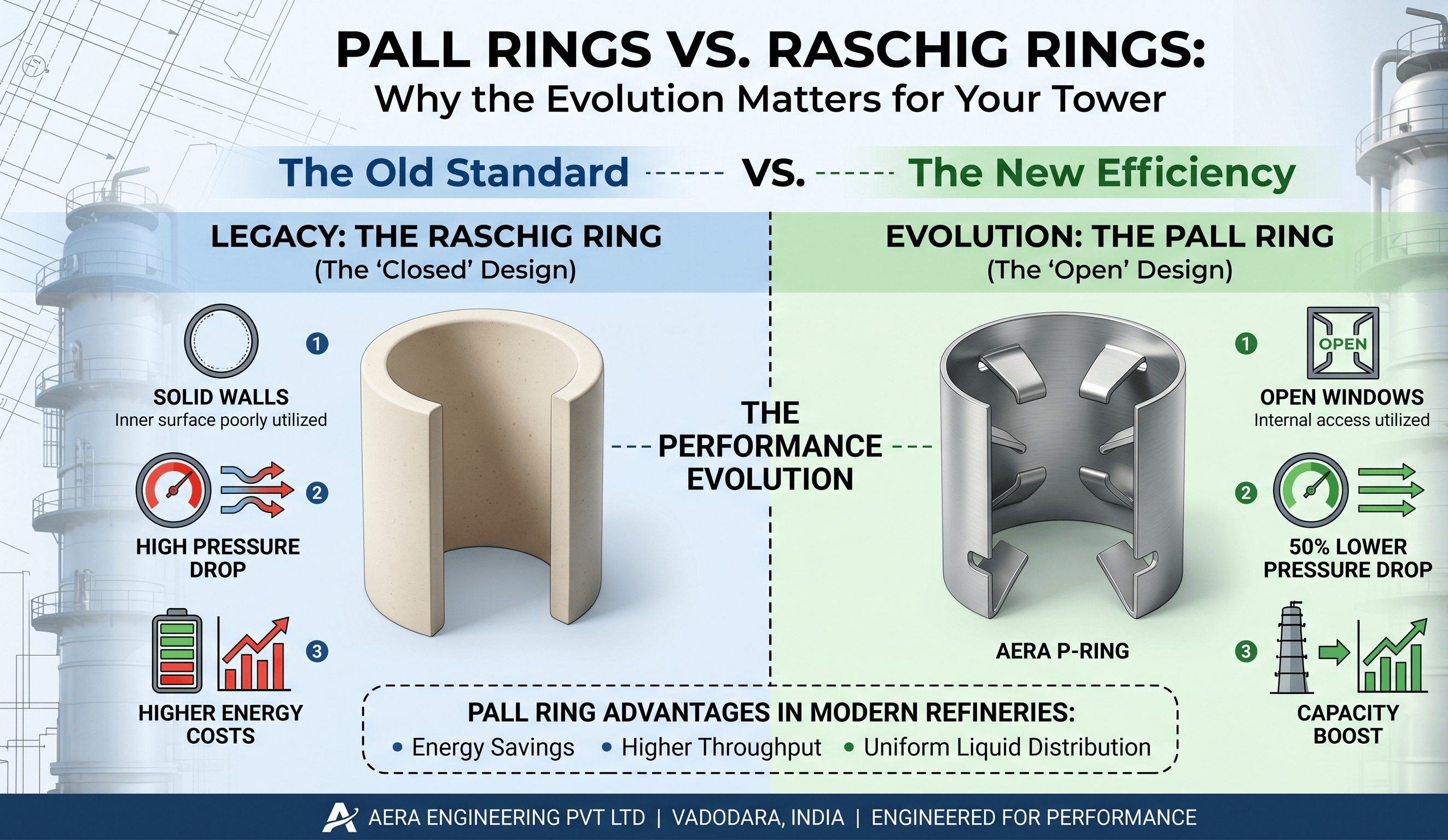
This blog is crafted to showcase Aera Engineering Pvt Ltd as a pioneer in mass transfer technology, helping global clients understand why upgrading from legacy components to modern designs is a strategic business move. In the early days of industrial distillation and absorption, the Raschig Ring was the gold standard. It was simple, revolutionary, and effective for its time. However, as global industrial demands for higher throughput and lower energy consumption have grown, the industry has evolved. At Aera Engineering Pvt Ltd, we often see facilities still utilizing legacy Raschig Ring designs. While they 'work, ' they may be costing your facility thousands in efficiency losses. Understanding the evolution from the Raschig Ring to the Pall Ring is essential for any plant manager looking to optimize performance. 1. The Raschig Ring: The Original Pioneer Invented by Friedrich Raschig, this design consists of a simple hollow cylinder with equal length and diameter. How it works: It provides a large surface area for liquid-gas contact within the tower. The Limitation: Because the cylinder is 'closed' (solid walls), the inner surface of the ring is poorly utilized. Gas and liquid often struggle to access the interior, leading to 'dead zones.' The Problem: Raschig Rings create a higher pressure drop. This means your fans and pumps have to work harder, consuming more energy to move gas through the tower. 2. The Pall Ring: The Evolution of Efficiency The Pall Ring, which Aera Engineering manufactures in various metals and plastics, was developed to solve the 'internal access' problem of the Raschig Ring. The Design Change: The Pall Ring takes the basic cylinder and adds 'windows' or tabs bent inward. The Result: These openings allow gas and liquid to flow freely through the center of the ring. This utilizes both the inner and outer surfaces for mass transfer. The Performance Boost: 50% Lower Pressure Drop: By opening the walls, resistance to flow is significantly reduced. Higher Capacity: You can push more gas and liquid through the same size tower. Better Distribution: The tabs act as drip points, ensuring a more uniform distribution of liquid and preventing 'channeling.' 3. Why the Evolution Matters for 2026 Operations For our export clients in the Middle East and beyond—especially those currently involved in emergency refinery repairs and capacity expansions—the choice between these two isn't just technical; it's financial. Energy Savings A 50% reduction in pressure drop directly translates to lower electricity bills for your blower and pump systems. Over a year of continuous operation, the Pall Ring pays for itself in energy savings alone. Smaller Tower Footprints Because Pall Rings are more efficient, new towers can be built smaller (shorter or narrower) while achieving the same results as a larger tower filled with Raschig Rings. This reduces initial capital expenditure (CAPEX) on steel and installation. Rapid Maintenance Turnarounds During the current wave of refinery reconstructions, upgrading from Raschig to Pall Rings allows plants to increase their output without needing to modify the physical shell of the tower. It is the ultimate 'plug-and-play' upgrade. The Aera Engineering Recommendation: While we still manufacture high-quality Aera Raschig Rings (particularly in Ceramic for high-acid environments where simplicity is key), we almost always recommend the Aera P-Ring (Pall Ring) for modern oil, gas, and chemical applications. Partner with the Experts in Vadodara At Aera Engineering Pvt Ltd, we don't just supply packing; we supply performance. Whether you are replacing damaged internals in an Iranian refinery or designing a new scrubber in India, our engineering team is here to help you calculate the exact ROI of your tower's evolution. Optimize your mass transfer today. Contact Aera Engineering for technical data sheets and export-ready quotes. Explore our Pall Ring Range | Vadodara, Gujarat, India
2026-04-24T10:00:01


Submit Your Enquiry