
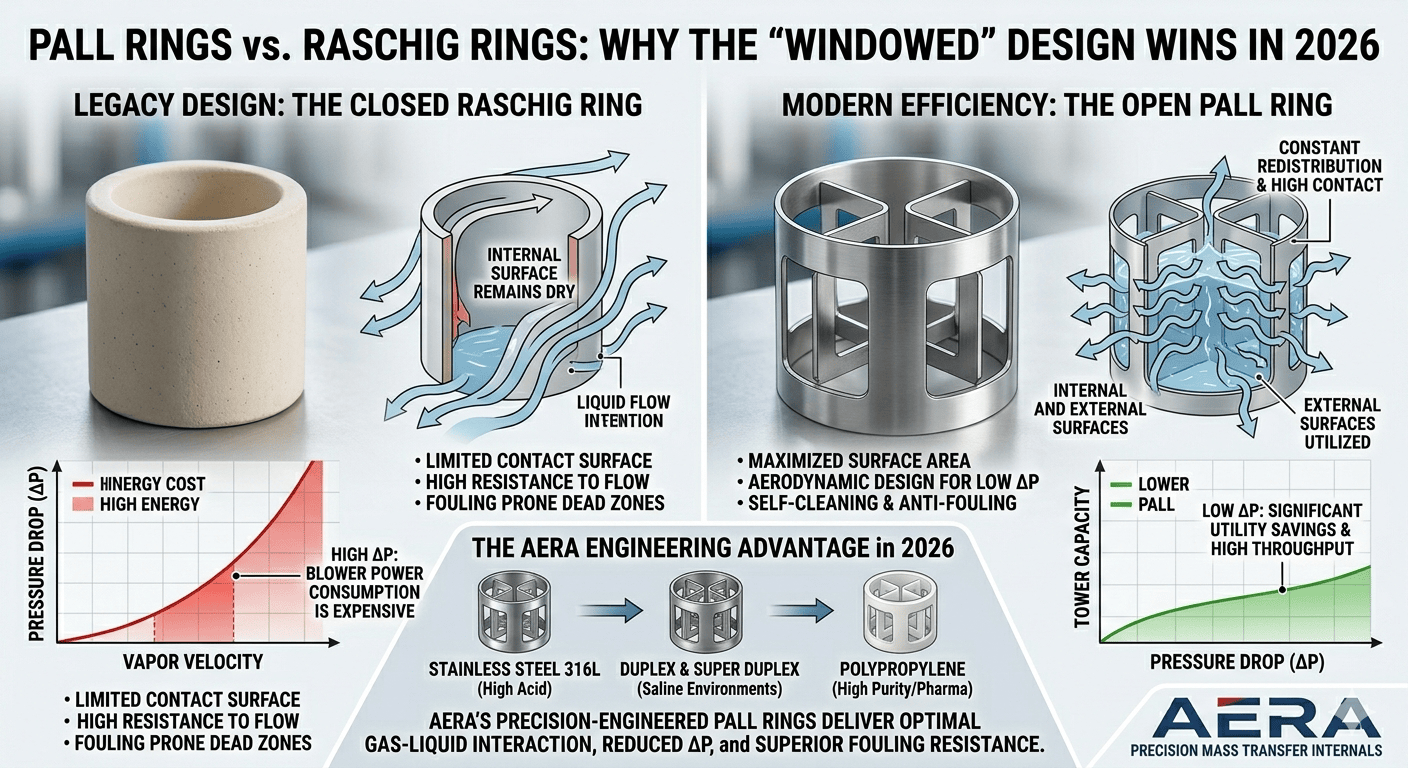
In the early days of industrial mass transfer, the Raschig Ring was a revolution. A simple, hollow cylinder that provided surface area for gas-liquid contact, it set the standard for distillation and absorption towers for decades. However, as we move through 2026, the demands on chemical processing and environmental compliance have intensified. At Aera Engineering Pvt Ltd, we’ve seen a decisive shift in the market. While Raschig rings are still found in legacy systems, the 'windowed' design of the Pall Ring has become the gold standard for modern efficiency. Here is why the Pall Ring consistently outperforms its predecessor in today’s industrial landscape. 1. The Geometry of Efficiency: Windows and Strips The fundamental flaw of the Raschig Ring is its closed wall. Liquid often flows only on the outside, while the inner surface remains 'dry' and underutilized. The Pall Ring solves this with its signature 'windowed' design. By punching tabs (internal strips) into the cylinder wall: Total Surface Utilization: Both the interior and exterior surfaces of the ring are active. Constant Redistribution: The internal strips act as tiny baffles, constantly breaking up liquid droplets and redistributing them, preventing the dreaded 'channeling' effect. 2. Drastic Reduction in Pressure Drop In 2026, energy costs are a primary concern for any plant manager. A tower packed with Raschig Rings creates significant resistance to upward vapor flow, requiring massive blower power. Because of its open-wall structure, a Pall Ring has a much higher void fraction. This allows gas and liquid to pass through the bed with significantly less resistance. The Result: A lower pressure drop ($Delta P$) across the column, which translates directly to lower utility bills and reduced wear on your pumps and fans. 3. Higher Capacity and Throughput For refineries and chemical plants looking to 'debottleneck' existing operations, Pall Rings are the easiest upgrade. Because they offer less resistance to flow, you can push a higher volume of gas and liquid through the same size tower without hitting the 'flooding' limit. At Aera Engineering, we’ve helped clients increase their tower capacity by up to 20–30% simply by swapping out old ceramic Raschig rings for precision-engineered metal Pall Rings. 4. Resistance to Fouling Closed-wall rings like the Raschig design are notorious for trapping solids and polymers in their 'dead zones.' Once fouling begins, the pressure drop spikes, and the tower must be shut down for cleaning. The open, aerodynamic windows of the Pall Ring create a 'self-cleaning' effect. The high-velocity vapor and liquid movement through the windows prevent the accumulation of debris, leading to longer run times and fewer maintenance turnarounds. 5. Material Versatility for Modern Standards While Raschig rings are often limited to ceramic or basic carbon steel, Aera Engineering manufactures Pall Rings in a wide array of high-performance materials suited for 2026's stringent requirements: Stainless Steel 316L/317: For high-acid environments. Duplex & Super Duplex: For offshore and high-salinity applications. Polypropylene & PFA: For high-purity pharmaceutical solvent recovery. The Aera Conclusion While the Raschig Ring holds a place in history, the Pall Ring holds the key to future profitability. Its superior mass transfer efficiency, lower energy consumption, and resistance to fouling make it the clear winner for any modern chemical or environmental application. At Aera Engineering Pvt Ltd, we specialize in the precision manufacturing of mass transfer internals. We don't just provide the rings; we provide the engineering expertise to ensure your tower operates at its theoretical maximum. Is your tower still running on 20th-century technology? Contact Aera Engineering today for a performance simulation and see how a switch to our Pall Rings can optimize your process.


This is your website preview.
Currently it only shows your basic business info. Start adding relevant business details such as description, images and products or services to gain your customers attention by using Boost 360 android app / iOS App / web portal.
Pall Rings vs. Raschig Rings: Why the "Windowed" Design Wins in 2026
2026-04-22T09:09:22
In the early days of industrial mass transfer, the Raschig Ring was a revolution. A simple, hollow cylinder that provided surface area for gas-liquid contact, it set the standard for distillation and absorption towers for decades. However, as we move through 2026, the demands on chemical processing and environmental compliance have intensified. At Aera Engineering Pvt Ltd, we’ve seen a decisive shift in the market. While Raschig rings are still found in legacy systems, the 'windowed' design of the Pall Ring has become the gold standard for modern efficiency. Here is why the Pall Ring consistently outperforms its predecessor in today’s industrial landscape. 1. The Geometry of Efficiency: Windows and Strips The fundamental flaw of the Raschig Ring is its closed wall. Liquid often flows only on the outside, while the inner surface remains 'dry' and underutilized. The Pall Ring solves this with its signature 'windowed' design. By punching tabs (internal strips) into the cylinder wall: Total Surface Utilization: Both the interior and exterior surfaces of the ring are active. Constant Redistribution: The internal strips act as tiny baffles, constantly breaking up liquid droplets and redistributing them, preventing the dreaded 'channeling' effect. 2. Drastic Reduction in Pressure Drop In 2026, energy costs are a primary concern for any plant manager. A tower packed with Raschig Rings creates significant resistance to upward vapor flow, requiring massive blower power. Because of its open-wall structure, a Pall Ring has a much higher void fraction. This allows gas and liquid to pass through the bed with significantly less resistance. The Result: A lower pressure drop ($Delta P$) across the column, which translates directly to lower utility bills and reduced wear on your pumps and fans. 3. Higher Capacity and Throughput For refineries and chemical plants looking to 'debottleneck' existing operations, Pall Rings are the easiest upgrade. Because they offer less resistance to flow, you can push a higher volume of gas and liquid through the same size tower without hitting the 'flooding' limit. At Aera Engineering, we’ve helped clients increase their tower capacity by up to 20–30% simply by swapping out old ceramic Raschig rings for precision-engineered metal Pall Rings. 4. Resistance to Fouling Closed-wall rings like the Raschig design are notorious for trapping solids and polymers in their 'dead zones.' Once fouling begins, the pressure drop spikes, and the tower must be shut down for cleaning. The open, aerodynamic windows of the Pall Ring create a 'self-cleaning' effect. The high-velocity vapor and liquid movement through the windows prevent the accumulation of debris, leading to longer run times and fewer maintenance turnarounds. 5. Material Versatility for Modern Standards While Raschig rings are often limited to ceramic or basic carbon steel, Aera Engineering manufactures Pall Rings in a wide array of high-performance materials suited for 2026's stringent requirements: Stainless Steel 316L/317: For high-acid environments. Duplex & Super Duplex: For offshore and high-salinity applications. Polypropylene & PFA: For high-purity pharmaceutical solvent recovery. The Aera Conclusion While the Raschig Ring holds a place in history, the Pall Ring holds the key to future profitability. Its superior mass transfer efficiency, lower energy consumption, and resistance to fouling make it the clear winner for any modern chemical or environmental application. At Aera Engineering Pvt Ltd, we specialize in the precision manufacturing of mass transfer internals. We don't just provide the rings; we provide the engineering expertise to ensure your tower operates at its theoretical maximum. Is your tower still running on 20th-century technology? Contact Aera Engineering today for a performance simulation and see how a switch to our Pall Rings can optimize your process.
2026-04-22T09:09:22


Keywords
- Low pressure drop IMTP saddle specifications
- Aera Engineering tower packing solutions
- Top rated IMTP saddles in India
- Custom CMR ring design services
- Plastic Pall Ring 50mm price India
- Industrial tower internals price list
- Metal CMR rings for distillation columns India
- Bulk IMTP saddle tower packing for sale
- Stainless Steel Pall Ring price per piece
- Mass transfer equipment manufacturers in Mumbai
- Random packing suppliers in Vadodara
- Random packing suppliers in Pune
- CMR rings price in India
- Tower packing manufacturers near me
- IMTP saddle suppliers in Gujarat
- Pall rings manufacturer in Vadodara
- Random Packing Surface Area Comparison
- Metal vs Plastic Pall Ring Application
- CMR Rings Equivalent for Chemical Processing
- IMTP vs Pall Rings Performance
- Acid Gas Scrubbing Packing Solutions
- High Void Fraction Packing Materials
- Liquid Distribution in Packed Columns
- Mass Transfer Efficiency Optimization
- Low Pressure Drop Tower Packing
- Metal Saddle Packing Manufacturers
- Random Tower Packing Manufacturers
- CMR Rings for Distillation Columns
- High-Performance IMTP Saddles
- Stainless Steel Pall Rings
- Pall Ring windowed design efficiency
- Raschig Ring legacy systems replacement
- mass transfer tower packing Pall Rings
- Aera Engineering Pall Ring materials 316L
- gas-liquid contact high surface utilization
Submit Your Enquiry