
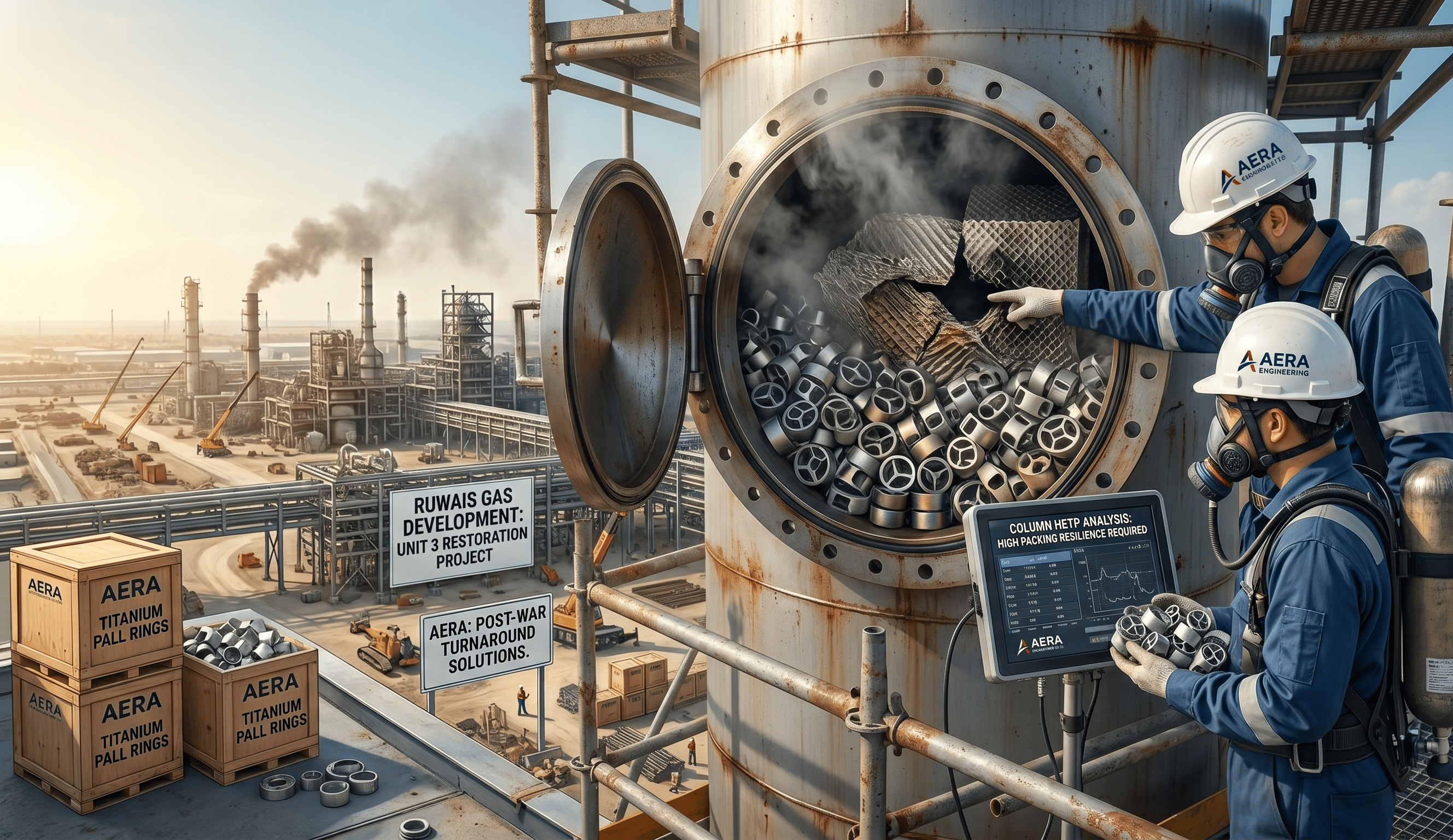
In the wake of the recent regional escalations in 2026, the global energy market is holding its breath as Gulf refineries begin the grueling process of restarting. From the drone-damaged units at Ruwais to the mothballed columns in Bapco, the path back to full capacity is fraught with technical hurdles. At Aera Engineering Pvt Ltd, we’ve seen that the success of a post-war restart doesn't just depend on fixing the pipes; it depends on the internal resilience of the mass transfer towers. Here is why your choice of packing material is now a strategic security decision. 1. Resilience Against 'Dirty' Feedstocks Post-conflict recovery rarely involves steady, high-grade crude. Damaged upstream infrastructure often results in feedstocks contaminated with particulates, scale, and unpredictable chemical variances. The Risk: Standard structured packing, with its narrow and precise channels, is highly prone to fouling and plugging when faced with unstable feeds. The Aera Solution: We recommend a shift toward robust Random Tower Packing. High-performance options like Aera SS 316L Pall Rings or Ceramic Raschig Rings provide a 'dumped' structure that is inherently more forgiving, ensuring your columns stay online even when the feed quality fluctuates. 2. Speed: The Ultimate Currency of Reconstruction Every day a refinery stays offline in the current 2026 market, millions in revenue are lost, and local energy prices spike. Ease of Installation: Structured packing requires weeks of meticulous, specialized labor to install—experts who may not be immediately available in a post-conflict zone. Rapid Turnaround: Random packing can be installed in a fraction of the time. At Aera, we specialize in rapid-response manufacturing of Metallic and Plastic P-Rings, allowing for 'dump-and-go' commissioning that can shave weeks off your restart timeline. 3. Dealing with Thermal and Mechanical Stress Refinery restarts after a prolonged shutdown (or after exposure to the high temperatures of a fire or strike) subject towers to extreme thermal expansion and contraction. Technical Insight: The performance of a column is defined by the Height Equivalent to a Theoretical Plate (HETP). Using damaged or inferior packing increases HETP, meaning your tower must work harder (and consume more energy) to achieve the same product purity. Aera’s Titanium and Duplex Pall Rings are engineered for these exact scenarios, offering superior mechanical strength-to-weight ratios that prevent 'crushing' under the weight of the bed during rapid thermal cycling. 4. Material Selection for Corrosive Environments The 2026 conflict has highlighted the vulnerability of stainless steel in high-corrosion environments where maintenance has been deferred. Material Best For Post-War Restarts Aera Product Hastelloy / Duplex Sour gas removal and high-chloride crudes. Hastelloy C276 Pall Rings Ceramic High-temperature acid absorption and heat recovery. Ceramic Raschig Rings PVDF / PTFE Corrosive scrubbing with weight limitations. Plastic P-Rings Aera Engineering: Engineering the Revival At Aera Engineering Pvt Ltd, based in the engineering heart of Vadodara, we don’t just supply parts; we supply Detailed Engineering support. As Gulf refineries look to stabilize their operations, we provide the simulation data and high-performance internals—from SS 316L CMR Mini Rings to specialized Saddle Packing—that turn a fragile restart into a resilient operation. The 2026 restart is a test of industrial endurance. Ensure your facility is equipped with the internals to pass it. Need an urgent assessment for your column internals? Visit www.randomtowerpacking.com or contact our technical team today to secure your turnaround materials.


This is your website preview.
Currently it only shows your basic business info. Start adding relevant business details such as description, images and products or services to gain your customers attention by using Boost 360 android app / iOS App / web portal.
Post-War Refinery Restart: Why Packing Materials Matter More Than Ever
2026-04-15T14:30:00
In the wake of the recent regional escalations in 2026, the global energy market is holding its breath as Gulf refineries begin the grueling process of restarting. From the drone-damaged units at Ruwais to the mothballed columns in Bapco, the path back to full capacity is fraught with technical hurdles. At Aera Engineering Pvt Ltd, we’ve seen that the success of a post-war restart doesn't just depend on fixing the pipes; it depends on the internal resilience of the mass transfer towers. Here is why your choice of packing material is now a strategic security decision. 1. Resilience Against 'Dirty' Feedstocks Post-conflict recovery rarely involves steady, high-grade crude. Damaged upstream infrastructure often results in feedstocks contaminated with particulates, scale, and unpredictable chemical variances. The Risk: Standard structured packing, with its narrow and precise channels, is highly prone to fouling and plugging when faced with unstable feeds. The Aera Solution: We recommend a shift toward robust Random Tower Packing. High-performance options like Aera SS 316L Pall Rings or Ceramic Raschig Rings provide a 'dumped' structure that is inherently more forgiving, ensuring your columns stay online even when the feed quality fluctuates. 2. Speed: The Ultimate Currency of Reconstruction Every day a refinery stays offline in the current 2026 market, millions in revenue are lost, and local energy prices spike. Ease of Installation: Structured packing requires weeks of meticulous, specialized labor to install—experts who may not be immediately available in a post-conflict zone. Rapid Turnaround: Random packing can be installed in a fraction of the time. At Aera, we specialize in rapid-response manufacturing of Metallic and Plastic P-Rings, allowing for 'dump-and-go' commissioning that can shave weeks off your restart timeline. 3. Dealing with Thermal and Mechanical Stress Refinery restarts after a prolonged shutdown (or after exposure to the high temperatures of a fire or strike) subject towers to extreme thermal expansion and contraction. Technical Insight: The performance of a column is defined by the Height Equivalent to a Theoretical Plate (HETP). Using damaged or inferior packing increases HETP, meaning your tower must work harder (and consume more energy) to achieve the same product purity. Aera’s Titanium and Duplex Pall Rings are engineered for these exact scenarios, offering superior mechanical strength-to-weight ratios that prevent 'crushing' under the weight of the bed during rapid thermal cycling. 4. Material Selection for Corrosive Environments The 2026 conflict has highlighted the vulnerability of stainless steel in high-corrosion environments where maintenance has been deferred. Material Best For Post-War Restarts Aera Product Hastelloy / Duplex Sour gas removal and high-chloride crudes. Hastelloy C276 Pall Rings Ceramic High-temperature acid absorption and heat recovery. Ceramic Raschig Rings PVDF / PTFE Corrosive scrubbing with weight limitations. Plastic P-Rings Aera Engineering: Engineering the Revival At Aera Engineering Pvt Ltd, based in the engineering heart of Vadodara, we don’t just supply parts; we supply Detailed Engineering support. As Gulf refineries look to stabilize their operations, we provide the simulation data and high-performance internals—from SS 316L CMR Mini Rings to specialized Saddle Packing—that turn a fragile restart into a resilient operation. The 2026 restart is a test of industrial endurance. Ensure your facility is equipped with the internals to pass it. Need an urgent assessment for your column internals? Visit www.randomtowerpacking.com or contact our technical team today to secure your turnaround materials.
2026-04-15T14:30:00


Keywords
- Carbon Steel Pall Rings for Gas Sweetening
- Acid-Resistant Ceramic Tower Packing
- High-Efficiency Random Packing for Distillation
- Random Tower Packing Manufacturers in Middle East
- Stainless Steel Cascade Mini Rings
- Plastic Intalox Saddles Dubai
- Ceramic Raschig Rings Saudi Arabia
- Metal Pall Rings UAE
- Oil and Gas Mass Transfer Equipment MEA
- Refinery Tower Internals Supplier
- Gas Dehydration Column Packing
- CO2 Scrubbing Tower Packing Solutions
- Desalination Plant Mass Transfer Products
- Petrochemical Separation Column Internals
- Ammonia Plant Tower Packing
- Low Pressure Drop Random Packing
- High Surface Area Tower Packing
- Mass Transfer Efficiency Optimization
- Column Packing Replacement Services
- Fouling Resistant Random Packing
- Tower Internals Suppliers in GCC
- Industrial Mass Transfer Solutions Qatar
- Chemical Processing Equipment Oman
- Random Packing for Scrubbers Kuwait
- Mass Transfer Technology Sharjah Free Zone
- random tower packing for refineries
- post-war refinery restart materials
- Pall Rings for corrosion resistance
- Sour gas removal packing materials
- rapid-response refinery packing solutions
Submit Your Enquiry