
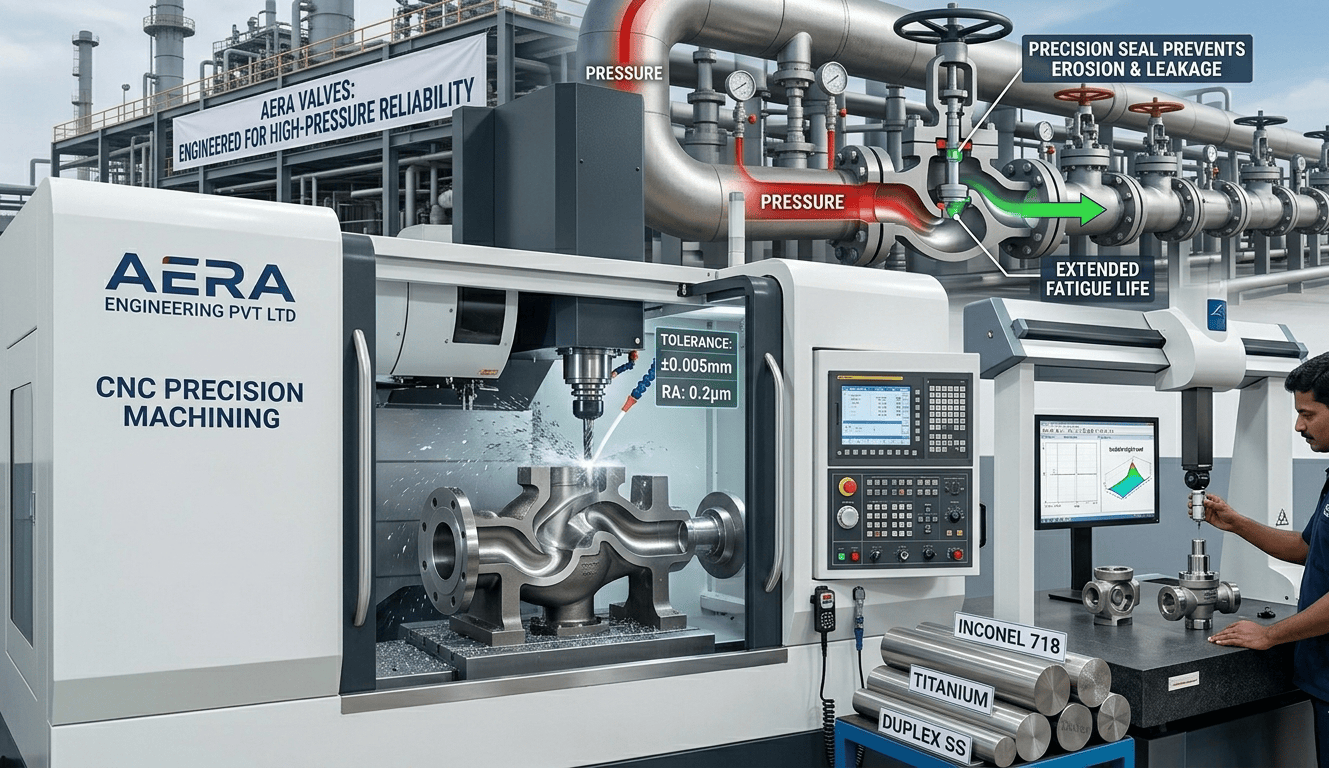
In the world of fluid dynamics and industrial processing, high-pressure valves are the gatekeepers of safety and efficiency. Whether they are controlling the flow of steam in a power plant or volatile chemicals in a refinery, these components operate in environments where there is zero room for error. For Aera Engineering Pvt Ltd, achieving 'Precision in Every Press' extends into our machining department. Here is why Computer Numerical Control (CNC) machining is the only viable method for producing high-pressure valve components. 1. Achieving Sub-Micron Tolerances High-pressure valves rely on metal-to-metal seals or extremely tight-fitting polymer inserts. If a valve stem or seat is off by even a few microns, the pressure will find that gap. The Risk: A minor deviation leads to 'weeping' or 'seepage, ' which eventually causes wire drawing—where high-velocity fluid erodes the metal, leading to catastrophic valve failure. The CNC Solution: CNC machines provide repeatable accuracy down to ±0.005mm. This ensures that the sealing surfaces are perfectly concentric and flat, maintaining a bubble-tight seal even under extreme loads. 2. Managing Exotic and Hardened Materials High-pressure environments often require materials like Inconel, Monel, Duplex Stainless Steel, or Titanium. These alloys are chosen for their strength and corrosion resistance, but they are notoriously difficult to machine. Traditional manual machining struggles with these materials because they 'work-harden' quickly. CNC machining allows for: Constant Surface Speeds: Ensuring the tool cuts through the material before it has a chance to harden. High-Pressure Coolant Systems: Directing lubricant exactly at the cutting edge to manage the immense heat generated when carving tough alloys. 3. Complexity of Internal Geometries Modern high-pressure valves, such as globe valves or multi-port manifolds, often feature complex internal galleries and contoured flow paths designed to reduce turbulence. Using 5-axis CNC machining, Aera Engineering can produce these complex internal shapes in a single setup. This eliminates the 'stack-up error' that occurs when a part is moved from one machine to another, ensuring that the internal flow path aligns perfectly with the external connections. 4. Surface Finish and Fatigue Life At high pressures, the surface finish of a component is directly linked to its lifespan. Microscopic scratches or 'chatter marks' from poor machining act as stress concentrators. Over time, the constant cycling of pressure causes these micro-cracks to expand, leading to fatigue failure. CNC machining delivers a superior, mirror-like surface finish ($Ra$ values) that: Reduces friction on moving parts (like stems and plungers). Eliminates potential points of crack initiation. Extends the Mean Time Between Failures (MTBF) for the end-user. The Aera Standard: Quality You Can Pressurize At Aera Engineering Pvt Ltd, we treat every valve component as a critical safety device. Our CNC machining process is integrated with rigorous inspection protocols, including CMM (Coordinate Measuring Machine) verification and pressure testing. When the pressure is on, your hardware shouldn't be a question mark. By leveraging advanced CNC technology, we ensure that every valve component leaving our facility is a masterpiece of precision engineering. Do your high-pressure systems demand higher reliability? Contact Aera Engineering today to discuss your custom CNC machining requirements and experience the difference that true precision makes.


This is your website preview.
Currently it only shows your basic business info. Start adding relevant business details such as description, images and products or services to gain your customers attention by using Boost 360 android app / iOS App / web portal.
Precision Under Pressure: Why CNC Machining is Critical for High-Pressure Valve Components
2026-04-21T12:30:02
In the world of fluid dynamics and industrial processing, high-pressure valves are the gatekeepers of safety and efficiency. Whether they are controlling the flow of steam in a power plant or volatile chemicals in a refinery, these components operate in environments where there is zero room for error. For Aera Engineering Pvt Ltd, achieving 'Precision in Every Press' extends into our machining department. Here is why Computer Numerical Control (CNC) machining is the only viable method for producing high-pressure valve components. 1. Achieving Sub-Micron Tolerances High-pressure valves rely on metal-to-metal seals or extremely tight-fitting polymer inserts. If a valve stem or seat is off by even a few microns, the pressure will find that gap. The Risk: A minor deviation leads to 'weeping' or 'seepage, ' which eventually causes wire drawing—where high-velocity fluid erodes the metal, leading to catastrophic valve failure. The CNC Solution: CNC machines provide repeatable accuracy down to ±0.005mm. This ensures that the sealing surfaces are perfectly concentric and flat, maintaining a bubble-tight seal even under extreme loads. 2. Managing Exotic and Hardened Materials High-pressure environments often require materials like Inconel, Monel, Duplex Stainless Steel, or Titanium. These alloys are chosen for their strength and corrosion resistance, but they are notoriously difficult to machine. Traditional manual machining struggles with these materials because they 'work-harden' quickly. CNC machining allows for: Constant Surface Speeds: Ensuring the tool cuts through the material before it has a chance to harden. High-Pressure Coolant Systems: Directing lubricant exactly at the cutting edge to manage the immense heat generated when carving tough alloys. 3. Complexity of Internal Geometries Modern high-pressure valves, such as globe valves or multi-port manifolds, often feature complex internal galleries and contoured flow paths designed to reduce turbulence. Using 5-axis CNC machining, Aera Engineering can produce these complex internal shapes in a single setup. This eliminates the 'stack-up error' that occurs when a part is moved from one machine to another, ensuring that the internal flow path aligns perfectly with the external connections. 4. Surface Finish and Fatigue Life At high pressures, the surface finish of a component is directly linked to its lifespan. Microscopic scratches or 'chatter marks' from poor machining act as stress concentrators. Over time, the constant cycling of pressure causes these micro-cracks to expand, leading to fatigue failure. CNC machining delivers a superior, mirror-like surface finish ($Ra$ values) that: Reduces friction on moving parts (like stems and plungers). Eliminates potential points of crack initiation. Extends the Mean Time Between Failures (MTBF) for the end-user. The Aera Standard: Quality You Can Pressurize At Aera Engineering Pvt Ltd, we treat every valve component as a critical safety device. Our CNC machining process is integrated with rigorous inspection protocols, including CMM (Coordinate Measuring Machine) verification and pressure testing. When the pressure is on, your hardware shouldn't be a question mark. By leveraging advanced CNC technology, we ensure that every valve component leaving our facility is a masterpiece of precision engineering. Do your high-pressure systems demand higher reliability? Contact Aera Engineering today to discuss your custom CNC machining requirements and experience the difference that true precision makes.
2026-04-21T12:30:02


Submit Your Enquiry