
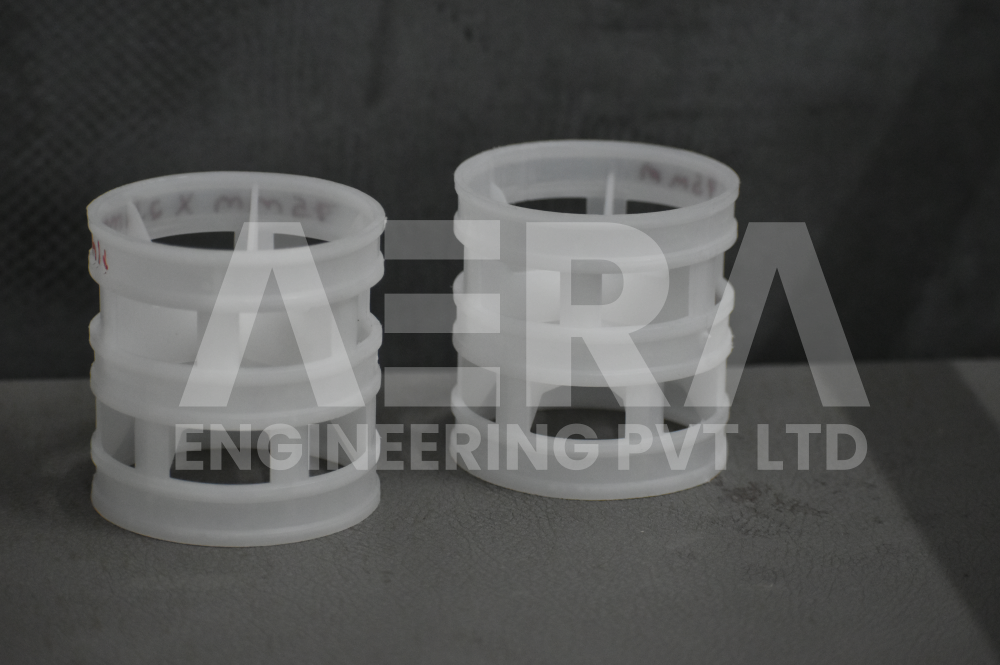
Navigating Polymer Mass Transfer: PVDF vs. PP Pall Rings for Indian Industries In the continuous operations of chemical processing units, industrial gas scrubbers, water treatment facilities, and pharmaceutical lines, process engineers frequently hit a defining material crossroads. When a column operates under low-to-medium temperature thresholds, heavy and expensive metals are often unnecessary. For these systems, engineered plastics provide the ultimate combination of structural economy, lightweight handling, and chemical inertness. Within the polymer random packing family, the Pall Ring stands out as a highly efficient structural geometry. Featuring open wall windows and internal projecting structural struts, the Pall Ring configuration allows gas and liquid streams to move continuously through both the inner and outer surfaces of the element. This open matrix eliminates internal dead zones, prevents liquid nesting or stagnant pools, and keeps operating pressure drops exceptionally low. However, selecting the right polymer to shape into this geometry determines whether your packed bed runs continuously for years or fails prematurely within weeks. The decision typically comes down to two major industrial materials: Polypropylene (PP) and Polyvinylidene Fluoride (PVDF). Operating from our advanced industrial hub in Vadodara, Gujarat—the heart of India’s chemical processing corridor—Aera Engineering Pvt. Ltd. fabricates top-tier mass transfer internals nationwide. This comprehensive guide breaks down the structural differences, operating boundaries, and long-term financial indicators between PP and PVDF Pall Rings to help your technical team choose the perfect match for your plant layout. Polypropylene (PP) Pall Rings: The Champion of Structural Economy For everyday chemical loops, municipal utilities, and environmental control systems, Polypropylene (PP) is the undisputed industry standard for cost-effective mass transfer. Molded from premium polymer chains, industrial-grade PP brings distinct operational advantages to a column bed. Key Performance Advantages of PP: • Excellent Base Chemical Resistance: PP remains completely inert and structurally stable when exposed to a massive spectrum of aggressive caustics, alkalis, inorganic salts, and most diluted mineral acids. • Lightweight Mechanical Performance: Possessing a remarkably low structural density, PP random packing elements exert minimal static downward weight on tower support grids. This allows engineering teams to design lighter, more cost-effective column shells and foundations. • Zero Moisture Absorption: Premium PP will not absorb water, swell, or warp over years of continuous exposure to heavy liquid hold-ups, ensuring that internal bed fluid dynamics remain completely predictable. • Outstanding Capital Optimization: PP offers an incredibly competitive cost-to-performance ratio, making it the preferred media for managing large-volume capital expenditures (CAPEX) in municipal and environmental facilities. For systems subjected to higher physical stresses, continuous hydraulic surges, or deep beds, we also supply Glass-Reinforced Polypropylene (RPP). This modification significantly boosts compressive crushing strength and prevents early bed compaction under heavy weight. Primary Sourcing Zones for PP: PP Pall Rings are highly sought after for large-volume municipal deaeration systems, VOC air stripping towers, wastewater treatment deaerators, and alkaline or caustic scrubbing units where operating temperatures remain strictly under 100°C. Polyvinylidene Fluoride (PVDF) Pall Rings: The Ultimate Frontier Shield While standard PP handles a vast array of everyday industrial utilities, it reaches a firm mechanical and chemical boundary when introduced to intense heat or highly volatile oxidizing streams. When process chemistry pushes past these limits, Polyvinylidene Fluoride (PVDF)—an elite fluoropolymer—becomes the necessary engineering benchmark. Key Performance Advantages of PVDF: • Elite Chemical Inertness: Belonging to the advanced fluoropolymer family, PVDF offers virtually absolute resistance to highly aggressive chemicals that would rapidly dissolve or degrade standard plastics. It remains completely inert against wet chlorine gas, bromine, strong oxidizers (such as ozone and concentrated nitric or sulfuric acids), hypochlorite solutions, and volatile organic compounds (VOCs). • Extended Thermal Thresholds: While standard Polypropylene softens and deforms as thermal loads rise, PVDF Pall Rings easily maintain their rigid geometric forms and mechanical crushing strength at continuous operating temperatures climbing all the way up to 140°C. • Inherent UV and Ozone Stability: PVDF does not suffer from polymer embrittlement, micro-cracking, or weathering when exposed to continuous ozone injection or intense outdoor solar UV rays, ensuring an exceptionally long, maintenance-free service life in exposed environmental scrubbers. • Ultra-Pure Performance (Zero Leaching): PVDF is an inherently pure polymer containing zero additives, lubricants, or thermal stabilizers. This ultra-low extraction profile ensures zero chemical leaching into the fluid stream, making it the definitive choice for high-purity applications where contamination is an unacceptable risk. Primary Sourcing Zones for PVDF: PVDF Pall Rings are the definitive choice for chlorine gas drying towers, advanced oxidation processes (AOPs), nuclear fuel reprocessing facilities, high-purity pharmaceutical separations, food-grade mass transfer, and semiconductor chemical loops. Financial Indicators: Upfront CAPEX vs. Total Cost of Ownership (TCO) When evaluating these materials, procurement managers frequently focus exclusively on the upfront cost per cubic meter. While Polypropylene delivers an incredibly low initial purchase price, analyzing the Total Cost of Ownership (TCO) is vital to long-term plant profitability. PVDF carries a premium price tag compared to standard PP, requiring specialized high-temperature automated injection molding infrastructure and premium virgin resins. However, an unoptimized material selection that saves money initially can quickly trigger an expensive column failure. If a chemical line experiences unexpected thermal surges or introduces aggressive oxidizers, standard PP packing can rapidly soften and deform. Once loaded into a column under thousands of kilograms of static downward weight, deformed elements compact tightly together. This behavior chokes the column’s vapor capacity, spikes operating pressure drops, and forces a premature, highly expensive plant shutdown. Investing in premium PVDF for aggressive chemical loops eliminates this risk, paying for itself by preventing catastrophic daily production losses. Precision Internal Integration & Quality Control A complete packed bed requires a comprehensive, holistic approach. To support your lightweight polymer random packing, your tower layout needs robust liquid distributors, support plates, and bed hold-down grids. Aera Engineering leverages high-speed hydraulic and pneumatic presses at our Vadodara facility to fabricate custom sheet metal pressed components and internals tailored precisely to your technical drawings, ensuring optimized weight-to-strength ratios across your entire column setup. Furthermore, operating as an ISO 9001:2015 certified organization, Aera Engineering enforces a strict quality tracking framework. Our plastic ranges are molded exclusively from premium certified virgin polymer resins to avoid the early thermal softening common in cheap recycled alternatives, and our automated injection molding machines precisely monitor thermal cycles to eliminate micro-warping or wall thinning. Summarizing Your Selection Framework To streamline your procurement pipeline for your next turnaround or grassroots project, our engineering desk maps out the direct selector rules for plastic packing: Choose Polypropylene (PP) Pall Rings when your column operating temperatures remain continuously under 100°C, the chemical stream consists of mild caustics, alkalis, or inorganic salts, and maximizing upfront capital economy across large bulk volumes is your primary objective. Upgrade to Polyvinylidene Fluoride (PVDF) Pall Rings when your process column operates at elevated thermal ranges up to 140°C, the fluid stream handles aggressive oxidizers, wet halogens, or strong mineral acids, or your process demands absolute material purity with zero chemical leaching into high-value pharmaceutical or semiconductor lines. Connect with Aera Engineering Today Don't let rigid component catalogs, unverified material tracking, or fragmented supply chains compromise your plant's capital efficiency and long-term asset integrity. Sourcing the perfect polymer tower packing requires balancing your fluid chemistry and temperature thresholds with factory-direct manufacturing economics. Connect with the technical sourcing desk at Aera Engineering Pvt. Ltd. today. Submit your column dimensions, share your volume requirements (in cubic meters or cubic feet) or structural drawings with our sales engineers, and receive a comprehensive, best-price factory-direct quotation tailored to maximize your mass transfer efficiency. Keywords Regarding This Guide • PVDF vs PP Pall Rings India • Aera Engineering Pvt Ltd Vadodara • Polypropylene Random Packing Sourcing • Plastic Pall Ring Manufacturer India • High-Capacity PVDF Tower Packing • Industrial Plastic Random Packing Suppliers • Sheet Metal Pressed Components Vadodara • Automated Injection Molding Vadodara • Chemical Tower Packing Sourcing India


This is your website preview.
Currently it only shows your basic business info. Start adding relevant business details such as description, images and products or services to gain your customers attention by using Boost 360 android app / iOS App / web portal.
PVDF vs PP Pall Rings – Best Choice in India
2026-06-15T11:01:37
Navigating Polymer Mass Transfer: PVDF vs. PP Pall Rings for Indian Industries In the continuous operations of chemical processing units, industrial gas scrubbers, water treatment facilities, and pharmaceutical lines, process engineers frequently hit a defining material crossroads. When a column operates under low-to-medium temperature thresholds, heavy and expensive metals are often unnecessary. For these systems, engineered plastics provide the ultimate combination of structural economy, lightweight handling, and chemical inertness. Within the polymer random packing family, the Pall Ring stands out as a highly efficient structural geometry. Featuring open wall windows and internal projecting structural struts, the Pall Ring configuration allows gas and liquid streams to move continuously through both the inner and outer surfaces of the element. This open matrix eliminates internal dead zones, prevents liquid nesting or stagnant pools, and keeps operating pressure drops exceptionally low. However, selecting the right polymer to shape into this geometry determines whether your packed bed runs continuously for years or fails prematurely within weeks. The decision typically comes down to two major industrial materials: Polypropylene (PP) and Polyvinylidene Fluoride (PVDF). Operating from our advanced industrial hub in Vadodara, Gujarat—the heart of India’s chemical processing corridor—Aera Engineering Pvt. Ltd. fabricates top-tier mass transfer internals nationwide. This comprehensive guide breaks down the structural differences, operating boundaries, and long-term financial indicators between PP and PVDF Pall Rings to help your technical team choose the perfect match for your plant layout. Polypropylene (PP) Pall Rings: The Champion of Structural Economy For everyday chemical loops, municipal utilities, and environmental control systems, Polypropylene (PP) is the undisputed industry standard for cost-effective mass transfer. Molded from premium polymer chains, industrial-grade PP brings distinct operational advantages to a column bed. Key Performance Advantages of PP: • Excellent Base Chemical Resistance: PP remains completely inert and structurally stable when exposed to a massive spectrum of aggressive caustics, alkalis, inorganic salts, and most diluted mineral acids. • Lightweight Mechanical Performance: Possessing a remarkably low structural density, PP random packing elements exert minimal static downward weight on tower support grids. This allows engineering teams to design lighter, more cost-effective column shells and foundations. • Zero Moisture Absorption: Premium PP will not absorb water, swell, or warp over years of continuous exposure to heavy liquid hold-ups, ensuring that internal bed fluid dynamics remain completely predictable. • Outstanding Capital Optimization: PP offers an incredibly competitive cost-to-performance ratio, making it the preferred media for managing large-volume capital expenditures (CAPEX) in municipal and environmental facilities. For systems subjected to higher physical stresses, continuous hydraulic surges, or deep beds, we also supply Glass-Reinforced Polypropylene (RPP). This modification significantly boosts compressive crushing strength and prevents early bed compaction under heavy weight. Primary Sourcing Zones for PP: PP Pall Rings are highly sought after for large-volume municipal deaeration systems, VOC air stripping towers, wastewater treatment deaerators, and alkaline or caustic scrubbing units where operating temperatures remain strictly under 100°C. Polyvinylidene Fluoride (PVDF) Pall Rings: The Ultimate Frontier Shield While standard PP handles a vast array of everyday industrial utilities, it reaches a firm mechanical and chemical boundary when introduced to intense heat or highly volatile oxidizing streams. When process chemistry pushes past these limits, Polyvinylidene Fluoride (PVDF)—an elite fluoropolymer—becomes the necessary engineering benchmark. Key Performance Advantages of PVDF: • Elite Chemical Inertness: Belonging to the advanced fluoropolymer family, PVDF offers virtually absolute resistance to highly aggressive chemicals that would rapidly dissolve or degrade standard plastics. It remains completely inert against wet chlorine gas, bromine, strong oxidizers (such as ozone and concentrated nitric or sulfuric acids), hypochlorite solutions, and volatile organic compounds (VOCs). • Extended Thermal Thresholds: While standard Polypropylene softens and deforms as thermal loads rise, PVDF Pall Rings easily maintain their rigid geometric forms and mechanical crushing strength at continuous operating temperatures climbing all the way up to 140°C. • Inherent UV and Ozone Stability: PVDF does not suffer from polymer embrittlement, micro-cracking, or weathering when exposed to continuous ozone injection or intense outdoor solar UV rays, ensuring an exceptionally long, maintenance-free service life in exposed environmental scrubbers. • Ultra-Pure Performance (Zero Leaching): PVDF is an inherently pure polymer containing zero additives, lubricants, or thermal stabilizers. This ultra-low extraction profile ensures zero chemical leaching into the fluid stream, making it the definitive choice for high-purity applications where contamination is an unacceptable risk. Primary Sourcing Zones for PVDF: PVDF Pall Rings are the definitive choice for chlorine gas drying towers, advanced oxidation processes (AOPs), nuclear fuel reprocessing facilities, high-purity pharmaceutical separations, food-grade mass transfer, and semiconductor chemical loops. Financial Indicators: Upfront CAPEX vs. Total Cost of Ownership (TCO) When evaluating these materials, procurement managers frequently focus exclusively on the upfront cost per cubic meter. While Polypropylene delivers an incredibly low initial purchase price, analyzing the Total Cost of Ownership (TCO) is vital to long-term plant profitability. PVDF carries a premium price tag compared to standard PP, requiring specialized high-temperature automated injection molding infrastructure and premium virgin resins. However, an unoptimized material selection that saves money initially can quickly trigger an expensive column failure. If a chemical line experiences unexpected thermal surges or introduces aggressive oxidizers, standard PP packing can rapidly soften and deform. Once loaded into a column under thousands of kilograms of static downward weight, deformed elements compact tightly together. This behavior chokes the column’s vapor capacity, spikes operating pressure drops, and forces a premature, highly expensive plant shutdown. Investing in premium PVDF for aggressive chemical loops eliminates this risk, paying for itself by preventing catastrophic daily production losses. Precision Internal Integration & Quality Control A complete packed bed requires a comprehensive, holistic approach. To support your lightweight polymer random packing, your tower layout needs robust liquid distributors, support plates, and bed hold-down grids. Aera Engineering leverages high-speed hydraulic and pneumatic presses at our Vadodara facility to fabricate custom sheet metal pressed components and internals tailored precisely to your technical drawings, ensuring optimized weight-to-strength ratios across your entire column setup. Furthermore, operating as an ISO 9001:2015 certified organization, Aera Engineering enforces a strict quality tracking framework. Our plastic ranges are molded exclusively from premium certified virgin polymer resins to avoid the early thermal softening common in cheap recycled alternatives, and our automated injection molding machines precisely monitor thermal cycles to eliminate micro-warping or wall thinning. Summarizing Your Selection Framework To streamline your procurement pipeline for your next turnaround or grassroots project, our engineering desk maps out the direct selector rules for plastic packing: Choose Polypropylene (PP) Pall Rings when your column operating temperatures remain continuously under 100°C, the chemical stream consists of mild caustics, alkalis, or inorganic salts, and maximizing upfront capital economy across large bulk volumes is your primary objective. Upgrade to Polyvinylidene Fluoride (PVDF) Pall Rings when your process column operates at elevated thermal ranges up to 140°C, the fluid stream handles aggressive oxidizers, wet halogens, or strong mineral acids, or your process demands absolute material purity with zero chemical leaching into high-value pharmaceutical or semiconductor lines. Connect with Aera Engineering Today Don't let rigid component catalogs, unverified material tracking, or fragmented supply chains compromise your plant's capital efficiency and long-term asset integrity. Sourcing the perfect polymer tower packing requires balancing your fluid chemistry and temperature thresholds with factory-direct manufacturing economics. Connect with the technical sourcing desk at Aera Engineering Pvt. Ltd. today. Submit your column dimensions, share your volume requirements (in cubic meters or cubic feet) or structural drawings with our sales engineers, and receive a comprehensive, best-price factory-direct quotation tailored to maximize your mass transfer efficiency. Keywords Regarding This Guide • PVDF vs PP Pall Rings India • Aera Engineering Pvt Ltd Vadodara • Polypropylene Random Packing Sourcing • Plastic Pall Ring Manufacturer India • High-Capacity PVDF Tower Packing • Industrial Plastic Random Packing Suppliers • Sheet Metal Pressed Components Vadodara • Automated Injection Molding Vadodara • Chemical Tower Packing Sourcing India
2026-06-15T11:01:37


Submit Your Enquiry