
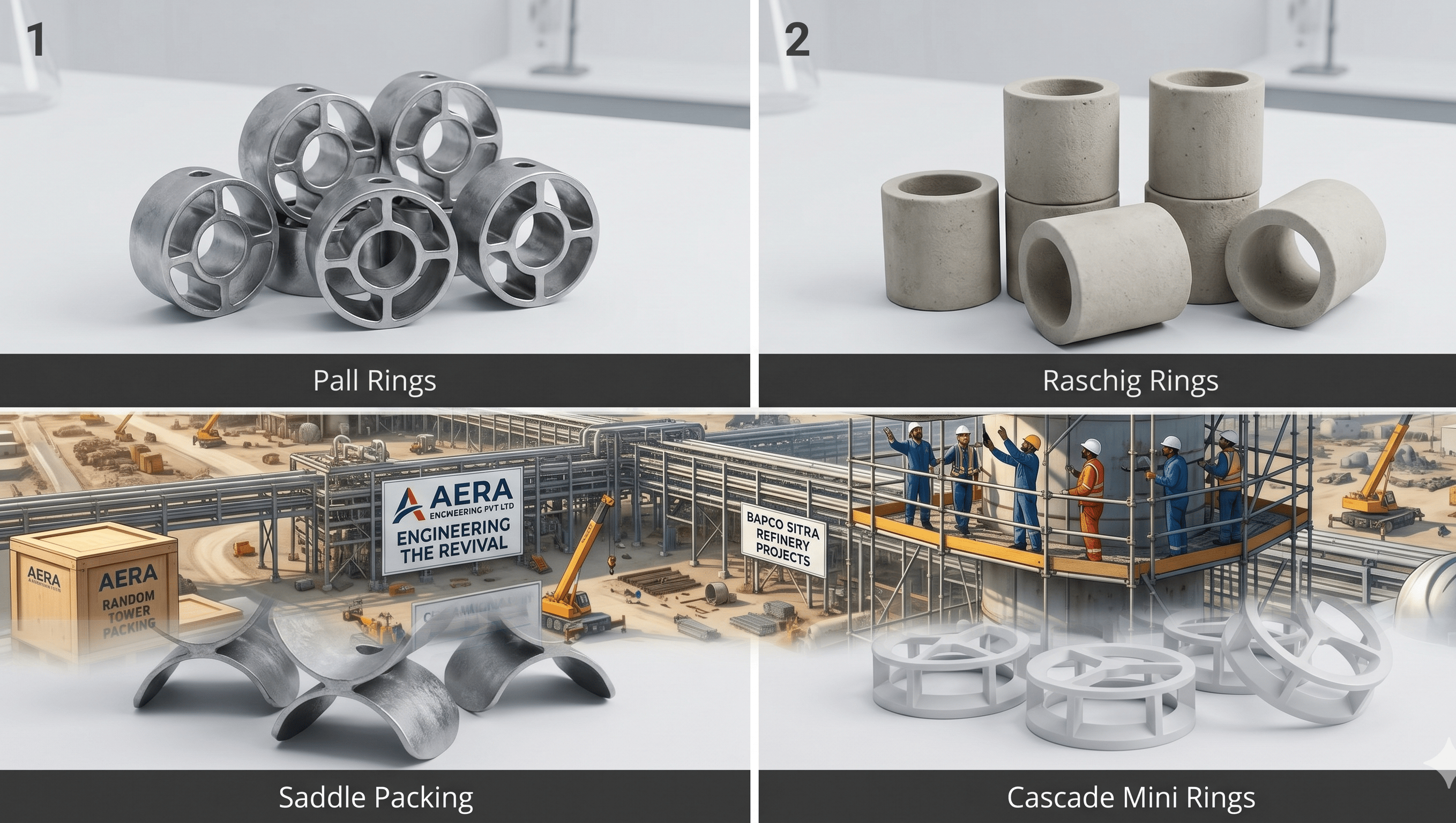
The global energy landscape shifted dramatically following the regional escalations in early 2026. With major assets like the GPIC facility, Ras Laffan gas terminals, and the Bapco Sitra Refinery facing operational halts due to conflict damage, the priority for the industry has moved from routine maintenance to rapid, resilient reconstruction. At Aera Engineering Pvt Ltd, we recognize that the heartbeat of these massive complexes lies within their mass transfer columns. As we support the region’s recovery, one technical solution stands out for its versatility and efficiency: Random Tower Packing. Why Random Packing is the Post-Conflict Recovery Standard Restoring a petrochemical plant after a conflict isn't just about replacing what was there—it’s about upgrading for a more volatile future. While structured packing has its merits, Random Tower Packing (such as our Aera Pall Rings, Saddle Rings, and Cascade Mini Rings) is proving to be the superior choice for the Gulf's current reality. 1. Speed of Deployment and Commissioning In a landscape where supply chains are strained and expert labor is at a premium, random packing offers an unmatched advantage: Ease of Installation. * Simplified Logistics: Unlike structured packing, which requires precise manual orientation and specific column dimensions, random packing can be 'dumped' into a column. Rapid Turnaround: This significantly reduces the time required for internal column assembly, allowing damaged plants to return to production weeks faster than with complex structured alternatives. 2. Resilience Against Feedstock Variability Post-conflict operations often deal with 'dirty' or variable gas and liquid feeds as upstream infrastructure is still being stabilized. Resistance to Fouling: Random packing is inherently more robust against the particulates and contaminants that can easily plug the narrow channels of structured grids. Operational Stability: It ensures the column remains functional even when the feedstock quality is less than ideal, providing much-needed stability to the region's chemical output. Technical Edge: Optimizing Mass Transfer Efficiency The Gulf’s extreme climate—coupled with the high-pressure demands of ammonia and ethylene production—requires internal components that can maximize performance while minimizing energy consumption. By utilizing high-performance materials like SS 316L Cascade Mini Rings (CMR) or Duplex Pall Rings, Aera Engineering helps plants achieve lower HETP values. This means a repaired tower can actually outperform its original design, delivering higher-purity products with less energy. Material Excellence for Harsh Environments Aera Engineering provides a diverse range of materials designed to withstand the corrosive and high-temperature environments typical of Gulf petrochemical processes: Material Type Key Application in Gulf Recovery Stainless Steel (316L/304) General refining and high-strength distillation. Titanium / Hastelloy Highly corrosive acid gas removal and desalination. Ceramic Raschig Rings High-temperature applications and strong acid absorption. High-Grade Plastics (PP/PVDF) Cooling towers and scrubbing units where weight and cost are factors. Aera Engineering: Your Partner in Industrial Rebirth Based in the engineering hub of Vadodara, Aera Engineering Pvt Ltd is uniquely positioned to support the Gulf's reconstruction efforts. Our precision-engineered random packing solutions—from SS 316L CMR Rings to Titanium Pall Rings—are already helping facilities across the globe optimize their mass transfer operations. The revival of the Gulf’s petrochemical prowess is a testament to technical ingenuity. By choosing the right internals today, we ensure the infrastructure of tomorrow is stronger, more efficient, and more resilient than ever before. Ready to optimize your plant’s recovery? Explore our full range of random packing solutions at www.aeraepl.com or contact our technical team for a consultation on your next turnaround.


This is your website preview.
Currently it only shows your basic business info. Start adding relevant business details such as description, images and products or services to gain your customers attention by using Boost 360 android app / iOS App / web portal.
Rebuilding Resilience: How Random Tower Packing is Restoring Gulf Petrochemical Giants
2026-04-15T09:41:50
The global energy landscape shifted dramatically following the regional escalations in early 2026. With major assets like the GPIC facility, Ras Laffan gas terminals, and the Bapco Sitra Refinery facing operational halts due to conflict damage, the priority for the industry has moved from routine maintenance to rapid, resilient reconstruction. At Aera Engineering Pvt Ltd, we recognize that the heartbeat of these massive complexes lies within their mass transfer columns. As we support the region’s recovery, one technical solution stands out for its versatility and efficiency: Random Tower Packing. Why Random Packing is the Post-Conflict Recovery Standard Restoring a petrochemical plant after a conflict isn't just about replacing what was there—it’s about upgrading for a more volatile future. While structured packing has its merits, Random Tower Packing (such as our Aera Pall Rings, Saddle Rings, and Cascade Mini Rings) is proving to be the superior choice for the Gulf's current reality. 1. Speed of Deployment and Commissioning In a landscape where supply chains are strained and expert labor is at a premium, random packing offers an unmatched advantage: Ease of Installation. * Simplified Logistics: Unlike structured packing, which requires precise manual orientation and specific column dimensions, random packing can be 'dumped' into a column. Rapid Turnaround: This significantly reduces the time required for internal column assembly, allowing damaged plants to return to production weeks faster than with complex structured alternatives. 2. Resilience Against Feedstock Variability Post-conflict operations often deal with 'dirty' or variable gas and liquid feeds as upstream infrastructure is still being stabilized. Resistance to Fouling: Random packing is inherently more robust against the particulates and contaminants that can easily plug the narrow channels of structured grids. Operational Stability: It ensures the column remains functional even when the feedstock quality is less than ideal, providing much-needed stability to the region's chemical output. Technical Edge: Optimizing Mass Transfer Efficiency The Gulf’s extreme climate—coupled with the high-pressure demands of ammonia and ethylene production—requires internal components that can maximize performance while minimizing energy consumption. By utilizing high-performance materials like SS 316L Cascade Mini Rings (CMR) or Duplex Pall Rings, Aera Engineering helps plants achieve lower HETP values. This means a repaired tower can actually outperform its original design, delivering higher-purity products with less energy. Material Excellence for Harsh Environments Aera Engineering provides a diverse range of materials designed to withstand the corrosive and high-temperature environments typical of Gulf petrochemical processes: Material Type Key Application in Gulf Recovery Stainless Steel (316L/304) General refining and high-strength distillation. Titanium / Hastelloy Highly corrosive acid gas removal and desalination. Ceramic Raschig Rings High-temperature applications and strong acid absorption. High-Grade Plastics (PP/PVDF) Cooling towers and scrubbing units where weight and cost are factors. Aera Engineering: Your Partner in Industrial Rebirth Based in the engineering hub of Vadodara, Aera Engineering Pvt Ltd is uniquely positioned to support the Gulf's reconstruction efforts. Our precision-engineered random packing solutions—from SS 316L CMR Rings to Titanium Pall Rings—are already helping facilities across the globe optimize their mass transfer operations. The revival of the Gulf’s petrochemical prowess is a testament to technical ingenuity. By choosing the right internals today, we ensure the infrastructure of tomorrow is stronger, more efficient, and more resilient than ever before. Ready to optimize your plant’s recovery? Explore our full range of random packing solutions at www.aeraepl.com or contact our technical team for a consultation on your next turnaround.
2026-04-15T09:41:50


Keywords
- Petrochemical column packing global supply chain
- Industrial random packing for gas scrubbing systems
- Refinery asset reliability services Saudi Arabia 2026
- Metal Pall ring vs Raschig ring for crude distillation
- Rapid delivery Pall rings for refinery shutdowns
- Reliable mass transfer equipment manufacturers Europe
- Pall ring packing for high-temperature distillation
- Impact of war on GCC refining infrastructure
- Refinery tower internals for emergency maintenance
- Stainless steel Pall ring for H2S stripping
- Top manufacturers of Pall ring in the world 2026
- Middle East refinery reconstruction equipment suppliers
- random tower packing for Gulf recovery
- Aera Engineering random packing solutions
- SS 316L Cascade Mini Rings
- Duplex Pall Rings Gulf petrochemical
- rapid installation random packing
Submit Your Enquiry