
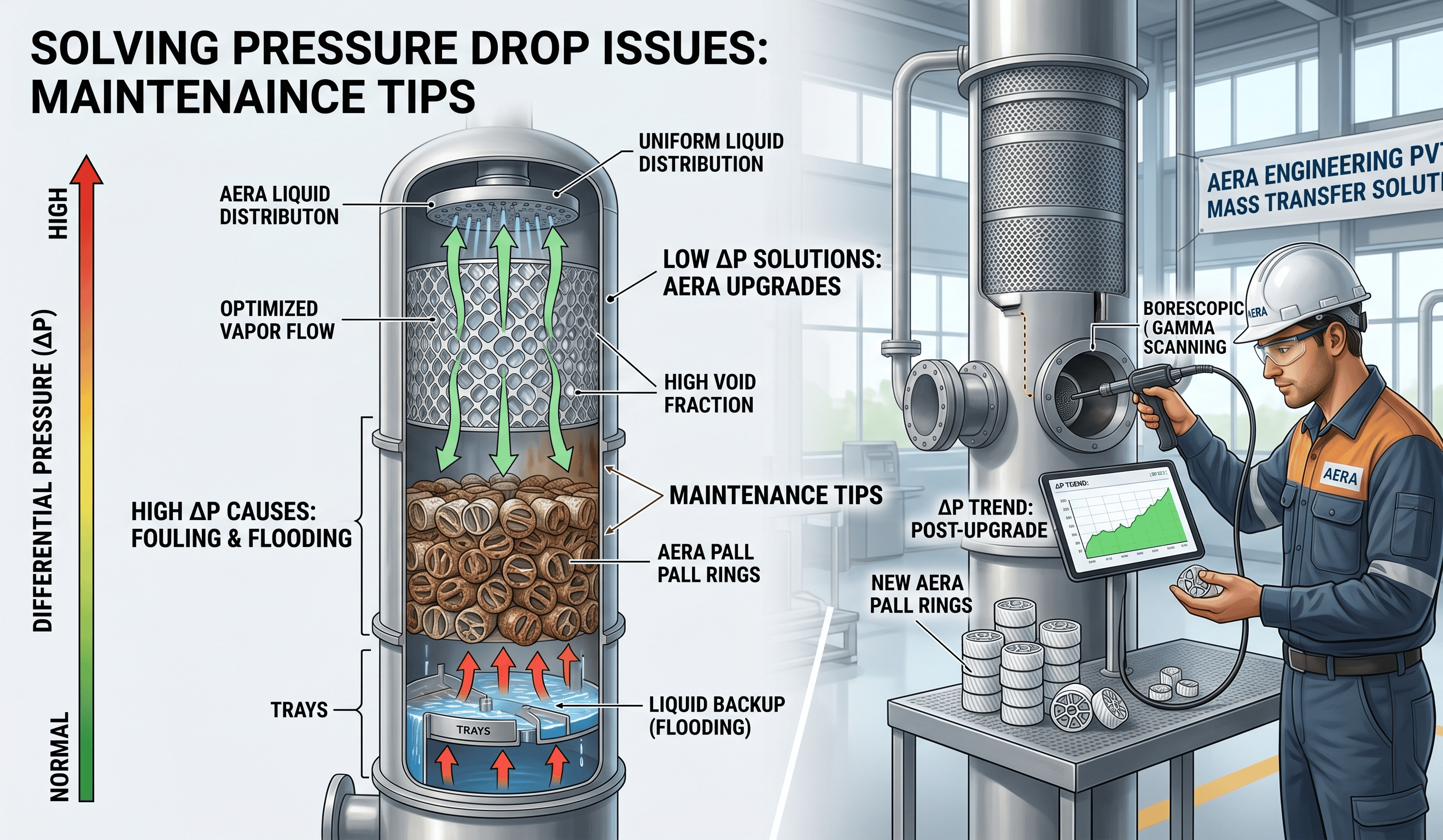
In the high-stakes environment of chemical processing and refining, the distillation column is often the heart of the operation. For maintenance engineers, one of the most persistent and costly challenges is an unexpected increase in pressure drop. At Aera Engineering Pvt Ltd, we understand that a spike in differential pressure isn't just a technical glitch—it’s a threat to product purity, energy efficiency, and equipment safety. Here is a guide to identifying, troubleshooting, and solving pressure drop issues to keep your columns running at peak performance. 1. Understanding the 'Why' Behind the Rise Pressure drop is the difference in pressure between the bottom and the top of the column. While some resistance is necessary for gas-liquid contact, excessive $Delta P$ usually signals one of three things: fouling, flooding, or mechanical failure. Common Culprits: Fouling and Scaling: The buildup of polymers, salts, or corrosion products on the packing or trays. Mechanical Damage: Collapsed packing or displaced trays that obstruct the vapor path. Liquid Flooding: When the upward vapor velocity is so high it prevents liquid from flowing down, causing 'backup' in the column. 2. The Maintenance Engineer’s Troubleshooting Checklist When the control room alerts you to a rising , follow these steps to isolate the cause: A. Analyze the Vapor/Liquid Loads Check the feed rates. If production has recently ramped up, you might simply be exceeding the column's hydraulic capacity. Small increases in vapor velocity can lead to exponential increases in pressure drop. B. Check the Temperature Profile A significant change in the temperature gradient across the column often points to fouling. If the bottom temperature is rising while the top stays constant, the reboiler might be working harder to 'push' vapor through a localized obstruction. C. Gamma Scanning For a non-invasive look inside, a Gamma Scan can identify flooded trays, missing packing sections, or liquid level abnormalities without needing to shut down the unit. 3. Long-Term Solutions: Better Hardware, Better Results Often, chronic pressure drop issues stem from using outdated or sub-optimal internal components. As specialists in mass transfer, Aera Engineering recommends the following upgrades: Switch to High-Efficiency Packing Traditional raschig rings or low-grade saddles often have a high resistance to flow. Upgrading to modern Pall Rings or Structured Packing can significantly reduce pressure drop. These designs offer a high void fraction, allowing vapor to pass freely while maintaining a massive surface area for liquid contact. Optimize Liquid Distribution If liquid is not distributed evenly across the packing, 'channeling' occurs. This forces vapor into smaller, constricted paths, artificially inflating the pressure drop. High-precision Liquid Distributors from Aera ensure a uniform 'rain' of solvent, keeping the full cross-section of the column active. 4. Proactive Maintenance Tips Regular Steam Cleaning: For columns prone to organic fouling, scheduled steaming can melt away deposits before they harden. Filter the Feed: Installing high-quality strainers on the feed line can prevent solids from entering the column and plugging the packing voids. Monitor Delta-P Trends: Don't wait for the alarm. Plotting pressure drop over time helps you predict when the column will need a turnaround, allowing for planned maintenance rather than emergency shutdowns. Partnering with Aera Engineering At Aera Engineering Pvt Ltd, we don't just provide parts; we provide solutions. Our range of Pall Rings, Trays, and Internals are engineered to provide the lowest possible pressure drop while maximizing separation efficiency. Efficiency is measured by what flows through the column, not what gets stuck inside. Is your column underperforming due to high pressure drop? Contact Aera Engineering today for a technical consultation on how our high-performance internals can restore your throughput and reduce your energy costs. Would you like a detailed specification sheet for our high-void fraction Pall Rings to help with your next turnaround?


This is your website preview.
Currently it only shows your basic business info. Start adding relevant business details such as description, images and products or services to gain your customers attention by using Boost 360 android app / iOS App / web portal.
Solving Pressure Drop Issues in Distillation Columns
2026-04-21T11:30:11
In the high-stakes environment of chemical processing and refining, the distillation column is often the heart of the operation. For maintenance engineers, one of the most persistent and costly challenges is an unexpected increase in pressure drop. At Aera Engineering Pvt Ltd, we understand that a spike in differential pressure isn't just a technical glitch—it’s a threat to product purity, energy efficiency, and equipment safety. Here is a guide to identifying, troubleshooting, and solving pressure drop issues to keep your columns running at peak performance. 1. Understanding the 'Why' Behind the Rise Pressure drop is the difference in pressure between the bottom and the top of the column. While some resistance is necessary for gas-liquid contact, excessive $Delta P$ usually signals one of three things: fouling, flooding, or mechanical failure. Common Culprits: Fouling and Scaling: The buildup of polymers, salts, or corrosion products on the packing or trays. Mechanical Damage: Collapsed packing or displaced trays that obstruct the vapor path. Liquid Flooding: When the upward vapor velocity is so high it prevents liquid from flowing down, causing 'backup' in the column. 2. The Maintenance Engineer’s Troubleshooting Checklist When the control room alerts you to a rising , follow these steps to isolate the cause: A. Analyze the Vapor/Liquid Loads Check the feed rates. If production has recently ramped up, you might simply be exceeding the column's hydraulic capacity. Small increases in vapor velocity can lead to exponential increases in pressure drop. B. Check the Temperature Profile A significant change in the temperature gradient across the column often points to fouling. If the bottom temperature is rising while the top stays constant, the reboiler might be working harder to 'push' vapor through a localized obstruction. C. Gamma Scanning For a non-invasive look inside, a Gamma Scan can identify flooded trays, missing packing sections, or liquid level abnormalities without needing to shut down the unit. 3. Long-Term Solutions: Better Hardware, Better Results Often, chronic pressure drop issues stem from using outdated or sub-optimal internal components. As specialists in mass transfer, Aera Engineering recommends the following upgrades: Switch to High-Efficiency Packing Traditional raschig rings or low-grade saddles often have a high resistance to flow. Upgrading to modern Pall Rings or Structured Packing can significantly reduce pressure drop. These designs offer a high void fraction, allowing vapor to pass freely while maintaining a massive surface area for liquid contact. Optimize Liquid Distribution If liquid is not distributed evenly across the packing, 'channeling' occurs. This forces vapor into smaller, constricted paths, artificially inflating the pressure drop. High-precision Liquid Distributors from Aera ensure a uniform 'rain' of solvent, keeping the full cross-section of the column active. 4. Proactive Maintenance Tips Regular Steam Cleaning: For columns prone to organic fouling, scheduled steaming can melt away deposits before they harden. Filter the Feed: Installing high-quality strainers on the feed line can prevent solids from entering the column and plugging the packing voids. Monitor Delta-P Trends: Don't wait for the alarm. Plotting pressure drop over time helps you predict when the column will need a turnaround, allowing for planned maintenance rather than emergency shutdowns. Partnering with Aera Engineering At Aera Engineering Pvt Ltd, we don't just provide parts; we provide solutions. Our range of Pall Rings, Trays, and Internals are engineered to provide the lowest possible pressure drop while maximizing separation efficiency. Efficiency is measured by what flows through the column, not what gets stuck inside. Is your column underperforming due to high pressure drop? Contact Aera Engineering today for a technical consultation on how our high-performance internals can restore your throughput and reduce your energy costs. Would you like a detailed specification sheet for our high-void fraction Pall Rings to help with your next turnaround?
2026-04-21T11:30:11


Keywords
- Top rated IMTP saddles in India
- Aera Engineering tower packing solutions
- Low pressure drop IMTP saddle specifications
- Corrosion-resistant random packing for chemical plants
- Tower packing for petrochemical distillation India
- Equivalent CMR rings for VOC removal
- High-efficiency IMTP packing for solvent recovery
- SS 316L Pall Rings for acid scrubbing
- Custom CMR ring design services
- Plastic Pall Ring 50mm price India
- Industrial tower internals price list
- Metal CMR rings for distillation columns India
- Bulk IMTP saddle tower packing for sale
- Stainless Steel Pall Ring price per piece
- Mass transfer equipment manufacturers in Mumbai
- Random packing suppliers in Pune
- CMR rings price in India
- Tower packing manufacturers near me
- IMTP saddle suppliers in Gujarat
- Pall rings manufacturer in Vadodara
- pressure drop in distillation column
- fouling and scaling causes
- high-velocity vapor flooding
- high-efficiency packing alternatives
- uniform liquid distributors for columns
Submit Your Enquiry