
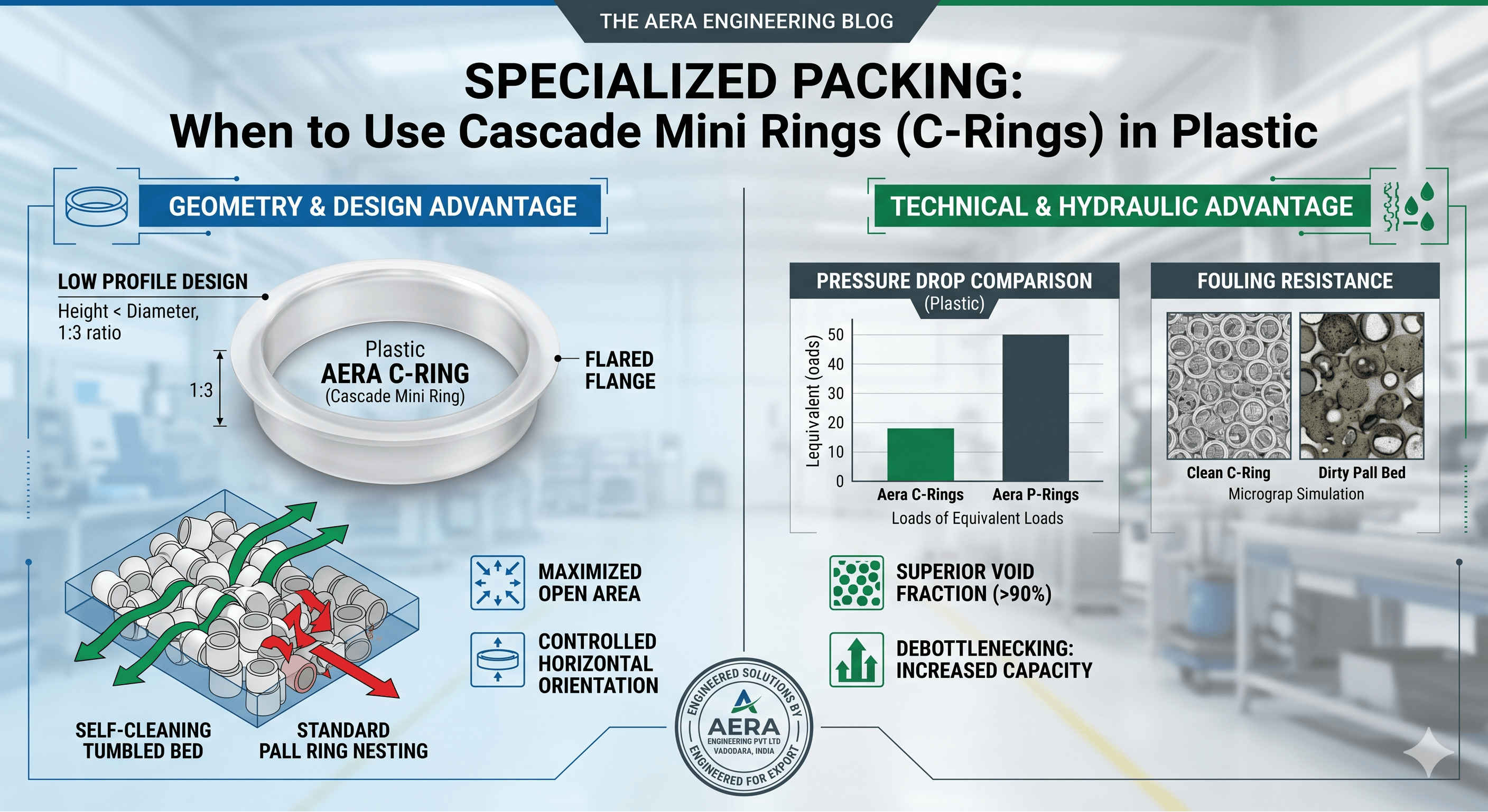
This blog is designed to position Aera Engineering Pvt Ltd as a high-end technical consultant. Cascade Mini Rings are a premium product, and this content helps justify the investment to your global B2B clients. In the evolution of mass transfer, we moved from the simple Raschig Ring to the high-performance Pall Ring. But for engineers facing the most extreme hydraulic challenges—where every millimeter of pressure drop matters and fouling is a constant threat—there is a specialized solution: the Cascade Mini Ring (C-Ring). At Aera Engineering Pvt Ltd, we manufacture Plastic Cascade Mini Rings for global export, providing a geometric advantage that pushes tower performance beyond the limits of standard random packing. But when exactly should you choose a C-Ring over a standard Pall Ring? This guide explores the 'when' and the 'why' of this specialized geometry. The Geometry of the 'Cascade' The Cascade Mini Ring is essentially a 'low-profile' Pall Ring. While a Pall Ring has a 1:1 aspect ratio (height equals diameter), the C-Ring has a height that is usually only 1/2 or 1/3 of its diameter. It also features a flared flange on one end. This subtle change in geometry creates three profound mechanical advantages: 1. The 'Self-Cleaning' Effect (Fouling Resistance) Standard cylinders can sometimes 'nest' or trap solids in low-flow zones. The flared edge of the C-Ring ensures that as the rings tumble into the tower, they cannot stack perfectly. The Result: A highly random bed with open flow paths that naturally flush out solids. When to use: Use C-Rings in scrubbers handling 'dirty' gas streams, such as those with particulate matter or lime-based slurries that would typically clog a standard Pall Ring. 2. Orientation Control (Hydraulic Efficiency) Because C-Rings are wider than they are tall, they naturally tend to land 'flat' (horizontally) when poured into a tower. The Result: This horizontal orientation presents the largest possible opening to the rising gas stream. When to use: Use C-Rings when you need the absolute lowest pressure drop possible. They offer significantly less resistance to gas flow than almost any other random packing. 3. High Capacity for High-Load Towers The unique flared design creates a very high 'void fraction.' This means there is more empty space for gas and liquid to move simultaneously. The Result: You can push higher volumes through a smaller diameter tower without reaching the 'flood point.' When to use: Use C-Rings in 'debottlenecking' projects. If your current tower is at maximum capacity and you need to increase throughput by 10-20% without building a new tower, C-Rings are the answer. Plastic C-Rings: PP, PVC, and Beyond While C-Rings are often used in metal for massive refinery columns, Aera’s Plastic C-Rings are the preferred choice for environmental and chemical applications: Polypropylene (PP): Ideal for general water treatment and cooling towers where energy savings on the blower fan are the priority. PVC/CPVC: Perfect for wet chlorine scrubbing and industrial acid gas removal. PVDF: The ultimate solution for high-temperature chemical stripping and aggressive halogen scrubbing. The Aera Engineering Export Standard Based in Vadodara, India, Aera Engineering Pvt Ltd provides precision-molded Cascade Mini Rings designed to meet the exact technical specifications of global EPC firms. Whether you are repairing a damaged gas-to-liquids plant in Kuwait or optimizing a VOC stripper in Southeast Asia, our C-Rings provide the geometric edge you need. Don't settle for 'standard' when your process demands 'specialized.' Contact the Aera Engineering technical team to see if Cascade Mini Rings are the right fit for your tower modernization or repair project. Request a C-Ring Technical Data Sheet | Vadodara, Gujarat, India


This is your website preview.
Currently it only shows your basic business info. Start adding relevant business details such as description, images and products or services to gain your customers attention by using Boost 360 android app / iOS App / web portal.
Specialized Packing: When to Use Cascade Mini Rings (C-Rings) in Plastic
2026-04-24T12:30:09
This blog is designed to position Aera Engineering Pvt Ltd as a high-end technical consultant. Cascade Mini Rings are a premium product, and this content helps justify the investment to your global B2B clients. In the evolution of mass transfer, we moved from the simple Raschig Ring to the high-performance Pall Ring. But for engineers facing the most extreme hydraulic challenges—where every millimeter of pressure drop matters and fouling is a constant threat—there is a specialized solution: the Cascade Mini Ring (C-Ring). At Aera Engineering Pvt Ltd, we manufacture Plastic Cascade Mini Rings for global export, providing a geometric advantage that pushes tower performance beyond the limits of standard random packing. But when exactly should you choose a C-Ring over a standard Pall Ring? This guide explores the 'when' and the 'why' of this specialized geometry. The Geometry of the 'Cascade' The Cascade Mini Ring is essentially a 'low-profile' Pall Ring. While a Pall Ring has a 1:1 aspect ratio (height equals diameter), the C-Ring has a height that is usually only 1/2 or 1/3 of its diameter. It also features a flared flange on one end. This subtle change in geometry creates three profound mechanical advantages: 1. The 'Self-Cleaning' Effect (Fouling Resistance) Standard cylinders can sometimes 'nest' or trap solids in low-flow zones. The flared edge of the C-Ring ensures that as the rings tumble into the tower, they cannot stack perfectly. The Result: A highly random bed with open flow paths that naturally flush out solids. When to use: Use C-Rings in scrubbers handling 'dirty' gas streams, such as those with particulate matter or lime-based slurries that would typically clog a standard Pall Ring. 2. Orientation Control (Hydraulic Efficiency) Because C-Rings are wider than they are tall, they naturally tend to land 'flat' (horizontally) when poured into a tower. The Result: This horizontal orientation presents the largest possible opening to the rising gas stream. When to use: Use C-Rings when you need the absolute lowest pressure drop possible. They offer significantly less resistance to gas flow than almost any other random packing. 3. High Capacity for High-Load Towers The unique flared design creates a very high 'void fraction.' This means there is more empty space for gas and liquid to move simultaneously. The Result: You can push higher volumes through a smaller diameter tower without reaching the 'flood point.' When to use: Use C-Rings in 'debottlenecking' projects. If your current tower is at maximum capacity and you need to increase throughput by 10-20% without building a new tower, C-Rings are the answer. Plastic C-Rings: PP, PVC, and Beyond While C-Rings are often used in metal for massive refinery columns, Aera’s Plastic C-Rings are the preferred choice for environmental and chemical applications: Polypropylene (PP): Ideal for general water treatment and cooling towers where energy savings on the blower fan are the priority. PVC/CPVC: Perfect for wet chlorine scrubbing and industrial acid gas removal. PVDF: The ultimate solution for high-temperature chemical stripping and aggressive halogen scrubbing. The Aera Engineering Export Standard Based in Vadodara, India, Aera Engineering Pvt Ltd provides precision-molded Cascade Mini Rings designed to meet the exact technical specifications of global EPC firms. Whether you are repairing a damaged gas-to-liquids plant in Kuwait or optimizing a VOC stripper in Southeast Asia, our C-Rings provide the geometric edge you need. Don't settle for 'standard' when your process demands 'specialized.' Contact the Aera Engineering technical team to see if Cascade Mini Rings are the right fit for your tower modernization or repair project. Request a C-Ring Technical Data Sheet | Vadodara, Gujarat, India
2026-04-24T12:30:09


Submit Your Enquiry