
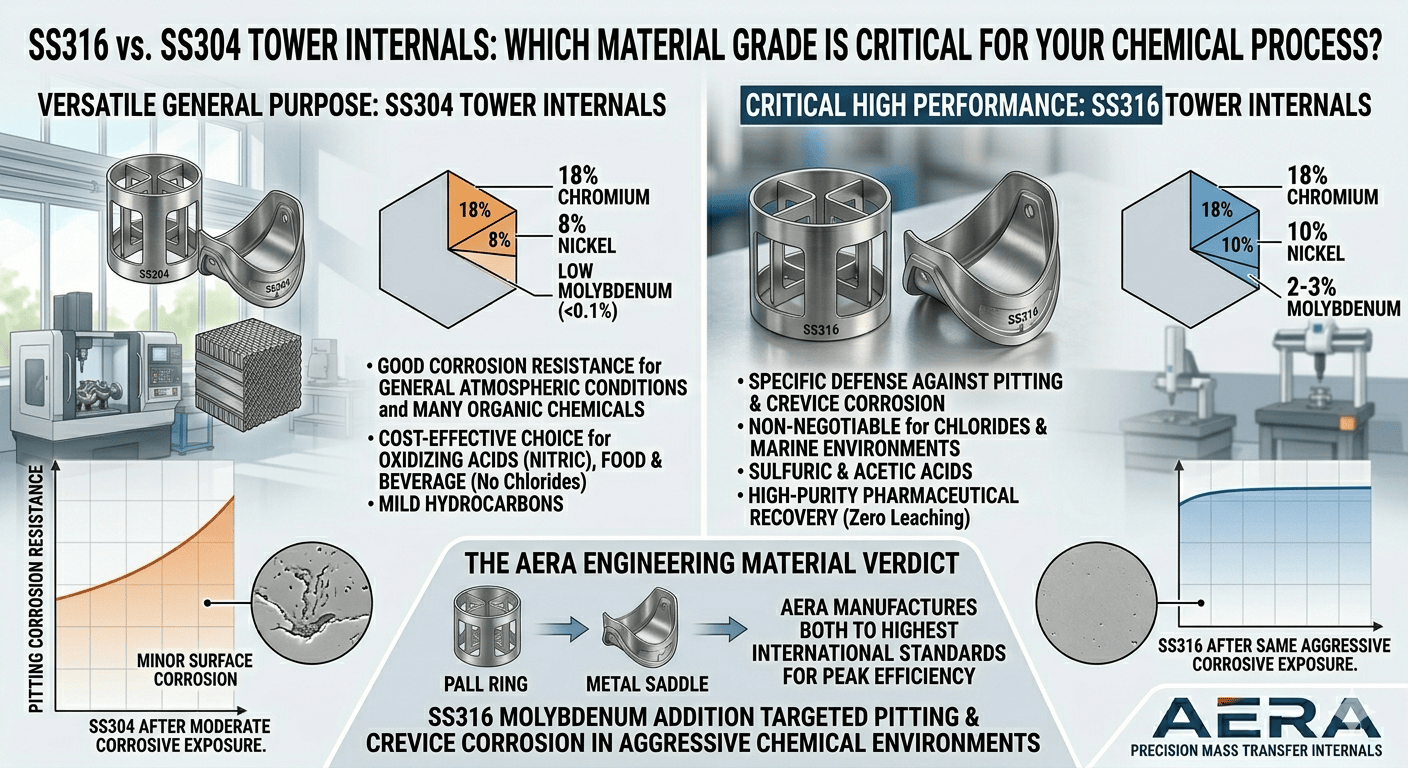
In the world of mass transfer, selecting the right geometry for your Pall Rings or structured packing is only half the battle. The other half is metallurgy. At Aera Engineering Pvt Ltd, we often see engineers facing a classic dilemma: Is the standard SS304 sufficient, or is the upgrade to SS316 critical for their specific tower internals? While both are 'stainless steels, ' the choice between them can be the difference between a tower that runs for a decade and one that suffers a catastrophic shutdown in six months. Here is how to make the right call for your chemical process. 1. The Chemistry of Resistance: The Molybdenum Difference The fundamental difference between these two grades lies in a single element: Molybdenum. SS304 (18/8 Stainless): Contains 18% chromium and 8% nickel. It offers excellent corrosion resistance for general atmospheric conditions and many organic chemicals. SS316 (18/10 Stainless): Contains 18% chromium, 10% nickel, and 2-3% Molybdenum. That small addition of Molybdenum specifically targets pitting and crevice corrosion. In distillation columns where liquids can stagnate in the corners of packing or tray supports, SS316 provides a robust defense that SS304 simply cannot match. 2. When SS304 is the Efficient Choice SS304 is the most widely used stainless steel in the world for a reason—it is cost-effective and versatile. At Aera Engineering, we recommend SS304 for: Oxidizing Acids: Excellent for nitric acid at moderate temperatures. Food and Beverage: Ideal for processing where hygiene is key but corrosive chlorides are absent. Mild Hydrocarbons: Most oil and gas refining stages that don't involve 'sour' (H2S) gases. 3. When SS316 is Non-Negotiable If your process involves any of the following, the upgrade to SS316 isn't just an option; it's a requirement for safety and longevity: Chlorides and Marine Environments: Chlorides are the nemesis of SS304. If your plant is near the coast or uses chlorinated solvents, SS304 will suffer from rapid pitting. Sulfuric and Acetic Acids: SS316 offers significantly better resistance to hot acetic acid and dilute sulfuric acid solutions. Pharmaceutical Solvent Recovery: To ensure zero metal leaching and maintain ultra-high purity, SS316 (or its low-carbon version, SS316L) is the pharmaceutical industry standard. 4. Total Cost of Ownership (TCO) Many procurement teams focus on the initial CAPEX. SS316 is generally 20-30% more expensive than SS304 due to the cost of nickel and molybdenum. However, a maintenance engineer looks at the Total Cost of Ownership. If using SS304 leads to a premature 'breakthrough' of the packing walls, the cost of the replacement packing, the crane hire, and the lost production far outweighs the initial savings. At Aera, we advocate for 'Engineering for the Lifecycle.' 5. The 'L' Variant: A Quick Note on Welding If your tower internals involve heavy welding (such as custom liquid distributors or tray supports), we often recommend SS304L or SS316L. The 'L' stands for Low Carbon, which prevents intergranular corrosion at the weld seams—a common failure point in high-pressure chemical columns. The Aera Verdict At Aera Engineering Pvt Ltd, we maintain a robust inventory of both SS304 and SS316. Our precision pressing and CNC machining processes are calibrated for the unique work-hardening characteristics of both grades. Choose SS304 for general-purpose, non-chloride environments to keep your project on budget. Choose SS316 for aggressive chemicals, saline environments, and high-purity pharmaceutical applications. Material integrity is the foundation of precision engineering. Unsure which grade your process fluid requires? Contact Aera Engineering today. Our technical team can review your material safety data sheets (MSDS) and help you select the metallurgy that ensures 'Precision in Every Press' lasts for the life of your plant.


This is your website preview.
Currently it only shows your basic business info. Start adding relevant business details such as description, images and products or services to gain your customers attention by using Boost 360 android app / iOS App / web portal.
SS316 vs. SS304 Tower Internals: Which Material Grade is Critical for Your Chemical Process?
2026-04-22T15:00:03
In the world of mass transfer, selecting the right geometry for your Pall Rings or structured packing is only half the battle. The other half is metallurgy. At Aera Engineering Pvt Ltd, we often see engineers facing a classic dilemma: Is the standard SS304 sufficient, or is the upgrade to SS316 critical for their specific tower internals? While both are 'stainless steels, ' the choice between them can be the difference between a tower that runs for a decade and one that suffers a catastrophic shutdown in six months. Here is how to make the right call for your chemical process. 1. The Chemistry of Resistance: The Molybdenum Difference The fundamental difference between these two grades lies in a single element: Molybdenum. SS304 (18/8 Stainless): Contains 18% chromium and 8% nickel. It offers excellent corrosion resistance for general atmospheric conditions and many organic chemicals. SS316 (18/10 Stainless): Contains 18% chromium, 10% nickel, and 2-3% Molybdenum. That small addition of Molybdenum specifically targets pitting and crevice corrosion. In distillation columns where liquids can stagnate in the corners of packing or tray supports, SS316 provides a robust defense that SS304 simply cannot match. 2. When SS304 is the Efficient Choice SS304 is the most widely used stainless steel in the world for a reason—it is cost-effective and versatile. At Aera Engineering, we recommend SS304 for: Oxidizing Acids: Excellent for nitric acid at moderate temperatures. Food and Beverage: Ideal for processing where hygiene is key but corrosive chlorides are absent. Mild Hydrocarbons: Most oil and gas refining stages that don't involve 'sour' (H2S) gases. 3. When SS316 is Non-Negotiable If your process involves any of the following, the upgrade to SS316 isn't just an option; it's a requirement for safety and longevity: Chlorides and Marine Environments: Chlorides are the nemesis of SS304. If your plant is near the coast or uses chlorinated solvents, SS304 will suffer from rapid pitting. Sulfuric and Acetic Acids: SS316 offers significantly better resistance to hot acetic acid and dilute sulfuric acid solutions. Pharmaceutical Solvent Recovery: To ensure zero metal leaching and maintain ultra-high purity, SS316 (or its low-carbon version, SS316L) is the pharmaceutical industry standard. 4. Total Cost of Ownership (TCO) Many procurement teams focus on the initial CAPEX. SS316 is generally 20-30% more expensive than SS304 due to the cost of nickel and molybdenum. However, a maintenance engineer looks at the Total Cost of Ownership. If using SS304 leads to a premature 'breakthrough' of the packing walls, the cost of the replacement packing, the crane hire, and the lost production far outweighs the initial savings. At Aera, we advocate for 'Engineering for the Lifecycle.' 5. The 'L' Variant: A Quick Note on Welding If your tower internals involve heavy welding (such as custom liquid distributors or tray supports), we often recommend SS304L or SS316L. The 'L' stands for Low Carbon, which prevents intergranular corrosion at the weld seams—a common failure point in high-pressure chemical columns. The Aera Verdict At Aera Engineering Pvt Ltd, we maintain a robust inventory of both SS304 and SS316. Our precision pressing and CNC machining processes are calibrated for the unique work-hardening characteristics of both grades. Choose SS304 for general-purpose, non-chloride environments to keep your project on budget. Choose SS316 for aggressive chemicals, saline environments, and high-purity pharmaceutical applications. Material integrity is the foundation of precision engineering. Unsure which grade your process fluid requires? Contact Aera Engineering today. Our technical team can review your material safety data sheets (MSDS) and help you select the metallurgy that ensures 'Precision in Every Press' lasts for the life of your plant.
2026-04-22T15:00:03


Keywords
- Absorption Tower CMR Rings
- Scrubber Column Pall Rings
- High-Capacity Metal Tower Packing
- Anti-Nesting CMR Rings
- High-Flux Pall Rings
- Low-Pressure Drop IMTP Saddles
- High-Surface Area CMR Rings
- 1 inch Stainless Steel Pall Rings
- 1-inch Stainless Steel Pall Rings
- 25 Metal IMTP Saddles
- 50mm CMR Rings
- 25mm IMTP Saddle Packing
- 15mm Metal Pall Rings
- Titanium Tower Packing Rings
- Duplex SS Random Packing
- Monel Metal Saddle Packing
- Carbon Steel IMTP Saddles
- Stainless Steel Pall Rings
- SS316 vs SS304 tower internals
- pall rings structured packing metallurgy
- chlorides marine environments corrosion
- pharmaceutical solvent recovery stainless steel
- Total Cost of Ownership stainless steel choice
Submit Your Enquiry