
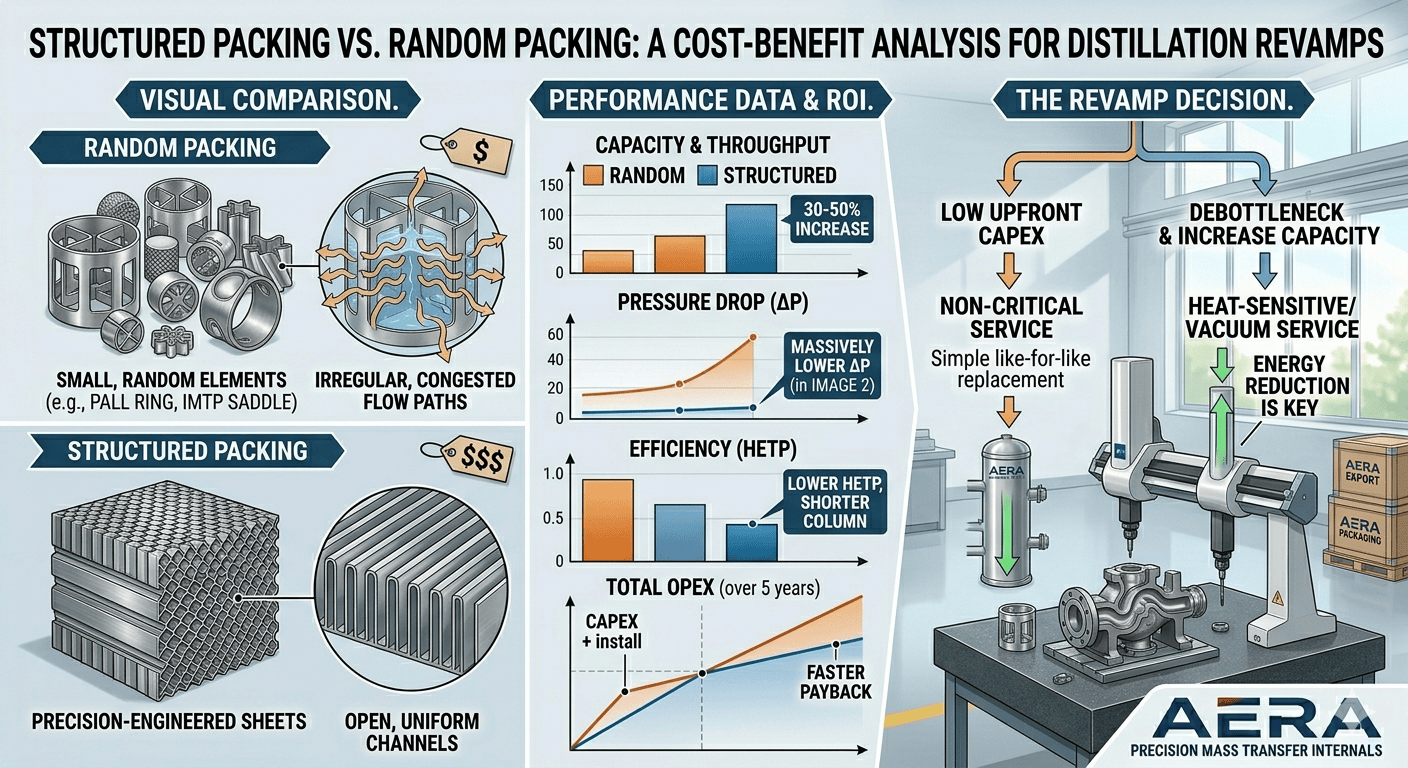
Distillation is a cornerstone of chemical processing, refining, and separation industries. Yet, many plants operate with aging columns that are bottlenecks to production or energy-inefficient. When the time comes to increase capacity, improve product purity, or reduce energy consumption, a distillation column revamp is often the most cost-effective solution. The central question during a revamp is almost always: should we use structured packing or random packing? At Aera Engineering Pvt Ltd, we specialize in mass transfer internals. We understand that this isn’t just a technical decision; it’s a financial one that impacts your bottom line. Let's break down the cost-benefit analysis of structured packing versus random packing to help you make an informed decision for your next turnaround. Understanding the Contenders Before diving into the financials, it's essential to understand the fundamental difference between the two technologies: Random Packing: This is the traditional approach. Small, individual packing elements (like Pall Rings, Metal Saddles, or Raschig Rings) are literally dumped 'at random' into the column. They rely on gravity to distribute them, and their geometry creates the surface area for gas-liquid contact. Think of a jar filled with marbles—they find their own resting places, creating many irregular flow paths. Structured Packing: This represents advanced, engineered geometry. Corrugated metal or plastic sheets are precisely shaped and stacked into structured blocks that are carefully installed inside the column. This creates uniform, open channels for the liquid and gas to pass through. Think of a series of perfectly aligned honeycombs—every flow path is predictable and maximized. Cost Analysis: Upfront Investment When looking purely at the initial purchase price, random packing is the clear 'budget' winner. Random Packing: The Low CAPEX Option Random packing is significantly cheaper per cubic meter. It is typically a commodity product that is mass-produced. Its manufacturing process (like metal stamping for Pall Rings) is efficient and straightforward. For projects where capital expenditure is severely restricted or for legacy columns operating in non-critical services, random packing provides a reliable and low-cost solution. Structured Packing: A Higher Initial Price Tag Structured packing is a precision-engineered product. The complex sheet metal forming, precise stacking, and specialized labor required for fabrication mean the material cost is substantially higher. Furthermore, installation is more complex. While you dump random packing, structured packing must be carefully maneuvered and stacked within the column, increasing installation time and cost during the shutdown. Upfront Cost Winner: Random Packing. It offers the lowest initial capital investment. Benefit Analysis: Performance and ROI While structured packing costs more upfront, its benefits often deliver a much higher Return on Investment (ROI) over the life of the plant. 1. Capacity and Throughput This is where structured packing dominates. Because it provides uniform, open channels for flow, it has a significantly lower resistance to upward-moving vapor. This means you can process a much higher volume of gas and liquid through the same size column without hitting the 'flooding point.' Structured packing can increase capacity by 30-50% compared to a conventional tray or random packing revamp. For an operator, this means more throughput and more revenue from the same hardware. 2. Pressure Drop Structured packing has a massively lower pressure drop compared to random packing. In random packing, gas must fight through the randomized, congested matrix of pieces. Structured packing’s open honeycomb channels offer a clear path. A lower Delta is critical, especially in vacuum distillation or columns handling heat-sensitive materials. It translates directly to: Lower vacuum requirements (smaller vacuum jets). Reduced reboiler temperatures, which prevents product degradation. Reduced load on compressors, leading to significant energy savings. Distillation column cutaway showing 'Optimal Vapor Flow' and 'Lower DP solutions' with smooth green arrows for high-void fraction packing, contrasting with the bottleneck on the fouled trays. 3. Efficiency (HETP) The efficiency of a packing is measured by its HETP (Height Equivalent to a Theoretical Plate). A lower HETP means the packing is more efficient and requires less height to achieve the same separation. Because structured packing provides superior and more uniform gas-liquid distribution, it consistently delivers a lower HETP than random packing, leading to better product purity or shorter column designs. Performance Winner: Structured Packing. It delivers superior capacity, energy savings, and efficiency. Making the Revamp Decision So, how do you decide for your distillation column? Aera Engineering recommends starting with your specific revamp goals: Choose Random Packing if: The primary goal is the lowest possible upfront CAPEX. The column is running in a low-value, non-critical service where efficiency is not a priority. You are performing a simple like-for-like replacement in a legacy column with no need for capacity increases. Choose Structured Packing if: You need to 'debottleneck' the column and dramatically increase capacity. This is often the highest payback scenario. The column processes heat-sensitive or valuable, high-purity chemicals. Energy reduction is a key driver for the revamp. The lower Delta and improved efficiency will reduce operating costs (OPEX) over the long term. Conclusion: Revamping with Precision In the world of distillation, the Contenders—Structured and Random—both have their place. While random packing offers a low initial price, it cannot compete with structured packing when performance is the priority. For most critical revamps, especially those aiming for increased capacity or energy efficiency, the higher initial cost of structured packing is rapidly paid back through increased revenue and lower operating costs. At Aera Engineering Pvt Ltd, we are here to help you navigate this decision. We manufacture high-quality random packing and structured packing, engineered to international standards. Our team can analyze your existing column performance, run simulations, and provide a clear cost-benefit projection. Don’t settle for a revamp that just replaces old with new; revamp with precision and choose the packing that maximizes your operation’s potential. Precision is about making the most cost-effective performance upgrade. Ready to optimize your column’s performance? Contact Aera Engineering today for a technical simulation and a personalized cost-benefit analysis for your upcoming distillation revamp. We will help you identify the packing that delivers the highest ROI for your unique process.


This is your website preview.
Currently it only shows your basic business info. Start adding relevant business details such as description, images and products or services to gain your customers attention by using Boost 360 android app / iOS App / web portal.
Structured Packing vs. Random Packing: A Cost-Benefit Analysis for Distillation Revamps
2026-04-22T11:30:02
Distillation is a cornerstone of chemical processing, refining, and separation industries. Yet, many plants operate with aging columns that are bottlenecks to production or energy-inefficient. When the time comes to increase capacity, improve product purity, or reduce energy consumption, a distillation column revamp is often the most cost-effective solution. The central question during a revamp is almost always: should we use structured packing or random packing? At Aera Engineering Pvt Ltd, we specialize in mass transfer internals. We understand that this isn’t just a technical decision; it’s a financial one that impacts your bottom line. Let's break down the cost-benefit analysis of structured packing versus random packing to help you make an informed decision for your next turnaround. Understanding the Contenders Before diving into the financials, it's essential to understand the fundamental difference between the two technologies: Random Packing: This is the traditional approach. Small, individual packing elements (like Pall Rings, Metal Saddles, or Raschig Rings) are literally dumped 'at random' into the column. They rely on gravity to distribute them, and their geometry creates the surface area for gas-liquid contact. Think of a jar filled with marbles—they find their own resting places, creating many irregular flow paths. Structured Packing: This represents advanced, engineered geometry. Corrugated metal or plastic sheets are precisely shaped and stacked into structured blocks that are carefully installed inside the column. This creates uniform, open channels for the liquid and gas to pass through. Think of a series of perfectly aligned honeycombs—every flow path is predictable and maximized. Cost Analysis: Upfront Investment When looking purely at the initial purchase price, random packing is the clear 'budget' winner. Random Packing: The Low CAPEX Option Random packing is significantly cheaper per cubic meter. It is typically a commodity product that is mass-produced. Its manufacturing process (like metal stamping for Pall Rings) is efficient and straightforward. For projects where capital expenditure is severely restricted or for legacy columns operating in non-critical services, random packing provides a reliable and low-cost solution. Structured Packing: A Higher Initial Price Tag Structured packing is a precision-engineered product. The complex sheet metal forming, precise stacking, and specialized labor required for fabrication mean the material cost is substantially higher. Furthermore, installation is more complex. While you dump random packing, structured packing must be carefully maneuvered and stacked within the column, increasing installation time and cost during the shutdown. Upfront Cost Winner: Random Packing. It offers the lowest initial capital investment. Benefit Analysis: Performance and ROI While structured packing costs more upfront, its benefits often deliver a much higher Return on Investment (ROI) over the life of the plant. 1. Capacity and Throughput This is where structured packing dominates. Because it provides uniform, open channels for flow, it has a significantly lower resistance to upward-moving vapor. This means you can process a much higher volume of gas and liquid through the same size column without hitting the 'flooding point.' Structured packing can increase capacity by 30-50% compared to a conventional tray or random packing revamp. For an operator, this means more throughput and more revenue from the same hardware. 2. Pressure Drop Structured packing has a massively lower pressure drop compared to random packing. In random packing, gas must fight through the randomized, congested matrix of pieces. Structured packing’s open honeycomb channels offer a clear path. A lower Delta is critical, especially in vacuum distillation or columns handling heat-sensitive materials. It translates directly to: Lower vacuum requirements (smaller vacuum jets). Reduced reboiler temperatures, which prevents product degradation. Reduced load on compressors, leading to significant energy savings. Distillation column cutaway showing 'Optimal Vapor Flow' and 'Lower DP solutions' with smooth green arrows for high-void fraction packing, contrasting with the bottleneck on the fouled trays. 3. Efficiency (HETP) The efficiency of a packing is measured by its HETP (Height Equivalent to a Theoretical Plate). A lower HETP means the packing is more efficient and requires less height to achieve the same separation. Because structured packing provides superior and more uniform gas-liquid distribution, it consistently delivers a lower HETP than random packing, leading to better product purity or shorter column designs. Performance Winner: Structured Packing. It delivers superior capacity, energy savings, and efficiency. Making the Revamp Decision So, how do you decide for your distillation column? Aera Engineering recommends starting with your specific revamp goals: Choose Random Packing if: The primary goal is the lowest possible upfront CAPEX. The column is running in a low-value, non-critical service where efficiency is not a priority. You are performing a simple like-for-like replacement in a legacy column with no need for capacity increases. Choose Structured Packing if: You need to 'debottleneck' the column and dramatically increase capacity. This is often the highest payback scenario. The column processes heat-sensitive or valuable, high-purity chemicals. Energy reduction is a key driver for the revamp. The lower Delta and improved efficiency will reduce operating costs (OPEX) over the long term. Conclusion: Revamping with Precision In the world of distillation, the Contenders—Structured and Random—both have their place. While random packing offers a low initial price, it cannot compete with structured packing when performance is the priority. For most critical revamps, especially those aiming for increased capacity or energy efficiency, the higher initial cost of structured packing is rapidly paid back through increased revenue and lower operating costs. At Aera Engineering Pvt Ltd, we are here to help you navigate this decision. We manufacture high-quality random packing and structured packing, engineered to international standards. Our team can analyze your existing column performance, run simulations, and provide a clear cost-benefit projection. Don’t settle for a revamp that just replaces old with new; revamp with precision and choose the packing that maximizes your operation’s potential. Precision is about making the most cost-effective performance upgrade. Ready to optimize your column’s performance? Contact Aera Engineering today for a technical simulation and a personalized cost-benefit analysis for your upcoming distillation revamp. We will help you identify the packing that delivers the highest ROI for your unique process.
2026-04-22T11:30:02


Keywords
- Metal IMTP Saddles India
- Plastic Pall Rings 25mm
- Ceramic Pall Rings for high-temp columns
- SS316L IMTP Saddle suppliers
- High-flux CMR rings
- Polypropylene Pall Rings manufacturer
- Carbon Steel Pall Rings
- PTFE IMTP Saddles
- Acid-resistant ceramic saddlesKynar (PVDF) Pall RingsSS304 CMR Rings price
- Metal random packing 50mm
- Pall rings near me
- IMTP saddle manufacturers in Gujarat
- Tower packing suppliers in Vadodara
- CMR rings near me
- Chemical tower internals India
- Random packing inventory in Maharashtra
- 1 inch metal Pall Rings
- IMTP equivalent saddles
- #25 IMTP equivalent saddles
- structured packing vs random packing
- distillation column revamp cost-benefit
- HETP structured packing efficiency
- throughput increase distillation packing
- energy savings distillation packing
Submit Your Enquiry