
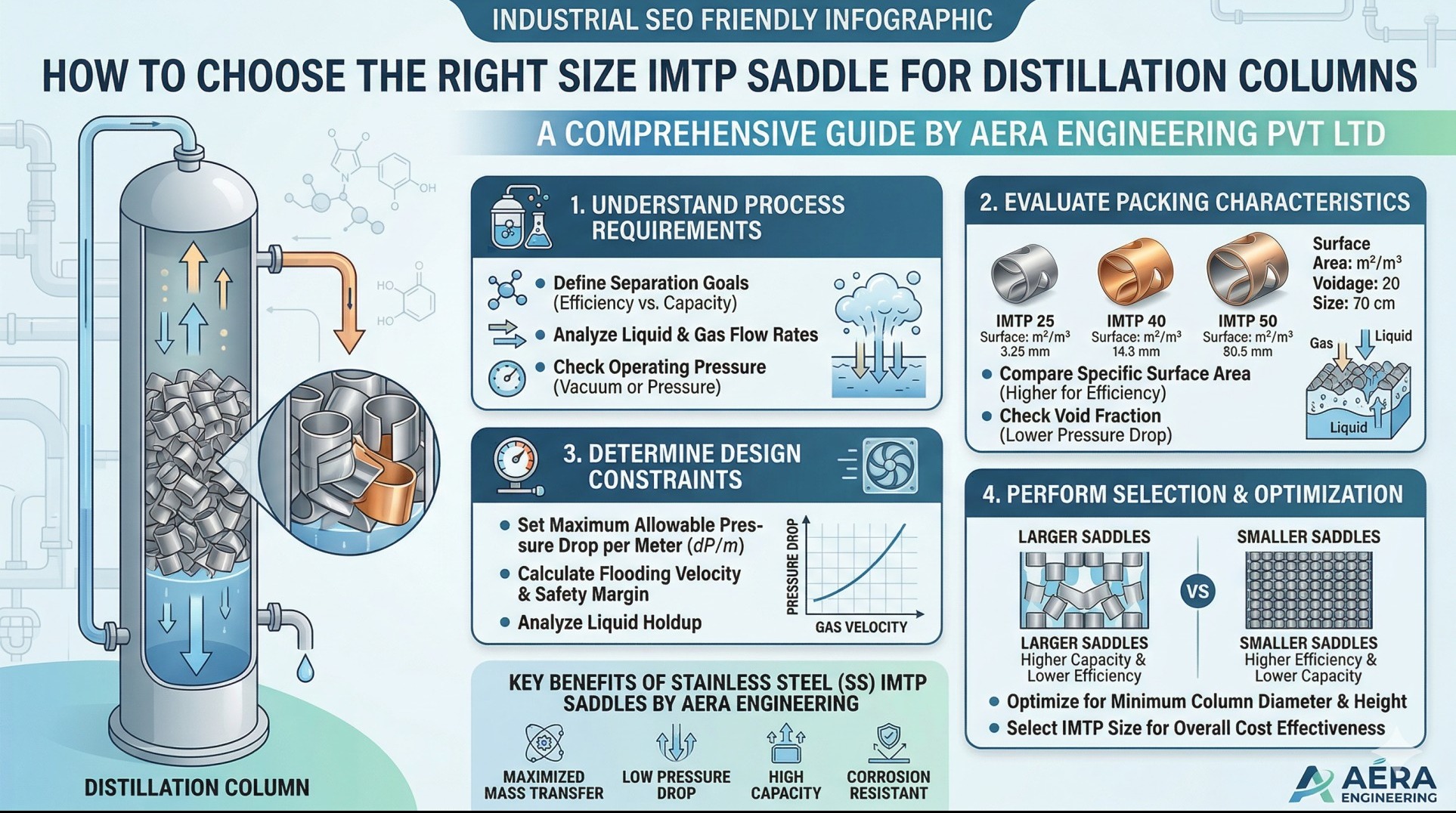
In the demanding world of chemical processing, the heart of any separation facility is the distillation column. While the column diameter and height set the primary boundaries, the internals—specifically the random tower packing—dictate the efficiency, capacity, and overall economic performance of your process. Among modern random packings, the Intalox Metal Tower Packing (IMTP) saddle shape is a third-generation industry standard, known for its optimal balance of mass transfer area and pressure drop. However, simply choosing SS Intalox Saddles isn't enough. You must select the right size. Choosing a packing that is too small leads to excessive pressure drop and premature flooding. Choosing one that is too large sacrifices separation efficiency, requiring a taller, more expensive tower to achieve the same product purity. This guide by Aera Engineering Pvt Ltd, a leading manufacturer of high-performance tower packing in Vadodara, Gujarat, walks you through the critical engineering factors needed to make the right decision. 1. Defining the Core Trade-Off: Efficiency vs. Capacity The selection of any random packing size is fundamentally a trade-off between two competing performance characteristics: A. Mass Transfer Efficiency (Separation Purity) Smaller IMTP sizes (e.g., IMTP 25) have a higher geometric surface area. They create more contact points between the ascending vapor and the descending liquid. • Metric to Watch: Higher Number of Theoretical Stages per Meter (NTSM). • Result: Greater separation purity or a shorter required column height to achieve a specific composition. B. Hydraulic Capacity (Throughput) Larger IMTP sizes (e.g., IMTP 50) have a larger nominal opening and higher void fraction (open space). This allows gas and liquid to flow more easily through the bed with less resistance. • Metric to Watch: Higher Flooding Velocity and lower pressure drop. • Result: Higher operational capacity (throughput) or a smaller column diameter required to handle a specific volumetric flow rate. 2. Key Process Constraints to Consider A. Minimum Column Diameter Ratio There is a mechanical rule of thumb to prevent maldistribution, in which the liquid primarily flows down the column walls rather than through the packing bed. • Rule: The nominal column diameter should be at least 15 times the nominal packing size. • Application: If your column diameter is 300 mm (12 inches), your maximum nominal packing size should be approximately 20 mm. Thus, IMTP 25 might be acceptable, but IMTP 40 or 50 is too large. For towers larger than 900 mm (3 feet), 40 mm or 50 mm saddles are generally required. B. System Operating Pressure: Vacuum vs. Pressure The operating pressure dramatically affects vapor density and, consequently, vapor velocity. • Vacuum Distillation: Operating at extremely low pressure drop is critical because vapor volumes are very high, and energy costs scale rapidly. This favors larger saddle sizes (e.g., IMTP 50) that offer the lowest restriction. • High-Pressure Distillation: Vapor volumes are smaller, and the separation might be harder. High pressure drop is less of an economic penalty. This scenario may allow for smaller, higher-efficiency saddles. C. Liquid and Vapor Loading Rates High vapor flow rates require large void space to prevent flooding, pushing the design toward larger packing. High liquid loading requires good surface area for wetting, favoring slightly smaller packing, but the design must still handle the total combined flow without high pressure drop. 3. Step-by-Step Selection Procedure While a rigorous solution requires mass transfer simulation software (like Aspen Hysys®), engineers can follow this iterative procedure for a conceptual design: 1. Establish System Goals: Determine required product purity, desired throughput, and allowed pressure drop. 2. Estimate Initial Column Diameter: Use shortcut methods to estimate the column diameter based on an expected factor (vapor superficial kinetic energy) for a typical packing class. 3. Check Mechanical Ratio: Compare the estimated diameter against the 15:1 ratio rule to identify the allowed range of packing sizes (e.g., IMTP 25 to IMTP 50). 4. Simulate Separation Performance (HETP): Calculate the Height Equivalent to a Theoretical Plate (HETP) for the chosen sizes. Smaller packings will require less total height. 5. Simulate Hydraulic Performance: Check the pressure drop ($dP/m$) and the approach to flood (usually designed at 80% of flooding). 6. Optimize: Repeat steps 2 through 5. Does choosing a slightly smaller packing reduce the tower height enough to offset the increased column diameter required to handle the higher pressure drop? Conclusion: Balancing Your Mass Transfer Needs Choosing the right IMTP saddle size is an optimization challenge. There is no single 'best' size—only the size that optimally balances the economics of your specific separation. Partner with Aera Engineering Pvt Ltd For technical support in random packing selection, pressure drop calculations, and high-quality manufacturing of SS Intalox Saddles (IMTP), trust the experts at Aera Engineering Pvt Ltd. Located in Vadodara, Gujarat, we export premium tower internals globally. Contact us today to receive technical data tables or to request a quote for your next distillation revamp or new installation project. IMTP Saddle Size Selection Distillation Column Packing SS Intalox Saddles Mass Transfer Efficiency Pressure Drop in Packed Towers Aera Engineering Pvt Ltd.


This is your website preview.
Currently it only shows your basic business info. Start adding relevant business details such as description, images and products or services to gain your customers attention by using Boost 360 android app / iOS App / web portal.
The Engineer’s Guide: How to Choose the Right Size IMTP Saddle for Distillation Columns
2026-03-30T04:59:32
In the demanding world of chemical processing, the heart of any separation facility is the distillation column. While the column diameter and height set the primary boundaries, the internals—specifically the random tower packing—dictate the efficiency, capacity, and overall economic performance of your process. Among modern random packings, the Intalox Metal Tower Packing (IMTP) saddle shape is a third-generation industry standard, known for its optimal balance of mass transfer area and pressure drop. However, simply choosing SS Intalox Saddles isn't enough. You must select the right size. Choosing a packing that is too small leads to excessive pressure drop and premature flooding. Choosing one that is too large sacrifices separation efficiency, requiring a taller, more expensive tower to achieve the same product purity. This guide by Aera Engineering Pvt Ltd, a leading manufacturer of high-performance tower packing in Vadodara, Gujarat, walks you through the critical engineering factors needed to make the right decision. 1. Defining the Core Trade-Off: Efficiency vs. Capacity The selection of any random packing size is fundamentally a trade-off between two competing performance characteristics: A. Mass Transfer Efficiency (Separation Purity) Smaller IMTP sizes (e.g., IMTP 25) have a higher geometric surface area. They create more contact points between the ascending vapor and the descending liquid. • Metric to Watch: Higher Number of Theoretical Stages per Meter (NTSM). • Result: Greater separation purity or a shorter required column height to achieve a specific composition. B. Hydraulic Capacity (Throughput) Larger IMTP sizes (e.g., IMTP 50) have a larger nominal opening and higher void fraction (open space). This allows gas and liquid to flow more easily through the bed with less resistance. • Metric to Watch: Higher Flooding Velocity and lower pressure drop. • Result: Higher operational capacity (throughput) or a smaller column diameter required to handle a specific volumetric flow rate. 2. Key Process Constraints to Consider A. Minimum Column Diameter Ratio There is a mechanical rule of thumb to prevent maldistribution, in which the liquid primarily flows down the column walls rather than through the packing bed. • Rule: The nominal column diameter should be at least 15 times the nominal packing size. • Application: If your column diameter is 300 mm (12 inches), your maximum nominal packing size should be approximately 20 mm. Thus, IMTP 25 might be acceptable, but IMTP 40 or 50 is too large. For towers larger than 900 mm (3 feet), 40 mm or 50 mm saddles are generally required. B. System Operating Pressure: Vacuum vs. Pressure The operating pressure dramatically affects vapor density and, consequently, vapor velocity. • Vacuum Distillation: Operating at extremely low pressure drop is critical because vapor volumes are very high, and energy costs scale rapidly. This favors larger saddle sizes (e.g., IMTP 50) that offer the lowest restriction. • High-Pressure Distillation: Vapor volumes are smaller, and the separation might be harder. High pressure drop is less of an economic penalty. This scenario may allow for smaller, higher-efficiency saddles. C. Liquid and Vapor Loading Rates High vapor flow rates require large void space to prevent flooding, pushing the design toward larger packing. High liquid loading requires good surface area for wetting, favoring slightly smaller packing, but the design must still handle the total combined flow without high pressure drop. 3. Step-by-Step Selection Procedure While a rigorous solution requires mass transfer simulation software (like Aspen Hysys®), engineers can follow this iterative procedure for a conceptual design: 1. Establish System Goals: Determine required product purity, desired throughput, and allowed pressure drop. 2. Estimate Initial Column Diameter: Use shortcut methods to estimate the column diameter based on an expected factor (vapor superficial kinetic energy) for a typical packing class. 3. Check Mechanical Ratio: Compare the estimated diameter against the 15:1 ratio rule to identify the allowed range of packing sizes (e.g., IMTP 25 to IMTP 50). 4. Simulate Separation Performance (HETP): Calculate the Height Equivalent to a Theoretical Plate (HETP) for the chosen sizes. Smaller packings will require less total height. 5. Simulate Hydraulic Performance: Check the pressure drop ($dP/m$) and the approach to flood (usually designed at 80% of flooding). 6. Optimize: Repeat steps 2 through 5. Does choosing a slightly smaller packing reduce the tower height enough to offset the increased column diameter required to handle the higher pressure drop? Conclusion: Balancing Your Mass Transfer Needs Choosing the right IMTP saddle size is an optimization challenge. There is no single 'best' size—only the size that optimally balances the economics of your specific separation. Partner with Aera Engineering Pvt Ltd For technical support in random packing selection, pressure drop calculations, and high-quality manufacturing of SS Intalox Saddles (IMTP), trust the experts at Aera Engineering Pvt Ltd. Located in Vadodara, Gujarat, we export premium tower internals globally. Contact us today to receive technical data tables or to request a quote for your next distillation revamp or new installation project. IMTP Saddle Size Selection Distillation Column Packing SS Intalox Saddles Mass Transfer Efficiency Pressure Drop in Packed Towers Aera Engineering Pvt Ltd.
2026-03-30T04:59:32


Keywords
- Random Packing for Absorption Towers
- Mass Transfer Equipment Exporters Vadodara
- Industrial Distillation Column Packing Price
- Metal Saddle Packing Capacity Chart
- HETP for Intalox Saddles
- IMTP vs Pall Ring Efficiency
- Acid Resistant Metal Saddles
- Low Pressure Drop Tower Internals
- High Efficiency Random Packing
- SS 316L IMTP 25mm Saddles
- Intalox Metal Tower Packing
- Metal Tower Packing India
- SS Intalox Saddles
- IMTP Packing Manufacturer
- IMTP saddle size selection
- SS Intalox Saddles IMTP sizing
- distillation column packing design
- Aera Engineering Vadodara Gujarat
- random packing height equivalent (HETP)
Submit Your Enquiry