
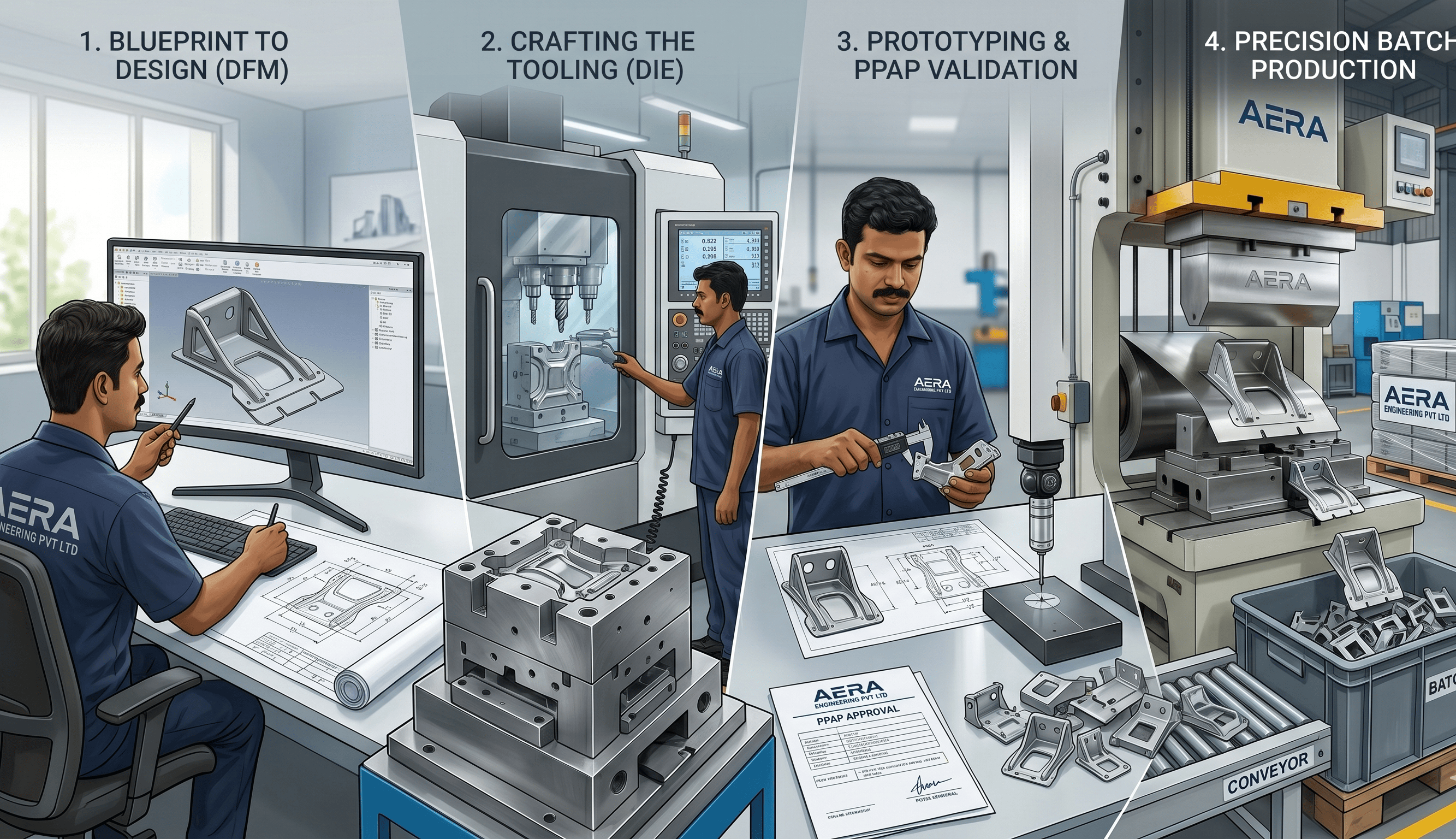
In the world of precision manufacturing, a finished part is more than just shaped metal. It is the culmination of meticulous engineering, rigorous testing, and advanced production techniques. For Aera Engineering Pvt Ltd, achieving 'Precision in Every Press' isn't just a slogan—it is a technical mandate that governs every stage of a component's lifecycle. When you require a custom pressed component, the journey from your initial concept to a finished batch ready for assembly is a sophisticated process. Here is how Aera Engineering brings your blueprint to life. Stage 1: The Blueprint – Engineering and Design The life cycle begins with your requirement. Our journey starts not on the factory floor, but at the engineering desk. Design for Manufacturability (DFM): Our engineering team analyzes your blueprints and 3D models. We don’t just look at dimensions; we look at feasibility. Can this sharp corner be pressed without tearing? Is the material choice optimal for the part's function? Simulations: Before a single piece of metal is cut, we use advanced simulation software to predict metal flow, stress distribution, and potential defects. This ensures the design is robust and optimized for production. Stage 2: The Tooling – Crafting the Mold The heart of any custom pressed component is the tooling (or die). This is the customized hardware that will shape the metal. Precision Machining: Our toolroom creates the dies to incredibly tight tolerances. Utilizing CNC machining, EDM (Electrical Discharge Machining), and grinding, we ensure that the die is an exact mirror image of your component design. Hardening: Once shaped, the tools are heat-treated to achieve the necessary hardness and durability to withstand the immense pressures of thousands of press cycles. Stage 3: The Trial – Prototyping and PPAP Before committing to a full production run, we must prove the process. This is the critical validation phase. First Articles: We produce a small run of parts using the production tooling. These components are subjected to comprehensive inspections. PPAP (Production Part Approval Process): Aera Engineering adheres strictly to PPAP standards. We provide documentation including dimensional results, material certifications, and process capability studies (Cpk), ensuring you have absolute confidence in the quality of the upcoming batch. [Image showing a quality control technician measuring a prototype part with a caliper, with a blueprint in the background] Stage 4: The Press – Production Batch Once approval is granted, the 'Precision in Every Press' directive moves into high gear. This is where the engineering planning pays off in high-volume efficiency. Material Selection: As discussed in our previous blog, the correct material is crucial. We verify the gauge, temper, and certification of the metal coils or sheets before feeding them into the press. The Operation: Whether utilizing progressive dies for high-speed multi-stage operations or single-stage deep drawing, our sophisticated presses cycle flawlessly. Every press stroke applies the precise force required to form the material consistently. In-Process Inspection: Quality isn't just checked at the end; it is monitored constantly. Operators and automated sensors ensure dimensions remain within tolerance throughout the production run. Stage 5: The Finish – Post-Processing and Delivery A pressed component is often not finished once it leaves the die. Secondary Operations: This may include deburring, washing, tapped holes, or welding components together. Surface Treatments: We manage requirements for plating (zinc, nickel, chrome), powder coating, or heat treatment to enhance performance or appearance. Logistics: The final components are carefully packed to prevent damage during transit and are delivered to your facility, ready for immediate use in your assembly line. Your Precision Partner: Aera Engineering The journey from a digital blueprint to a physical batch of thousands of components requires expertise at every juncture. By choosing Aera Engineering Pvt Ltd, you are partnering with a team that treats your custom component with the precision it demands, from the very first conceptual discussion to the final delivery. Ready to start the lifecycle of your next custom component? Contact Aera Engineering today to discuss how we can bring precision to your project.


This is your website preview.
Currently it only shows your basic business info. Start adding relevant business details such as description, images and products or services to gain your customers attention by using Boost 360 android app / iOS App / web portal.
The Lifecycle of a Custom Pressed Component
2026-04-20T18:31:30
In the world of precision manufacturing, a finished part is more than just shaped metal. It is the culmination of meticulous engineering, rigorous testing, and advanced production techniques. For Aera Engineering Pvt Ltd, achieving 'Precision in Every Press' isn't just a slogan—it is a technical mandate that governs every stage of a component's lifecycle. When you require a custom pressed component, the journey from your initial concept to a finished batch ready for assembly is a sophisticated process. Here is how Aera Engineering brings your blueprint to life. Stage 1: The Blueprint – Engineering and Design The life cycle begins with your requirement. Our journey starts not on the factory floor, but at the engineering desk. Design for Manufacturability (DFM): Our engineering team analyzes your blueprints and 3D models. We don’t just look at dimensions; we look at feasibility. Can this sharp corner be pressed without tearing? Is the material choice optimal for the part's function? Simulations: Before a single piece of metal is cut, we use advanced simulation software to predict metal flow, stress distribution, and potential defects. This ensures the design is robust and optimized for production. Stage 2: The Tooling – Crafting the Mold The heart of any custom pressed component is the tooling (or die). This is the customized hardware that will shape the metal. Precision Machining: Our toolroom creates the dies to incredibly tight tolerances. Utilizing CNC machining, EDM (Electrical Discharge Machining), and grinding, we ensure that the die is an exact mirror image of your component design. Hardening: Once shaped, the tools are heat-treated to achieve the necessary hardness and durability to withstand the immense pressures of thousands of press cycles. Stage 3: The Trial – Prototyping and PPAP Before committing to a full production run, we must prove the process. This is the critical validation phase. First Articles: We produce a small run of parts using the production tooling. These components are subjected to comprehensive inspections. PPAP (Production Part Approval Process): Aera Engineering adheres strictly to PPAP standards. We provide documentation including dimensional results, material certifications, and process capability studies (Cpk), ensuring you have absolute confidence in the quality of the upcoming batch. [Image showing a quality control technician measuring a prototype part with a caliper, with a blueprint in the background] Stage 4: The Press – Production Batch Once approval is granted, the 'Precision in Every Press' directive moves into high gear. This is where the engineering planning pays off in high-volume efficiency. Material Selection: As discussed in our previous blog, the correct material is crucial. We verify the gauge, temper, and certification of the metal coils or sheets before feeding them into the press. The Operation: Whether utilizing progressive dies for high-speed multi-stage operations or single-stage deep drawing, our sophisticated presses cycle flawlessly. Every press stroke applies the precise force required to form the material consistently. In-Process Inspection: Quality isn't just checked at the end; it is monitored constantly. Operators and automated sensors ensure dimensions remain within tolerance throughout the production run. Stage 5: The Finish – Post-Processing and Delivery A pressed component is often not finished once it leaves the die. Secondary Operations: This may include deburring, washing, tapped holes, or welding components together. Surface Treatments: We manage requirements for plating (zinc, nickel, chrome), powder coating, or heat treatment to enhance performance or appearance. Logistics: The final components are carefully packed to prevent damage during transit and are delivered to your facility, ready for immediate use in your assembly line. Your Precision Partner: Aera Engineering The journey from a digital blueprint to a physical batch of thousands of components requires expertise at every juncture. By choosing Aera Engineering Pvt Ltd, you are partnering with a team that treats your custom component with the precision it demands, from the very first conceptual discussion to the final delivery. Ready to start the lifecycle of your next custom component? Contact Aera Engineering today to discuss how we can bring precision to your project.
2026-04-20T18:31:30


Keywords
- Pall rings manufacturer in Vadodara
- IMTP saddle suppliers in Gujarat
- Tower packing manufacturers near me
- CMR rings price in India
- Random packing suppliers in Pune
- Mass transfer equipment manufacturers in Mumbai
- Stainless Steel Pall Ring price per piece
- Bulk IMTP saddle tower packing for sale
- Metal CMR rings for distillation columns India
- Industrial tower internals price list
- Plastic Pall Ring 50mm price India
- Custom CMR ring design services
- SS 316L Pall Rings for acid scrubbing
- High-efficiency IMTP packing for solvent recovery
- Equivalent CMR rings for VOC removal
- Tower packing for petrochemical distillation India
- Corrosion-resistant random packing for chemical plants
- Low pressure drop IMTP saddle specifications
- Top rated IMTP saddles in India
- custom pressed component lifecycle
- precision engineering manufacturing
- Tooling die CNC EDM grinding
- PPAP Production Part Approval Process
- post-processing and delivery services
Submit Your Enquiry