
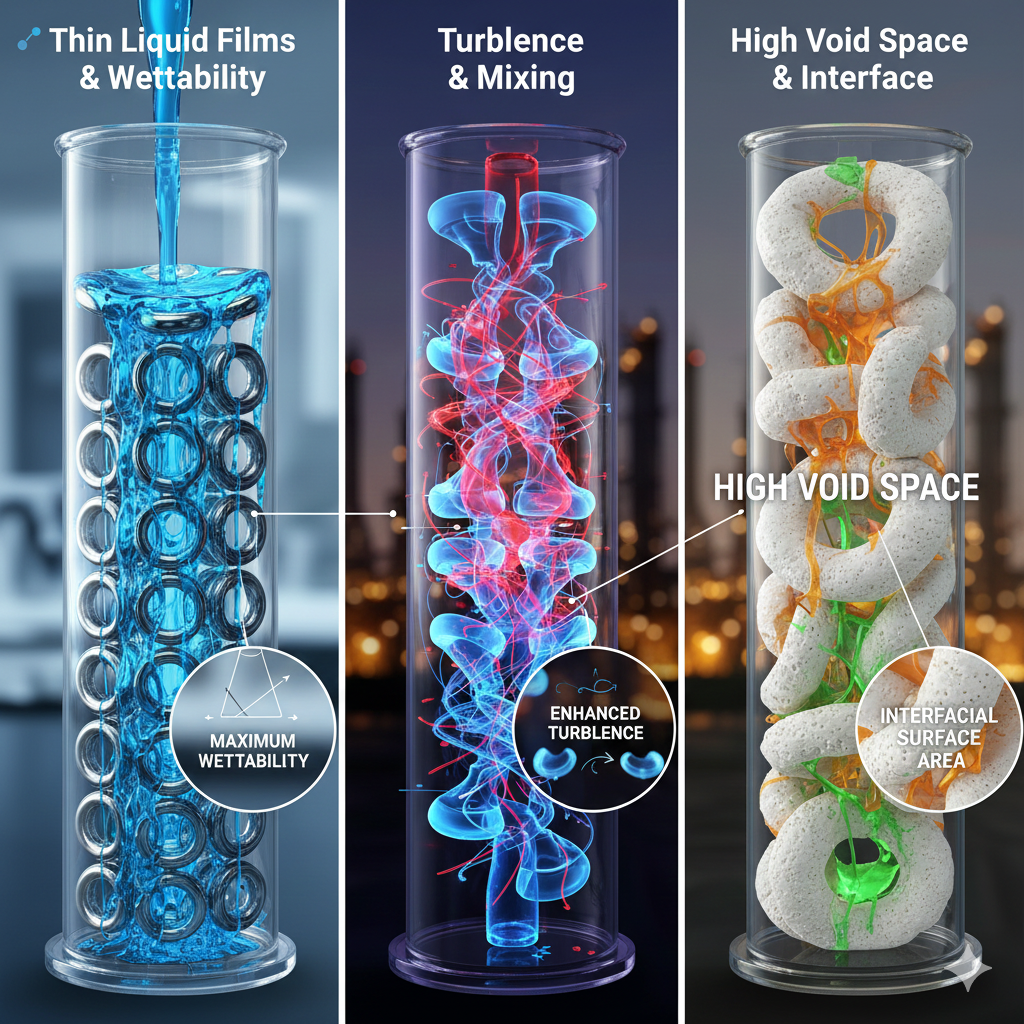
The Heart of Separation: Interfacial Area Mass transfer, the core principle of packed columns, relies on molecules moving between two phases (e.g., liquid to gas). This movement is maximized when the interfacial surface area between the phases is as large as possible. How Packing Creates Surface Area Thin Liquid Films: Packing encourages liquid to spread into thin films, dramatically increasing its exposed surface. Turbulence and Mixing: The complex pathways through the packing promote turbulence, constantly refreshing the liquid-gas interface. High Void Space: Allows for unimpeded flow of both phases, maintaining the interface. Key Factors Affecting Mass Transfer Wettability: How well the liquid spreads over the packing material. (Metal generally has better wettability than some plastics). Surface Roughness: Microscopic roughness can enhance film spreading and turbulence. Packing Geometry: Shapes like Pall Rings and Saddles are designed to expose maximum surface area while minimizing pressure drop. Measuring Efficiency: HETP and HTU HETP (Height Equivalent to a Theoretical Plate): A lower HETP indicates higher efficiency (shorter column needed for same separation). HTU (Height of a Transfer Unit): Another metric of mass transfer efficiency, often broken down by phase. The Engineering Challenge The goal is to design packing that maximizes this critical surface area for mass transfer, without creating excessive resistance to flow (pressure drop).


This is your website preview.
Currently it only shows your basic business info. Start adding relevant business details such as description, images and products or services to gain your customers attention by using Boost 360 android app / iOS App / web portal.
The Science of Surface: How Packing Maximizes Mass Transfer
2025-12-07T18:30:01
The Heart of Separation: Interfacial Area Mass transfer, the core principle of packed columns, relies on molecules moving between two phases (e.g., liquid to gas). This movement is maximized when the interfacial surface area between the phases is as large as possible. How Packing Creates Surface Area Thin Liquid Films: Packing encourages liquid to spread into thin films, dramatically increasing its exposed surface. Turbulence and Mixing: The complex pathways through the packing promote turbulence, constantly refreshing the liquid-gas interface. High Void Space: Allows for unimpeded flow of both phases, maintaining the interface. Key Factors Affecting Mass Transfer Wettability: How well the liquid spreads over the packing material. (Metal generally has better wettability than some plastics). Surface Roughness: Microscopic roughness can enhance film spreading and turbulence. Packing Geometry: Shapes like Pall Rings and Saddles are designed to expose maximum surface area while minimizing pressure drop. Measuring Efficiency: HETP and HTU HETP (Height Equivalent to a Theoretical Plate): A lower HETP indicates higher efficiency (shorter column needed for same separation). HTU (Height of a Transfer Unit): Another metric of mass transfer efficiency, often broken down by phase. The Engineering Challenge The goal is to design packing that maximizes this critical surface area for mass transfer, without creating excessive resistance to flow (pressure drop).
2025-12-07T18:30:01


Submit Your Enquiry