
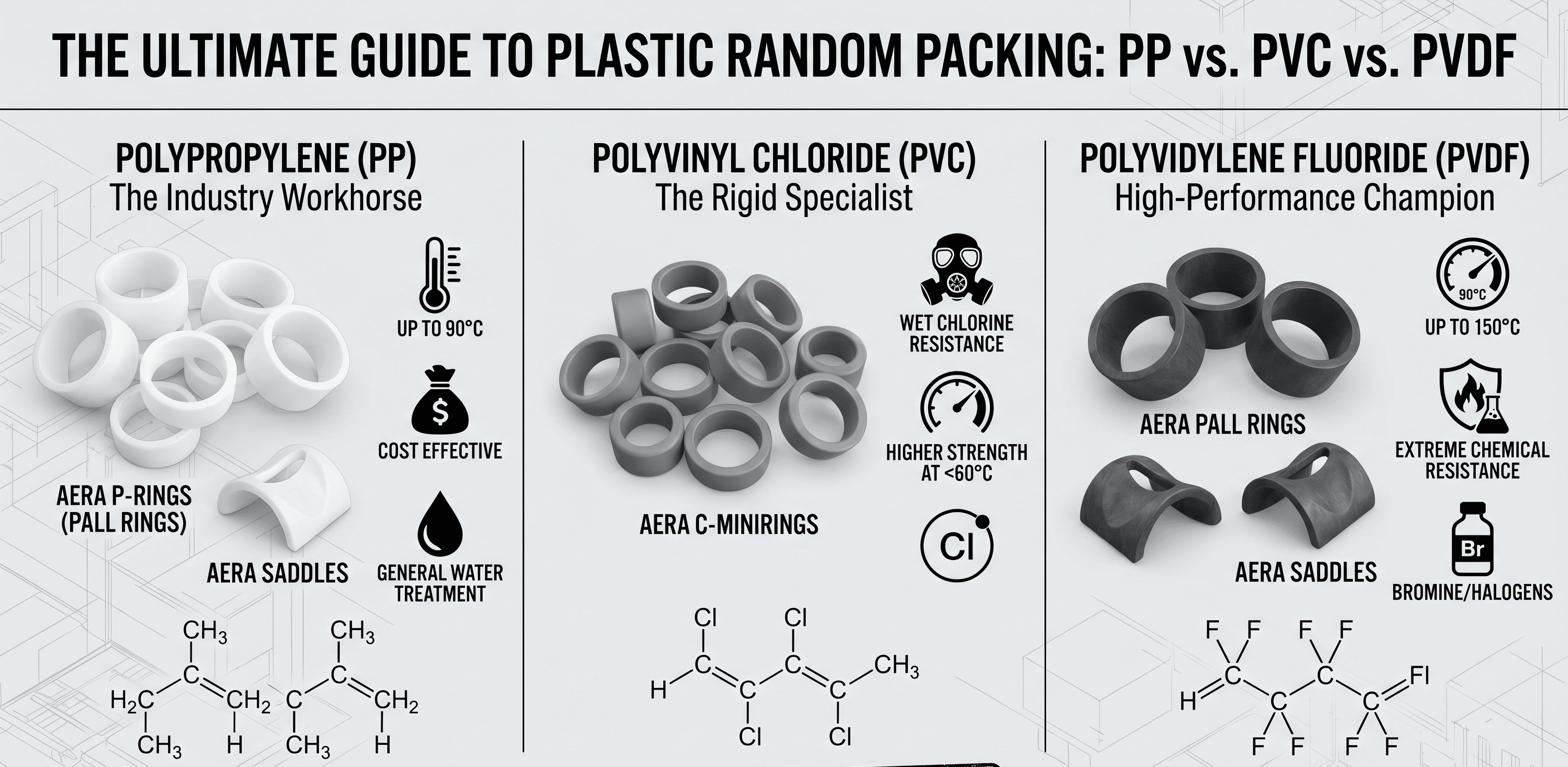
This blog is designed to position Aera Engineering Pvt Ltd as a technical authority for international buyers, specifically those in the Middle East and Southeast Asia looking for high-durability solutions for chemical scrubbing and water treatment. In the world of mass transfer, selecting the right material is just as critical as selecting the right packing shape. At Aera Engineering Pvt Ltd, we’ve seen how the right choice in polymer can extend the life of a scrubbing tower by decades, while the wrong choice can lead to catastrophic structural failure within months. When designing or refurbishing a tower, engineers primarily weigh three heavyweight polymers: Polypropylene (PP), Polyvinyl Chloride (PVC), and Polyvinylidene Fluoride (PVDF). This guide breaks down the technical nuances of each to help you make an informed decision for your next project. 1. Polypropylene (PP): The Industry Workhorse Polypropylene is the most widely used plastic for random packing (such as Aera P-Rings and Saddles) due to its exceptional balance of cost and performance. Temperature Range: Effective up to 90°C (194°F). Beyond this, the material begins to soften, leading to packing deformation and increased pressure drop. Chemical Resistance: Excellent resistance to aqueous solutions of inorganic salts, as well as most inorganic acids and bases. Best For: Water treatment, cooling towers, and general-purpose acid scrubbing where temperatures remain moderate. The Aera Advantage: Our PP packings are UV-stabilized, making them ideal for outdoor installations where solar exposure is a factor. 2. Polyvinyl Chloride (PVC): The Rigid Specialist PVC is often chosen for its superior mechanical strength and specific chemical resistances that PP cannot match. Temperature Range: Lower than PP, typically limited to 60°C (140°F). Chemical Resistance: Superior resistance to oxidizing agents and high concentrations of chlorine. This makes it a staple in chlor-alkali plants. Best For: Wet chlorine gas scrubbing, brine processing, and applications requiring high structural rigidity at lower temperatures. Note: If your process involves temperatures above 60°C, we recommend looking at CPVC (Chlorinated PVC), which pushes the limit to 90°C while maintaining PVC’s chemical profile. 3. PVDF: The High-Performance Champion When the environment is too aggressive for standard plastics, PVDF is the premium solution. It bridges the gap between plastic and exotic metals. Temperature Range: Highly stable up to 140°C–150°C (302°F). Chemical Resistance: Virtually inert to most acids, solvents, and oxidizers. It is particularly resistant to bromine, fluorine, and high-temperature sulfuric acid. Best For: High-temperature chemical processing, pharmaceutical manufacturing, and ultra-pure water systems where leaching must be zero. The Aera Advantage: Our PVDF Pall Rings and Saddles are engineered for maximum surface area, ensuring that even in low-volume, high-concentration chemical reactions, the mass transfer efficiency remains peak. Why Material Selection Matters for Global Exports For our clients in the Middle East—especially those currently undergoing emergency refinery and petrochemical repairs—material selection is a strategic decision. A tower in a Saudi Arabian petrochemical plant processing high-temperature corrosive gases cannot afford the downtime of a melted PP packing. Conversely, for a desalination plant in the UAE, utilizing expensive PVDF when PP would suffice is an unnecessary capital expenditure. Conclusion: Partner with Aera Engineering Choosing the right plastic random packing is a science. At Aera Engineering Pvt Ltd, we don't just manufacture components; we provide engineering consultation. Whether you are rebuilding a damaged scrubber in Kuwait or optimizing a new plant in India, our team ensures you have the right polymer for the right process. Ready to optimize your tower? Contact Aera Engineering’s technical desk today for material compatibility charts and custom quotes for your export requirements. Visit our Product Gallery | Vadodara, Gujarat, India


This is your website preview.
Currently it only shows your basic business info. Start adding relevant business details such as description, images and products or services to gain your customers attention by using Boost 360 android app / iOS App / web portal.
The Ultimate Guide to Plastic Random Packing: PP vs. PVC vs. PVDF
2026-04-24T08:32:03
This blog is designed to position Aera Engineering Pvt Ltd as a technical authority for international buyers, specifically those in the Middle East and Southeast Asia looking for high-durability solutions for chemical scrubbing and water treatment. In the world of mass transfer, selecting the right material is just as critical as selecting the right packing shape. At Aera Engineering Pvt Ltd, we’ve seen how the right choice in polymer can extend the life of a scrubbing tower by decades, while the wrong choice can lead to catastrophic structural failure within months. When designing or refurbishing a tower, engineers primarily weigh three heavyweight polymers: Polypropylene (PP), Polyvinyl Chloride (PVC), and Polyvinylidene Fluoride (PVDF). This guide breaks down the technical nuances of each to help you make an informed decision for your next project. 1. Polypropylene (PP): The Industry Workhorse Polypropylene is the most widely used plastic for random packing (such as Aera P-Rings and Saddles) due to its exceptional balance of cost and performance. Temperature Range: Effective up to 90°C (194°F). Beyond this, the material begins to soften, leading to packing deformation and increased pressure drop. Chemical Resistance: Excellent resistance to aqueous solutions of inorganic salts, as well as most inorganic acids and bases. Best For: Water treatment, cooling towers, and general-purpose acid scrubbing where temperatures remain moderate. The Aera Advantage: Our PP packings are UV-stabilized, making them ideal for outdoor installations where solar exposure is a factor. 2. Polyvinyl Chloride (PVC): The Rigid Specialist PVC is often chosen for its superior mechanical strength and specific chemical resistances that PP cannot match. Temperature Range: Lower than PP, typically limited to 60°C (140°F). Chemical Resistance: Superior resistance to oxidizing agents and high concentrations of chlorine. This makes it a staple in chlor-alkali plants. Best For: Wet chlorine gas scrubbing, brine processing, and applications requiring high structural rigidity at lower temperatures. Note: If your process involves temperatures above 60°C, we recommend looking at CPVC (Chlorinated PVC), which pushes the limit to 90°C while maintaining PVC’s chemical profile. 3. PVDF: The High-Performance Champion When the environment is too aggressive for standard plastics, PVDF is the premium solution. It bridges the gap between plastic and exotic metals. Temperature Range: Highly stable up to 140°C–150°C (302°F). Chemical Resistance: Virtually inert to most acids, solvents, and oxidizers. It is particularly resistant to bromine, fluorine, and high-temperature sulfuric acid. Best For: High-temperature chemical processing, pharmaceutical manufacturing, and ultra-pure water systems where leaching must be zero. The Aera Advantage: Our PVDF Pall Rings and Saddles are engineered for maximum surface area, ensuring that even in low-volume, high-concentration chemical reactions, the mass transfer efficiency remains peak. Why Material Selection Matters for Global Exports For our clients in the Middle East—especially those currently undergoing emergency refinery and petrochemical repairs—material selection is a strategic decision. A tower in a Saudi Arabian petrochemical plant processing high-temperature corrosive gases cannot afford the downtime of a melted PP packing. Conversely, for a desalination plant in the UAE, utilizing expensive PVDF when PP would suffice is an unnecessary capital expenditure. Conclusion: Partner with Aera Engineering Choosing the right plastic random packing is a science. At Aera Engineering Pvt Ltd, we don't just manufacture components; we provide engineering consultation. Whether you are rebuilding a damaged scrubber in Kuwait or optimizing a new plant in India, our team ensures you have the right polymer for the right process. Ready to optimize your tower? Contact Aera Engineering’s technical desk today for material compatibility charts and custom quotes for your export requirements. Visit our Product Gallery | Vadodara, Gujarat, India
2026-04-24T08:32:03


Submit Your Enquiry