
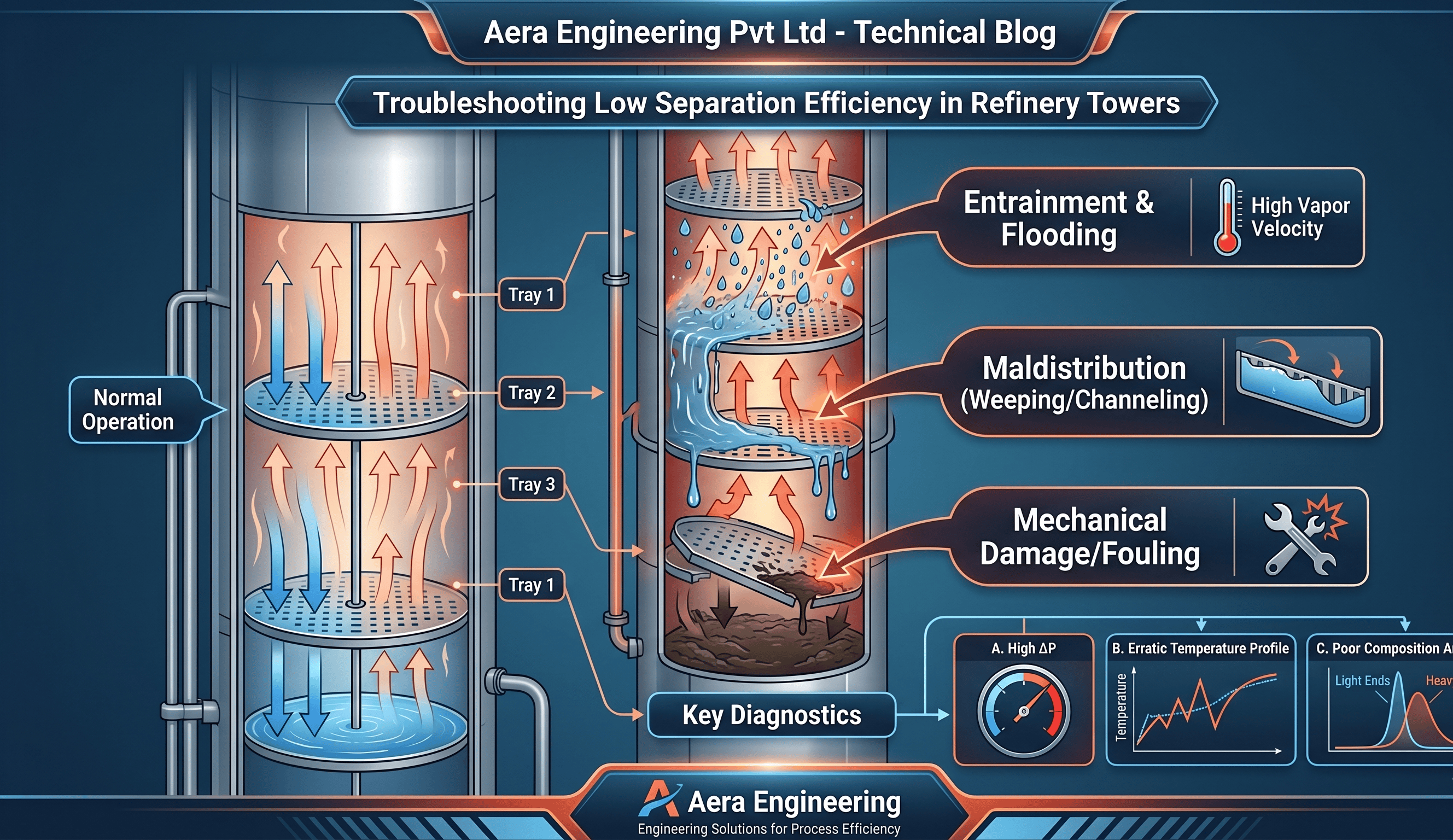
In the high-stakes world of refining, the distillation tower is the heart of the process. When separation efficiency drops, it isn’t just a technical hiccup—it’s a direct hit to your bottom line through off-spec products, increased energy consumption, and reduced throughput. At Aera Engineering, we specialize in diagnosing these complex internal dynamics. Here is a breakdown of how to identify and solve the most common culprits of low separation efficiency. 1. Identifying the Symptoms Before diving into the hardware, look for the 'fingerprints' of inefficiency in your data: Overlapping Boiling Points: Heavy ends showing up in your light cuts (or vice versa). High Pressure Drop : A sudden spike often indicates physical blockage or flooding. Erratic Temperature Profiles: If tray temperatures aren't following the predicted gradient, internal liquid/vapor distribution is likely compromised. 2. Common Culprits and Solutions A. Internal Maldistribution Efficiency relies on the intimate contact between rising vapor and falling liquid. If the liquid channels down one side of the tower while vapor bypasses it on the other, your theoretical stages effectively disappear. The Cause: Levelness issues with trays, plugged distributors, or damaged weir plates. The Fix: During turnarounds, verify the levelness of all tray decks to within $pm 3$ mm and ensure distributors are clear of debris or scale. B. Entrainment and Flooding When vapor velocity is too high, it carries liquid droplets up to the tray above (entrainment), or the liquid simply cannot flow down fast enough (flooding). The Cause: Operating above design capacity or foaming issues. The Fix: If foaming is the culprit, chemical anti-foaming agents can provide a quick fix. Long-term, consider upgrading to high-capacity trays or structured packing designed for higher vapor loads. C. Mechanical Damage Refinery environments are harsh. Pressure surges during startups or shutdowns can 'dislodge' trays or weeping valves. The Cause: High-pressure steam-outs or sudden feed surges. The Fix: Utilize Gamma Scanning while the tower is online. This non-invasive diagnostic tool allows us to 'see' inside the tower and identify collapsed trays or missing sections without a shutdown. 3. The Role of Advanced Process Control (APC) Sometimes the hardware is fine, but the 'brain' is struggling. Fluctuating feed compositions or unstable heat duties can make it impossible for a tower to maintain steady-state separation. Solution: Implementing robust reflux control and feed-forward loops ensures the tower can compensate for upstream changes before they ruin the product cut. Engineering a Solution with Aera Troubleshooting a tower requires a blend of theoretical modeling and 'boots-on-the-ground' experience. Whether it’s a hydraulic bottleneck or a mechanical failure, Aera Engineering provides the forensic analysis needed to restore your tower to peak performance. Is your tower meeting its design specs? Contact our technical team today for a comprehensive performance audit. Optimizing Energy. Maximizing Yield. Aera Engineering Pvt Ltd.


This is your website preview.
Currently it only shows your basic business info. Start adding relevant business details such as description, images and products or services to gain your customers attention by using Boost 360 android app / iOS App / web portal.
Troubleshooting Low Separation Efficiency in Refinery Towers
2026-04-19T01:30:04
In the high-stakes world of refining, the distillation tower is the heart of the process. When separation efficiency drops, it isn’t just a technical hiccup—it’s a direct hit to your bottom line through off-spec products, increased energy consumption, and reduced throughput. At Aera Engineering, we specialize in diagnosing these complex internal dynamics. Here is a breakdown of how to identify and solve the most common culprits of low separation efficiency. 1. Identifying the Symptoms Before diving into the hardware, look for the 'fingerprints' of inefficiency in your data: Overlapping Boiling Points: Heavy ends showing up in your light cuts (or vice versa). High Pressure Drop : A sudden spike often indicates physical blockage or flooding. Erratic Temperature Profiles: If tray temperatures aren't following the predicted gradient, internal liquid/vapor distribution is likely compromised. 2. Common Culprits and Solutions A. Internal Maldistribution Efficiency relies on the intimate contact between rising vapor and falling liquid. If the liquid channels down one side of the tower while vapor bypasses it on the other, your theoretical stages effectively disappear. The Cause: Levelness issues with trays, plugged distributors, or damaged weir plates. The Fix: During turnarounds, verify the levelness of all tray decks to within $pm 3$ mm and ensure distributors are clear of debris or scale. B. Entrainment and Flooding When vapor velocity is too high, it carries liquid droplets up to the tray above (entrainment), or the liquid simply cannot flow down fast enough (flooding). The Cause: Operating above design capacity or foaming issues. The Fix: If foaming is the culprit, chemical anti-foaming agents can provide a quick fix. Long-term, consider upgrading to high-capacity trays or structured packing designed for higher vapor loads. C. Mechanical Damage Refinery environments are harsh. Pressure surges during startups or shutdowns can 'dislodge' trays or weeping valves. The Cause: High-pressure steam-outs or sudden feed surges. The Fix: Utilize Gamma Scanning while the tower is online. This non-invasive diagnostic tool allows us to 'see' inside the tower and identify collapsed trays or missing sections without a shutdown. 3. The Role of Advanced Process Control (APC) Sometimes the hardware is fine, but the 'brain' is struggling. Fluctuating feed compositions or unstable heat duties can make it impossible for a tower to maintain steady-state separation. Solution: Implementing robust reflux control and feed-forward loops ensures the tower can compensate for upstream changes before they ruin the product cut. Engineering a Solution with Aera Troubleshooting a tower requires a blend of theoretical modeling and 'boots-on-the-ground' experience. Whether it’s a hydraulic bottleneck or a mechanical failure, Aera Engineering provides the forensic analysis needed to restore your tower to peak performance. Is your tower meeting its design specs? Contact our technical team today for a comprehensive performance audit. Optimizing Energy. Maximizing Yield. Aera Engineering Pvt Ltd.
2026-04-19T01:30:04


Submit Your Enquiry