
This blog is designed to address a common pain point for plant operators, positioning Aera Engineering Pvt Ltd as a troubleshooting expert and a provider of high-durability solutions. In a packed tower, 'flooding' is the ultimate operational nightmare. It happens when the upward velocity of gas prevents the downward flow of liquid, causing the liquid to accumulate and eventually blow out the top of the column. While flooding is often blamed on incorrect flow rates or pressure surges, the silent culprit is frequently the physical condition of the internals. At Aera Engineering Pvt Ltd, our forensic analysis of failed towers often points to one specific issue: degraded or collapsed plastic packing. Understanding how plastic media degrades—and how that leads to flooding—is the first step in preventing costly unplanned shutdowns. The Mechanics of Flooding For a tower to operate efficiently, it needs a consistent 'void fraction' ($epsilon$). This is the empty space through which gas and liquid pass. When the void fraction decreases, the gas velocity must increase to pass through the smaller openings. Eventually, this velocity hits a 'critical point' where it suspends the liquid. This is the Flood Point. How Degraded Plastic Packing Triggers Flooding Plastic random media (PP, PVC, PVDF) are incredibly durable, but they are not immortal. Here are the three ways degradation leads to a flooded tower: 1. Thermal Softening (The 'Nesting' Effect) Every polymer has a Maximum Service Temperature. If a process surge exceeds this limit (e.g., 90°C for Polypropylene), the packing begins to soften. What happens: Under the weight of the bed, the softened rings lose their structural integrity and 'nest' into one another. The Result: The random bed becomes a solid mass. The void fraction collapses, resistance to flow skyrockets, and the tower floods almost instantly. 2. Chemical Embrittlement Exposure to strong oxidizers or UV radiation can break the polymer chains, making the plastic brittle. What happens: The packing pieces begin to crack and shatter. Small shards of plastic (fines) fall through the bed and accumulate at the support plate. The Result: These 'fines' act like a filter, plugging the holes in the support plate and the interstices of the packing. This creates a localized flood zone at the bottom of the tower. 3. Scaling and Fouling While not a degradation of the plastic itself, the surface texture of old, 'etched' plastic packing can promote the buildup of scale or biological growth. What happens: Rough, degraded surfaces provide more 'anchors' for solids to attach to. The Result: As scale builds up, it physically takes up the space intended for gas flow, reducing the void fraction. Troubleshooting Steps: Is Your Packing the Problem? If your tower is experiencing chronic flooding, follow this checklist: Check Pressure Drop ($Delta P$): A steady increase in pressure drop over time, even at constant flow rates, usually indicates a gradual collapse or fouling of the packing bed. Analyze Sight Glasses: Look for 'liquid entrainment' (mist) at the top of the bed. Physical Inspection (The Hand-Hole Test): If possible, extract a sample of the packing. If the pieces are deformed, discolored, or brittle to the touch, a full bed replacement is likely necessary. The Aera Engineering Solution: Preventive Quality At Aera Engineering Pvt Ltd, we believe the best way to troubleshoot flooding is to prevent it during the procurement phase. High-Grade Resins: We use only virgin, UV-stabilized resins to ensure maximum life and resistance to embrittlement. Reinforced Geometries: Our Aera P-Rings and I-Saddles are designed with specific rib thicknesses to provide superior mechanical strength, even at the upper limits of their temperature ranges. Material Consulting: Not sure if PP is right for your 85°C scrubber? Our engineers provide material compatibility audits to ensure you don't face a 'thermal collapse' six months into operation. Conclusion: Don't Wait for the Flood A flooded tower isn't just a technical failure; it's a massive financial drain. If you suspect your plastic packing is nearing the end of its lifecycle, the time to act is during your next scheduled turnaround. Rebuild with Confidence. Contact Aera Engineering for an audit of your current tower internals and a quote for high-durability replacement media. [Consult our Troubleshooting Team] | Aera Engineering Pvt Ltd | Vadodara, India


This is your website preview.
Currently it only shows your basic business info. Start adding relevant business details such as description, images and products or services to gain your customers attention by using Boost 360 android app / iOS App / web portal.
Troubleshooting Tower Flooding: The Role of Degraded Plastic Packing
2026-04-25T05:32:06
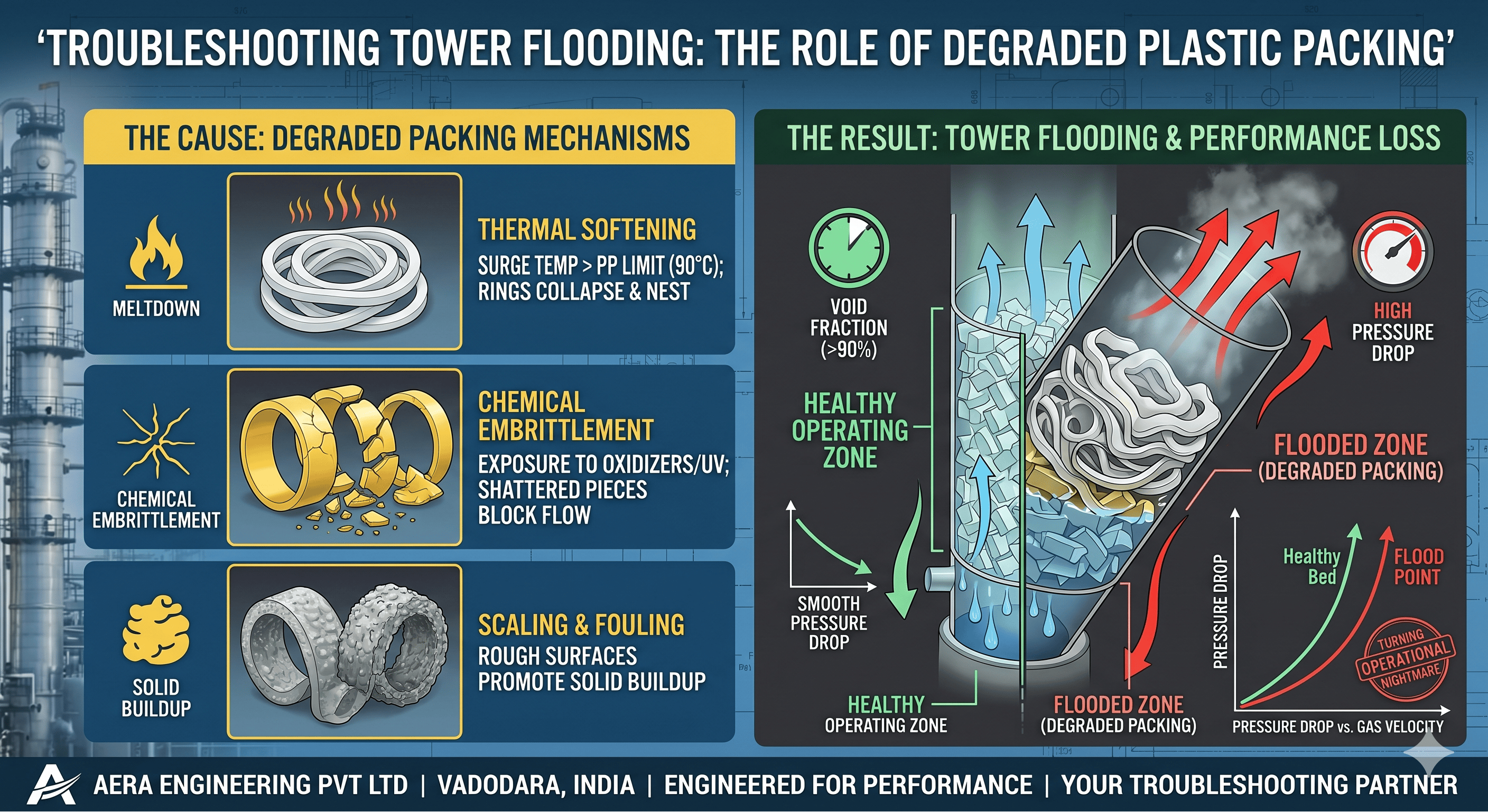
This blog is designed to address a common pain point for plant operators, positioning Aera Engineering Pvt Ltd as a troubleshooting expert and a provider of high-durability solutions. In a packed tower, 'flooding' is the ultimate operational nightmare. It happens when the upward velocity of gas prevents the downward flow of liquid, causing the liquid to accumulate and eventually blow out the top of the column. While flooding is often blamed on incorrect flow rates or pressure surges, the silent culprit is frequently the physical condition of the internals. At Aera Engineering Pvt Ltd, our forensic analysis of failed towers often points to one specific issue: degraded or collapsed plastic packing. Understanding how plastic media degrades—and how that leads to flooding—is the first step in preventing costly unplanned shutdowns. The Mechanics of Flooding For a tower to operate efficiently, it needs a consistent 'void fraction' ($epsilon$). This is the empty space through which gas and liquid pass. When the void fraction decreases, the gas velocity must increase to pass through the smaller openings. Eventually, this velocity hits a 'critical point' where it suspends the liquid. This is the Flood Point. How Degraded Plastic Packing Triggers Flooding Plastic random media (PP, PVC, PVDF) are incredibly durable, but they are not immortal. Here are the three ways degradation leads to a flooded tower: 1. Thermal Softening (The 'Nesting' Effect) Every polymer has a Maximum Service Temperature. If a process surge exceeds this limit (e.g., 90°C for Polypropylene), the packing begins to soften. What happens: Under the weight of the bed, the softened rings lose their structural integrity and 'nest' into one another. The Result: The random bed becomes a solid mass. The void fraction collapses, resistance to flow skyrockets, and the tower floods almost instantly. 2. Chemical Embrittlement Exposure to strong oxidizers or UV radiation can break the polymer chains, making the plastic brittle. What happens: The packing pieces begin to crack and shatter. Small shards of plastic (fines) fall through the bed and accumulate at the support plate. The Result: These 'fines' act like a filter, plugging the holes in the support plate and the interstices of the packing. This creates a localized flood zone at the bottom of the tower. 3. Scaling and Fouling While not a degradation of the plastic itself, the surface texture of old, 'etched' plastic packing can promote the buildup of scale or biological growth. What happens: Rough, degraded surfaces provide more 'anchors' for solids to attach to. The Result: As scale builds up, it physically takes up the space intended for gas flow, reducing the void fraction. Troubleshooting Steps: Is Your Packing the Problem? If your tower is experiencing chronic flooding, follow this checklist: Check Pressure Drop ($Delta P$): A steady increase in pressure drop over time, even at constant flow rates, usually indicates a gradual collapse or fouling of the packing bed. Analyze Sight Glasses: Look for 'liquid entrainment' (mist) at the top of the bed. Physical Inspection (The Hand-Hole Test): If possible, extract a sample of the packing. If the pieces are deformed, discolored, or brittle to the touch, a full bed replacement is likely necessary. The Aera Engineering Solution: Preventive Quality At Aera Engineering Pvt Ltd, we believe the best way to troubleshoot flooding is to prevent it during the procurement phase. High-Grade Resins: We use only virgin, UV-stabilized resins to ensure maximum life and resistance to embrittlement. Reinforced Geometries: Our Aera P-Rings and I-Saddles are designed with specific rib thicknesses to provide superior mechanical strength, even at the upper limits of their temperature ranges. Material Consulting: Not sure if PP is right for your 85°C scrubber? Our engineers provide material compatibility audits to ensure you don't face a 'thermal collapse' six months into operation. Conclusion: Don't Wait for the Flood A flooded tower isn't just a technical failure; it's a massive financial drain. If you suspect your plastic packing is nearing the end of its lifecycle, the time to act is during your next scheduled turnaround. Rebuild with Confidence. Contact Aera Engineering for an audit of your current tower internals and a quote for high-durability replacement media. [Consult our Troubleshooting Team] | Aera Engineering Pvt Ltd | Vadodara, India
2026-04-25T05:32:06


Submit Your Enquiry