
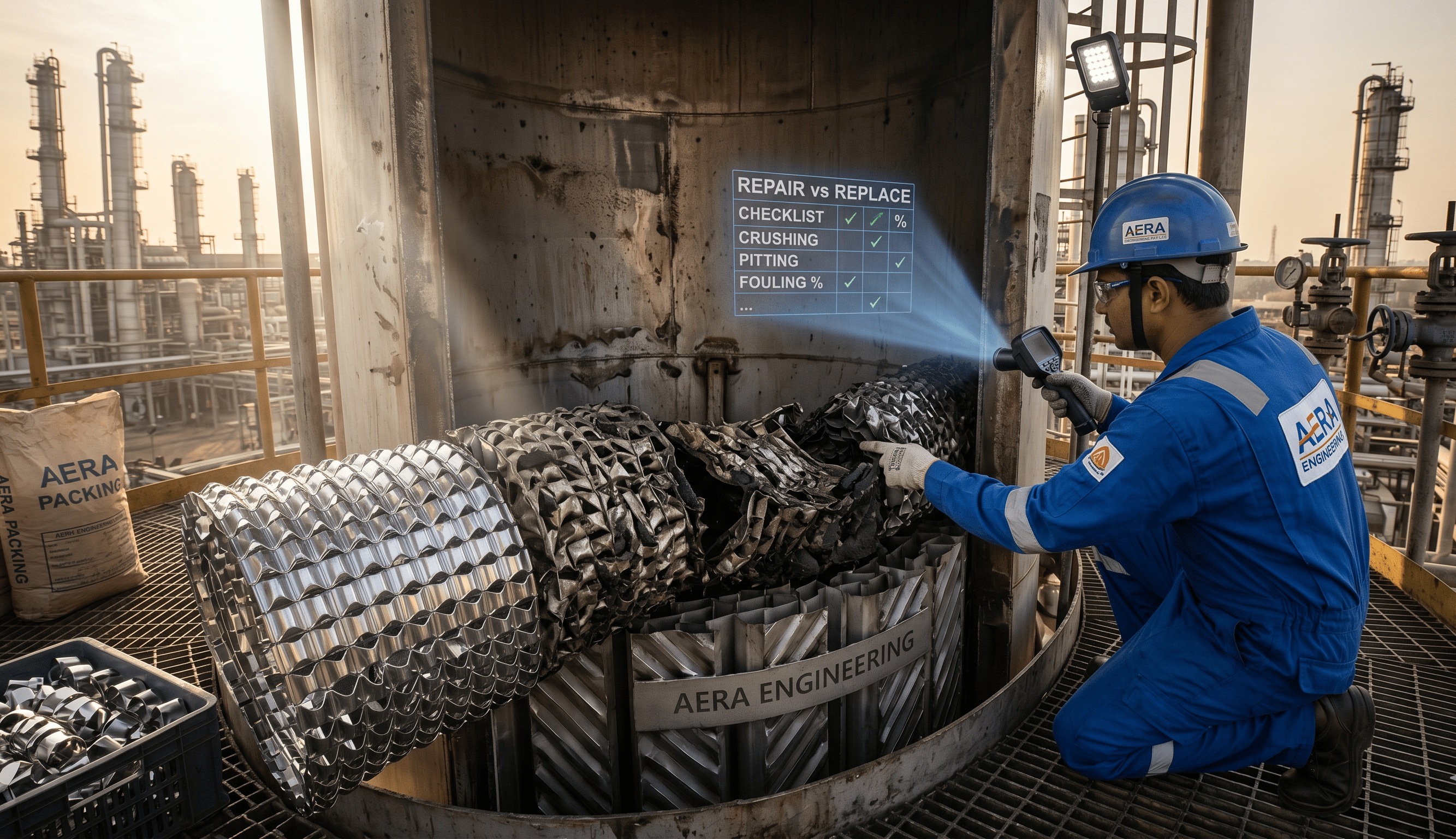
In the lifecycle of a refinery or petrochemical plant, maintenance managers eventually face a multi-million-dollar question during a turnaround: Do we clean and repair our tower packing, or do we scrap it and replace the entire bed? Choosing the wrong path can be costly. Repairing packing that is past its prime leads to poor separation and energy waste, while replacing packing that simply needed a professional wash is a waste of capital expenditure. At Aera Engineering Pvt Ltd, we help our clients navigate this decision by focusing on three critical factors: mechanical integrity, fouling severity, and hydraulic potential. 1. Evaluate Mechanical Integrity: The 'Point of No Return' The most obvious sign that replacement is necessary is physical degradation. Metal packing like Pall Rings or Saddles is designed to maintain a specific geometric shape to ensure open void space for vapor flow. When to Replace: If the packing shows signs of 'bed settling' or crushing. Once metal packing is flattened, it cannot be 'un-crushed.' If the bottom 20% of your bed has collapsed, the pressure drop ($Delta P$) will remain high even after cleaning. When to Repair/Reuse: If the packing is structurally sound but has merely shifted due to a minor pressure surge. In this case, removing the packing, inspecting the support grids, and re-leveling the bed can restore performance. 2. The Fouling Test: Surface Area vs. 'Dead Zones' Fouling—whether it’s coke, calcium carbonate scale, or polymer buildup—is the enemy of mass transfer. When to Replace: If the fouling is 'hard scaling' that requires aggressive mechanical hydro-blasting or acid baths that might compromise the metal's wall thickness. If the cost of cleaning per cubic meter approaches 50-60% of the cost of new packing, replacement is the more economical long-term choice. When to Repair/Clean: If the buildup is 'soft fouling' (sludge or loose deposits) that can be easily removed with a standard steam-out or mild chemical wash without damaging the metal surface. 3. The Technology Gap: Is Your Packing Obsolete? Sometimes, the decision to replace isn't about damage; it's about efficiency. The 'Upgrade' Rule: If your tower is currently running on 20-year-old Raschig Rings or first-generation Pall Rings, even 'perfectly clean' old packing is costing you money. The Aera Advantage: Replacing legacy designs with modern Aera Cascade Mini Rings (CMR) or IMTP-style Saddles can increase your tower’s capacity by 15-25%. In these scenarios, the 'payback period' for new packing is often achieved in just a few months through increased throughput and lower energy consumption. Decision Matrix: Repair vs. Replace Indicator Path: Repair & Clean Path: Full Replacement Pressure Drop Slightly elevated Chronic / High $Delta P$ Metal Condition Shiny or lightly stained Pitted, thinned, or brittle Bed Geometry Level and uniform Visible 'dips' or settling Product Purity Meets spec after cleaning Consistently 'off-spec' Technology Modern (Gen 3 or 4) Legacy (Raschig / Gen 1) 4. Strategic 'Partial Replacement' At Aera Engineering, we often recommend a middle path for towers on a budget: The 30/70 Rule. Because the highest stress and fouling often occur at the top (feed inlet) or the bottom (reboiler return) of the bed, you can replace the most damaged 30% of the packing with high-performance Aera SADDLES while cleaning and reusing the remaining 70%. This targets the bottleneck without the cost of a full bed replacement. Why Partner with Aera Engineering? Based in Vadodara, Aera Engineering Pvt Ltd is a leader in manufacturing precision mass transfer internals. We don't just supply parts; we provide technical audits to help you make the 'Repair vs. Replace' call with confidence. We offer rapid manufacturing of SS 316L, SS 304, and Carbon Steel packing to ensure that if you do choose to replace, your turnaround stays on schedule. Not sure if your packing has another cycle left? Contact our technical team for an internal inspection and hydraulic analysis. We'll help you maximize your tower's ROI. Aera Engineering Pvt Ltd | Bending Metal, Creating Possibilities. Visit: www.aeraepl.com | Consult: +91 97377 73751 Do you have a current inspection report from your last shutdown to compare against your tower's original design data?


This is your website preview.
Currently it only shows your basic business info. Start adding relevant business details such as description, images and products or services to gain your customers attention by using Boost 360 android app / iOS App / web portal.
When Should You Replace vs. Repair Tower Packing?
2026-04-18T01:30:01
In the lifecycle of a refinery or petrochemical plant, maintenance managers eventually face a multi-million-dollar question during a turnaround: Do we clean and repair our tower packing, or do we scrap it and replace the entire bed? Choosing the wrong path can be costly. Repairing packing that is past its prime leads to poor separation and energy waste, while replacing packing that simply needed a professional wash is a waste of capital expenditure. At Aera Engineering Pvt Ltd, we help our clients navigate this decision by focusing on three critical factors: mechanical integrity, fouling severity, and hydraulic potential. 1. Evaluate Mechanical Integrity: The 'Point of No Return' The most obvious sign that replacement is necessary is physical degradation. Metal packing like Pall Rings or Saddles is designed to maintain a specific geometric shape to ensure open void space for vapor flow. When to Replace: If the packing shows signs of 'bed settling' or crushing. Once metal packing is flattened, it cannot be 'un-crushed.' If the bottom 20% of your bed has collapsed, the pressure drop ($Delta P$) will remain high even after cleaning. When to Repair/Reuse: If the packing is structurally sound but has merely shifted due to a minor pressure surge. In this case, removing the packing, inspecting the support grids, and re-leveling the bed can restore performance. 2. The Fouling Test: Surface Area vs. 'Dead Zones' Fouling—whether it’s coke, calcium carbonate scale, or polymer buildup—is the enemy of mass transfer. When to Replace: If the fouling is 'hard scaling' that requires aggressive mechanical hydro-blasting or acid baths that might compromise the metal's wall thickness. If the cost of cleaning per cubic meter approaches 50-60% of the cost of new packing, replacement is the more economical long-term choice. When to Repair/Clean: If the buildup is 'soft fouling' (sludge or loose deposits) that can be easily removed with a standard steam-out or mild chemical wash without damaging the metal surface. 3. The Technology Gap: Is Your Packing Obsolete? Sometimes, the decision to replace isn't about damage; it's about efficiency. The 'Upgrade' Rule: If your tower is currently running on 20-year-old Raschig Rings or first-generation Pall Rings, even 'perfectly clean' old packing is costing you money. The Aera Advantage: Replacing legacy designs with modern Aera Cascade Mini Rings (CMR) or IMTP-style Saddles can increase your tower’s capacity by 15-25%. In these scenarios, the 'payback period' for new packing is often achieved in just a few months through increased throughput and lower energy consumption. Decision Matrix: Repair vs. Replace Indicator Path: Repair & Clean Path: Full Replacement Pressure Drop Slightly elevated Chronic / High $Delta P$ Metal Condition Shiny or lightly stained Pitted, thinned, or brittle Bed Geometry Level and uniform Visible 'dips' or settling Product Purity Meets spec after cleaning Consistently 'off-spec' Technology Modern (Gen 3 or 4) Legacy (Raschig / Gen 1) 4. Strategic 'Partial Replacement' At Aera Engineering, we often recommend a middle path for towers on a budget: The 30/70 Rule. Because the highest stress and fouling often occur at the top (feed inlet) or the bottom (reboiler return) of the bed, you can replace the most damaged 30% of the packing with high-performance Aera SADDLES while cleaning and reusing the remaining 70%. This targets the bottleneck without the cost of a full bed replacement. Why Partner with Aera Engineering? Based in Vadodara, Aera Engineering Pvt Ltd is a leader in manufacturing precision mass transfer internals. We don't just supply parts; we provide technical audits to help you make the 'Repair vs. Replace' call with confidence. We offer rapid manufacturing of SS 316L, SS 304, and Carbon Steel packing to ensure that if you do choose to replace, your turnaround stays on schedule. Not sure if your packing has another cycle left? Contact our technical team for an internal inspection and hydraulic analysis. We'll help you maximize your tower's ROI. Aera Engineering Pvt Ltd | Bending Metal, Creating Possibilities. Visit: www.aeraepl.com | Consult: +91 97377 73751 Do you have a current inspection report from your last shutdown to compare against your tower's original design data?
2026-04-18T01:30:01


Submit Your Enquiry