
In the competitive world of petrochemical manufacturing, 'capacity' is the primary driver of profitability. Yet, many plants operate at 10% to 15% below their design potential simply because of the aging internals within their distillation columns. At Aera Engineering Pvt Ltd, we’ve observed that while operators meticulously maintain high-value assets like compressors and turbines, the tower packing is often treated with a 'set it and forget it' mentality. However, old packing doesn't just age—it actively steals your output. Here is how. 1. The Loss of Effective Surface Area The core function of tower packing—whether it’s Pall Rings, Saddles, or Raschig Rings—is to provide the maximum surface area for liquid-vapor contact. Over years of service, microscopic layers of polymers, salts, and heavy 'ends' coat the packing. The Result: Even a millimeter of buildup significantly reduces the 'active' area where mass transfer occurs. The Impact: To achieve the same product purity, you are forced to increase your reflux ratio, which consumes more energy and limits the total volume of fresh feed the column can handle. 2. Increased 'Pressure Drop' ($Delta P$) and the Hydraulic Bottleneck Every distillation column has a 'flooding point'—the maximum vapor velocity before the liquid is physically pushed back up the tower. Old, degraded, or settled packing creates a high-resistance path for vapor. The Problem: When packing breaks or deforms due to thermal cycling, it fills the 'void spaces' designed for vapor flow. The Bottleneck: As $Delta P$ rises, the column approaches its flood point much sooner. To prevent a total process upset, operators must 'throttle back' the feed rate. In short, your old packing is acting like a clogged filter, restricting your plant's throughput. 3. Liquid Channeling: The Purity Killer For a column to work, liquid must flow uniformly across the entire cross-section of the bed. Old packing often shifts or settles unevenly, creating 'paths of least resistance.' The Failure: This is known as channeling. Liquid bypasses the vapor in certain zones, leading to poor separation. The Output Hit: When purity drops below spec, the only way to fix it is to slow down the feed to give the liquid more 'residence time.' You are essentially paying for a 100-ton-per-day column but only getting 80 tons of sellable product. Cost of Inaction: A Financial Comparison Metric With Old/Fouled Packing With New Aera Precision Packing Throughput 80% - 85% of Design 100% - 105% of Design Energy Usage High (High Reflux/Steam) Optimized (Low $Delta P$) Product Purity Inconsistent / 'On the Edge' Stable and High-Grade Maintenance Frequent 'Mini-Cleanings' Long, Predictable Run Cycles 4. Structural Integrity and Downstream Risks Old packing, especially in corrosive petrochemical environments, eventually becomes brittle. Pieces of metal or plastic packing can break off and migrate out of the column. The Danger: These fragments end up in reboilers, heat exchangers, and pumps, causing mechanical failures that can lead to an unscheduled, total plant shutdown. The Aera Advantage: Restoring Design Capacity Modern engineering has come a long way since your plant was first commissioned. Replacing 15-year-old Raschig rings with high-performance Aera Cascade Mini Rings (CMR) or Aera Saddles can actually allow you to exceed your original design capacity. Aera Engineering Pvt Ltd, based in the industrial heart of Vadodara, specializes in manufacturing precision-pressed components that restore hydraulic efficiency. We don't just provide a replacement; we provide an upgrade. Our internals are designed to: Minimize pressure drop. Maximize vapor-liquid contact. Resist the fouling that plagues older designs. Don't let your internals limit your income. If your column is struggling to hit its nameplate capacity, it’s time for a technical audit. Aera Engineering Pvt Ltd | Bending Metal, Creating Possibilities. Visit: www.aeraepl.com | Email: sales@aeraepl.com | Call: +91 97377 73751 Is your current $Delta P$ across the main splitter significantly higher than the commissioning data from five years ago?


This is your website preview.
Currently it only shows your basic business info. Start adding relevant business details such as description, images and products or services to gain your customers attention by using Boost 360 android app / iOS App / web portal.
Why Old Packing Reduces Output in Petrochemical Plants
2026-04-18T06:30:12
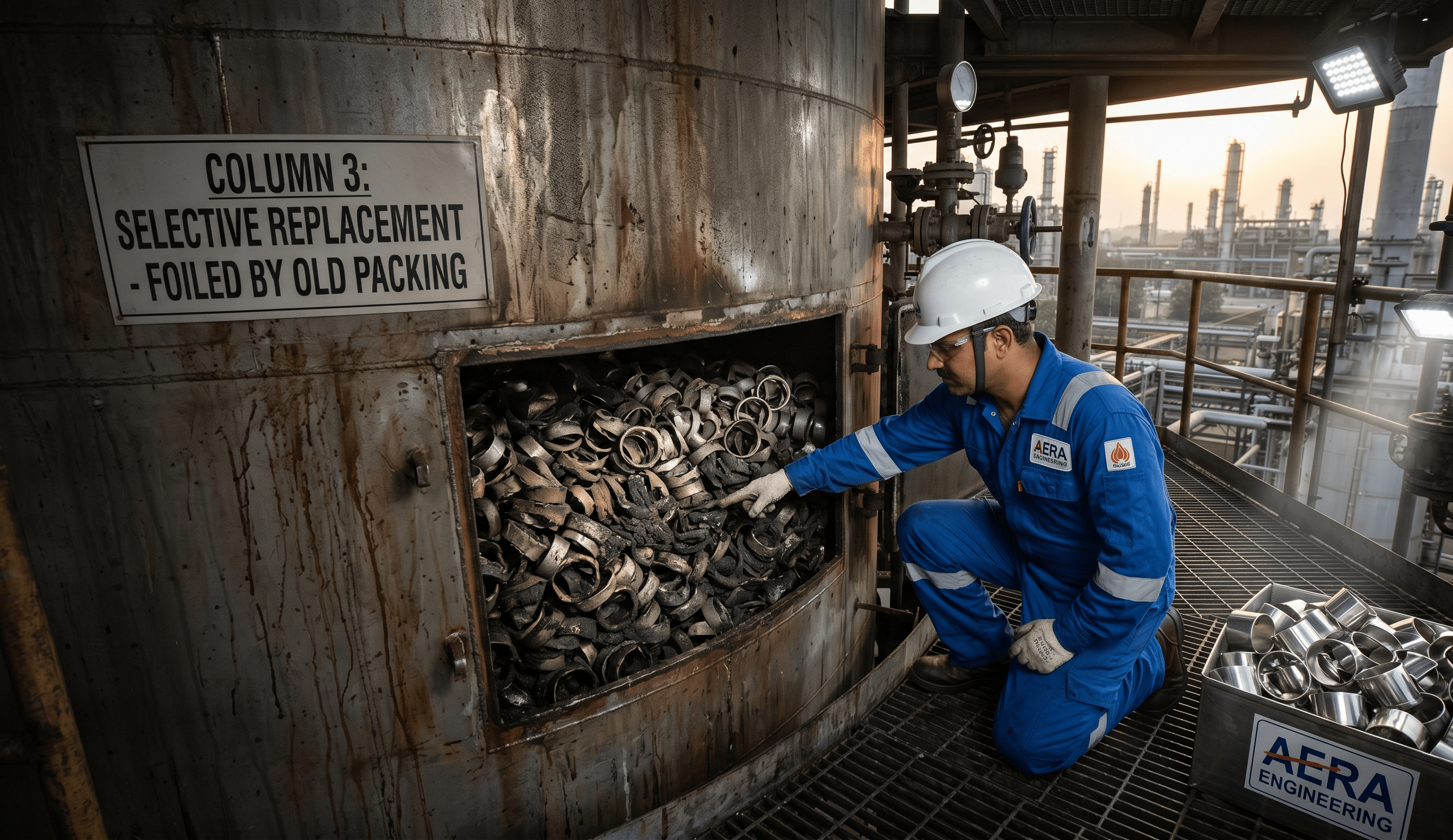
In the competitive world of petrochemical manufacturing, 'capacity' is the primary driver of profitability. Yet, many plants operate at 10% to 15% below their design potential simply because of the aging internals within their distillation columns. At Aera Engineering Pvt Ltd, we’ve observed that while operators meticulously maintain high-value assets like compressors and turbines, the tower packing is often treated with a 'set it and forget it' mentality. However, old packing doesn't just age—it actively steals your output. Here is how. 1. The Loss of Effective Surface Area The core function of tower packing—whether it’s Pall Rings, Saddles, or Raschig Rings—is to provide the maximum surface area for liquid-vapor contact. Over years of service, microscopic layers of polymers, salts, and heavy 'ends' coat the packing. The Result: Even a millimeter of buildup significantly reduces the 'active' area where mass transfer occurs. The Impact: To achieve the same product purity, you are forced to increase your reflux ratio, which consumes more energy and limits the total volume of fresh feed the column can handle. 2. Increased 'Pressure Drop' ($Delta P$) and the Hydraulic Bottleneck Every distillation column has a 'flooding point'—the maximum vapor velocity before the liquid is physically pushed back up the tower. Old, degraded, or settled packing creates a high-resistance path for vapor. The Problem: When packing breaks or deforms due to thermal cycling, it fills the 'void spaces' designed for vapor flow. The Bottleneck: As $Delta P$ rises, the column approaches its flood point much sooner. To prevent a total process upset, operators must 'throttle back' the feed rate. In short, your old packing is acting like a clogged filter, restricting your plant's throughput. 3. Liquid Channeling: The Purity Killer For a column to work, liquid must flow uniformly across the entire cross-section of the bed. Old packing often shifts or settles unevenly, creating 'paths of least resistance.' The Failure: This is known as channeling. Liquid bypasses the vapor in certain zones, leading to poor separation. The Output Hit: When purity drops below spec, the only way to fix it is to slow down the feed to give the liquid more 'residence time.' You are essentially paying for a 100-ton-per-day column but only getting 80 tons of sellable product. Cost of Inaction: A Financial Comparison Metric With Old/Fouled Packing With New Aera Precision Packing Throughput 80% - 85% of Design 100% - 105% of Design Energy Usage High (High Reflux/Steam) Optimized (Low $Delta P$) Product Purity Inconsistent / 'On the Edge' Stable and High-Grade Maintenance Frequent 'Mini-Cleanings' Long, Predictable Run Cycles 4. Structural Integrity and Downstream Risks Old packing, especially in corrosive petrochemical environments, eventually becomes brittle. Pieces of metal or plastic packing can break off and migrate out of the column. The Danger: These fragments end up in reboilers, heat exchangers, and pumps, causing mechanical failures that can lead to an unscheduled, total plant shutdown. The Aera Advantage: Restoring Design Capacity Modern engineering has come a long way since your plant was first commissioned. Replacing 15-year-old Raschig rings with high-performance Aera Cascade Mini Rings (CMR) or Aera Saddles can actually allow you to exceed your original design capacity. Aera Engineering Pvt Ltd, based in the industrial heart of Vadodara, specializes in manufacturing precision-pressed components that restore hydraulic efficiency. We don't just provide a replacement; we provide an upgrade. Our internals are designed to: Minimize pressure drop. Maximize vapor-liquid contact. Resist the fouling that plagues older designs. Don't let your internals limit your income. If your column is struggling to hit its nameplate capacity, it’s time for a technical audit. Aera Engineering Pvt Ltd | Bending Metal, Creating Possibilities. Visit: www.aeraepl.com | Email: sales@aeraepl.com | Call: +91 97377 73751 Is your current $Delta P$ across the main splitter significantly higher than the commissioning data from five years ago?
2026-04-18T06:30:12


Submit Your Enquiry